
This Is the Reason Reduced Efficiency Is Best
And a 5-step process to increase your resiliency
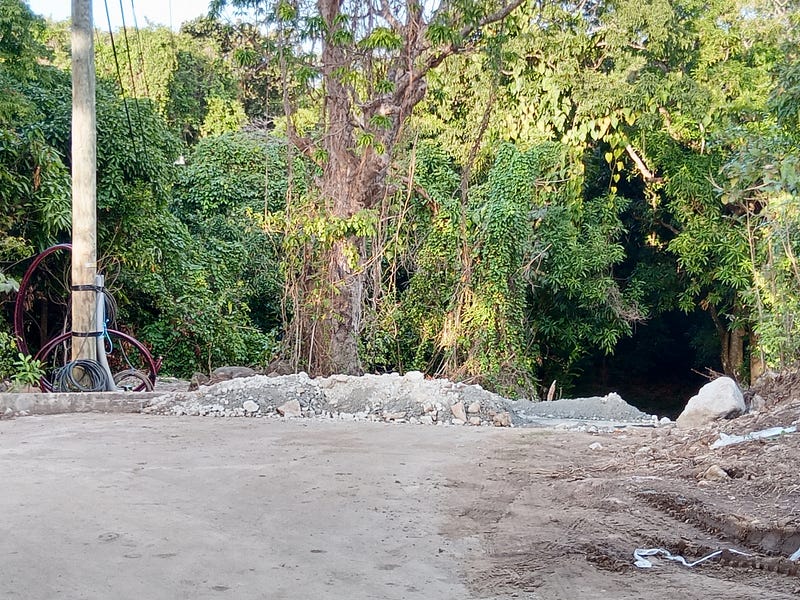
Yesterday, coming down the road from our house on the tropical island of Nevis to run errands, we encountered an unexpected obstacle. The road was completely filled with a mound of gravel and rocks.
There were no signs. No notifications. No long-suffering member of the police patiently guiding traffic around the obstacle. Just an impassable section of the only road into town.
Our first thought was that we would have to go back home, and try again tomorrow. But we were meeting someone. We had to find a way around.
We find a way
After reasoning that whoever dumped all that gravel had to make some allowance for traffic, we looked around, and found a pile of dirt next to the curb. Further inspection indicated the dirt mound was supposed to be used to get your car over the curb. Then you could follow a dirt path around the obstacle, and exit via another mound of dirt onto the road beyond the blockage.
When we came upon the second pile of gravel further down the road, we found the byroad and traversed it quickly.
It was a far cry from the many warning cones, signs, notifications, and posted detours we were used to in Colorado. And it got me to thinking.
I know all those signs are a way to keep traffic moving. Even the infamous “traffic patterns have changed” sign, which I find highly annoying because I only encounter them the first time I am driving somewhere. So I never know what the original traffic pattern was, only what it was changed to be.
But here on the island, there is very little traffic to worry about. Heavy, “rush hour” traffic may just mean a line of seven or eight cars. So the time it took for us to figure out what was going on and what to do about it inconvenienced no one but us.
Efficiency versus resiliency
The signs and notifications so common in Colorado are a matter of efficiency. Given the thousands of drivers passing through those construction zones every day, even a short delay while they figure out what to do, quickly becomes a traffic nightmare.
Drivers also need to be informed of changes to traffic patterns, as well as what the new patterns are supposed to be. Given the volume of cars, as well as the speed most of them are traveling, any question about where they should be going can lead to a serious accident.
But the drivers become reliant upon this. They expect that if conditions change, they will be informed of what to do and how to do it. They will not be required to think.
We’ve lived on the island for less than a month, and already our road into town has been blocked by a herd of goats, a backhoe repairing a stone fence, a pair of cars going in opposite directions whose drivers stopped to talk to each other, and now, a large pile of gravel.
Each of these requires a different response. Do you wait? Back up? Go around? It requires not just thought, but analysis — of the environment, of other people or animals involved, and of the culture.
This leads to much greater resiliency. Our confidence is growing that no matter what obstacle next crops up to block our road, we will be able to deal with it appropriately.
The best solution
Systems theorists have studied the efficiency/resiliency question for a while. They’ve determined that the best systems are those that tip slightly in favor of resiliency. Somewhere around a 60–40 split seems to give the best chance of long term survival of species, and the same ratios hold for man-made systems as well.
All around the world, people are suffering from supply chain shortages and disruptions. These processes were too efficient, and broke under pressure. More resilient manufacturing processes were able to keep going.
In the animal kingdom, having a single prey animal that supports your species is highly efficient, but can lead to your species being wiped out if something happens to your prey. Being able to eat a wide variety of prey animals is highly resilient, but it means your species has to expend more energy to catch the prey, because you haven’t developed specialized hunting skills. That can leave you open to being overtaken by a more efficient predator.
A 60–40 split in favor of resiliency means you have a number of prey animals you can eat, but you may have one that you prefer and are well adapted to hunting.
This means that being told how to handle obstacles is useful for times that efficiency really matters. But for everything else, which should be about 60% of situations, you should be figuring out your own solutions. It will take longer, and potentially not be the best solution.
But it will greatly increase your resilience. So if something truly unique happens — whether it’s a natural disaster or the zombie apocalypse — you’ll be better prepared to handle it.
How to grow resilience
First, determine if efficiency or resilience is the best choice in this situation.
- Is time of the essence? We all want to get rid of our obstacles as quickly as possible. But do you need to? Or can you afford the time to practice resiliency?
- Do you need to find the best answer? Or will a good answer be good enough?
Second, accept the situation in all its fullness. If, for example, you come across a large pile of gravel blocking your only route into town, accept that you will be delayed. Accept that the solution may cause issues down the line for your car. Accept that you feel annoyance, and frustration, and confusion, and anger. If you feel any negative self-talk or recriminations, accept that you feel that way, without accepting the negative judgments as truth.
Having accepted the truth of what is, you can let it go, and focus on what you want to be true instead. In this third step, you determine your requirements. In the example I gave, our requirements were to be able to get into town, that day, and not destroy our car in the process.
The fourth step is to start looking at options. If any solution will do, you can stop when you find an option that meets all your requirements. If you have the time and energy, you can continue looking at options to find a better one. Don’t feel that you have to find the best possible solution, though. Being resilient also means you can change and adapt to improve your solution.
Finally, pick an option and take action. Compare your results to your requirements and adjust as needed. And if you can learn something from the experience to make the next obstacle easier to overcome, so much the better.
Conclusion
In high traffic areas, such as the Denver-Boulder megalopolis in Colorado, efficient solutions to traffic obstacles is a necessity. As a result, there are many signs, notices, warnings, signals, and guidance.
In low traffic areas, such as a very small Caribbean island, resilient solutions to traffic obstacles is a necessity. It’s up to every person who encounters the obstacle to figure out how to handle it.
When you are spoon fed the solutions to obstacles, you lose the ability to create your own solutions. You become efficient, at the cost of resiliency.
For long term survival of species, a mix of 60% resiliency to 40% efficiency is ideal. So save the spoon-feeding of solutions for the times when efficiency really matters. The rest of the time, develop your resiliency by finding your own solutions.
Follow the five-step process for increasing your resiliency.
In case of zombie apocalypse (or other disaster), you’ll be more likely to survive.
Read all of my best self-improvement stories here. Medium offers amazing content from thousands of unique authors with wildly divergent outlooks and world views, who are funny, scholarly, and everything in between. No matter what you like to read, you can find someone writing it on Medium. Subscribe via my referral link and I’ll get a small commission, at no additional cost to you.
For more tips on overcoming obstacles, read this by Liberty Forrest, Author:
To learn how to be more resilient, read this by Sude Hammal:
Shameem Anwar has written a helpful article about how to accept and dismiss negative thoughts, and the impact of not doing that:
And finally, Debbra Lupien, Voice of the Akashic Records shared a bit of inspiration to help you see the opportunities that arise in all obstacles:


