
This Is The Real Reason You Procrastinate (No, It’s Not A Lack of Motivation)
Your brain is programmed to procrastinate — here’s how to rewire it.
Procrastination is something we all experience.
We plan to do something, we say we’re going to do something, or we know we really need to do something, but we don’t do it.
And it’s not that we tell ourselves we’re never going to do it…
It’s that we tell ourselves we’ll get started tomorrow, later, or someday.
But when tomorrow, later, or someday arrives, we tell ourselves the exact same thing; not today, but tomorrow.
And that’s why procrastination is so dangerous.
We often believe our future self will magically be more productive or disciplined than today’s self, but that’s rarely the case.
If you don’t address the root cause of procrastination, nothing will change.
That’s why, in this article, we’ll dive into the real reason why people procrastinate (and no, it’s not a lack of motivation or self-discipline).
Procrastination Is About Avoiding Pain
Studies have shown the brain is hardwired to move away from pain and toward pleasure. Not just physical pain, but also psychological pain.
Think of uncomfortable emotions such as boredom, overwhelm, fear, doubt, stress, frustration, or any other feelings of discomfort.
The brain wants to protect us from experiencing psychological pain, so it comes up with all kinds of clever reasons to avoid the tasks that trigger it.
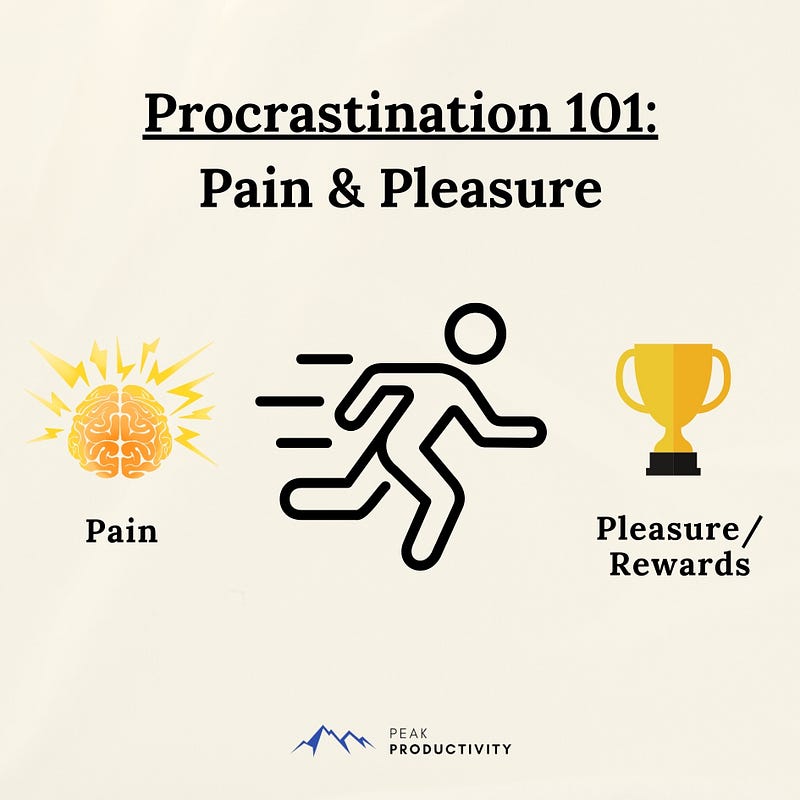
The problem is that most of our tasks tend to trigger uncomfortable emotions (e.g. psychological pain).
For example, you’re facing a complex work project and it triggers feelings of stress, frustration, and overwhelm.
You’re studying for an important test but the material is quite dry, so it triggers feelings of boredom.
You’re thinking of starting a business but it triggers feelings of self-doubt, fear of failure, and overwhelm.
And since the brain is hardwired to avoid pain, it convinces us to put off these tasks until tomorrow, next week, or later.
In the immediate moment, procrastination provides emotional relief.
We don’t have to face the psychological pain of the task, and can even enjoy the pleasure of a fun distraction (video games, Netflix, social media, etc.)
This shows that procrastination is mostly an emotional problem:
When the uncomfortable emotions (pain) we associate with a task outweigh the positive emotions (pleasure), it triggers procrastination.
That’s why we don’t tend to procrastinate on playing video games, watching Netflix, checking social media, or other pleasurable activities.
We experience more positive emotions with these activities than negative emotions, so there’s practically zero mental resistance.
All in all, we procrastinate because the brain is hardwired to move away from pain (physical and psychological) and toward pleasure.
So, the more pain (boredom, stress, discomfort, self-doubt, etc.) we associate with a task, the more likely we are to postpone taking action.
Procrastination Antidote #1: Identify The Uncomfortable Emotions
Becoming aware of the uncomfortable emotions you associate with a task can often be enough to stop them from holding you back.
By creating awareness, these emotions will lose some of the power they have over you.
For example, if you’ve been planning to improve your fitness but you’ve procrastinated on going to the gym for months, reflect on the uncomfortable emotions you associate with going to the gym.
Maybe you feel intimidated by all the gym equipment and you don’t really know which exercises to do and how to perform them correctly.
In other words, going to the gym triggers feelings of uncertainty, overwhelm, and potential embarrassment.
It’s because of these uncomfortable emotions that you haven’t been going to the gym — not because of a lack of motivation or low self-discipline.
Now, we have a few options to deal with this challenge:
- Find practical solutions to reduce the uncomfortable emotions (for example, watch fitness tutorials on YouTube or hire a personal trainer to guide you)
- Accept that your first few weeks in the gym are going to feel a bit uncertain and overwhelming before it becomes better (by accepting uncomfortable emotions, they lose their power)
- Keep procrastinating on going to the gym (I wouldn’t recommend this option)
All in all, if you’ve been procrastinating on a certain goal, task, or project for a while, reflect on all the uncomfortable emotions you associate with it.
Awareness is the first step towards behavioral change.
Procrastination Antidote #2: Think About Your Future Self
Highly effective people are, just like anyone else, also motivated by avoiding pain and seeking pleasure/rewards.
However, they approach pain and pleasure with a different timeframe.
Procrastinators think short-term, while high-performers think long-term.
High-performers focus on avoiding future pain and gaining future rewards, while most others focus on avoiding short-term pain and gaining short-term rewards.
For example, by skipping today’s workout you can avoid short-term pain, such as effort and discomfort.
But if you do that for long enough, your future self is going to experience pain in the form of chronic fatigue, aches & pains, and being out of shape — which is far more painful.
And by postponing studying for an important exam until the last minute, you can avoid short-term pain, such as boredom and frustration.
But your future self is going to experience pain in the form of stress, pulling an all-nighter, and potentially failing the exam — which again is far more painful.
In short, there’s always going to be some form of pain. That’s just part of life. There’s no point in trying to escape it.
As Jim Rohn wrote in The Art of Exceptional Living:
“We must all suffer from one of two pains: the pain of discipline or the pain of regret. The difference is discipline weighs ounces while regret weighs tons.”
So, it’s not about avoiding pain, it’s about choosing which pain to endure:
- Short-Term Pain: Effort, discomfort, self-doubt, fear, stress, boredom, going out of your comfort zone, making sacrifices, delaying gratification, etc.
- Future Pain: Unfulfilled goals, missed opportunities, regret, health problems, financial stress, being stuck in your career, not living up to your potential, etc.
The difference is that short-term pain — the pain of taking action — has a pay-off, while future pain doesn’t.
And that’s what we need to keep in mind.
Whenever you feel like procrastinating, think about your future self.
Accept that short-term pain is the price you pay so your future self can live a life of achievement instead of regret.