
This Is the Note-Taking System That Gives Me the Most Ideas
It’s dead simple, it’s useful, and it doesn’t take a lot of time.

The perfect note-taking system doesn’t exist.
That being said, some systems are more suited to some uses than others. And recently, I’ve been coming back to a system that proved to be REALLY GOOD at taking me out of a rut, and into a frenzy of ideas and thinking.
It’s dead simple, it’s useful, and it doesn’t take a lot of time.
My goal is to write my own set of Gibbs’s rules
I’m a fan of detective shows. I learned to speak English following the adventures of Poirot, Castle, Monk, Sherlock and Gibbs. Gibbs is the lead investigator on NCIS, and he has this set of rules that he and his team follow.
Like :
- Rule 51 : Sometimes, you’re wrong.
- Rule 7 : Always be specific when you lie.
- Rule 62 : Give people space when they get off an elevator.
And if you’re not taking notes to extract some sort of rules… then why are you taking notes, right?
So now I have my own set of rules.
For example :
- Get into interesting conversations
- Write like you talk
- Make gifts for people
- There are plenty of paths to success
- Don’t settle when you can still fight
- Algorithms create bubbles.
They are short sentences I can remember easily in the right context. Some warn me about what not to do, others remind me of a way to approach a problem, others are broad rules I always aim for.
I have 134 so far.
I’m not a fictional character though
Gibbs’s rules are interesting. But they are very limited because Gibbs is a character in a show. Me, I’m a really human being, and what’s more, I’m a writer. Which means I’m going to end up with a lot more rules, in fields much more varied than just… fictional naval investigation.
Giving my rules numbers is not going to cut it.
Down the line, I want to be able to use those rules for me, but also use them as material for my writing. If you look closely at most non-fictional writing, you’ll find that it’s really just sets of rules.
So I want a system that allows me to easily play with, compound and add to my rules.
And that’s why I do this in Obsidian. Because it’s flexible, and I can link things together. So every time I open a rule, I have :
- a list of ‘related rules’ that I can use in an article, or as starting ideas for other chapters
- examples I accumulate from my own experience and sources I consume
- remarks on how to make it work, or the best contexts in which to use the rule
- and a pretty graph I can reference
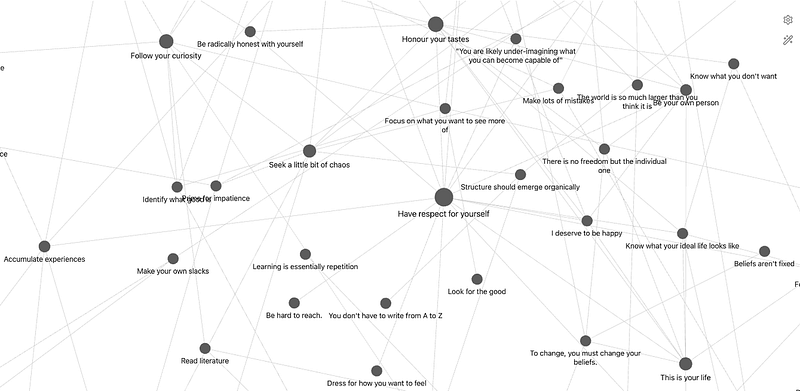
How I do this a little bit everyday
It’s a massive task to sit down and write the rules of your life. Daunting, even if all you have right now is a blank vault.
That’s why I don’t do this from scratch. Nor all at once.
I committed to doing just one thing every day :
- Review 5 to 8 ideas I saved (with Readwise Daily)
- Use those 5 to 8 ideas to modify, add to, or create my rules.
Some days, I barely change anything because the ideas I saved aren’t interesting after all, or don’t inspire me today. And some days, I end up spending a lot of time on refining a set of rules for a specific purpose.
And that’s where the writing magic begins. Because doing this gets me inspired to ‘compile’ my rules into an article, or add one to a draft, or use one specific rule for a story.
I NEVER get as many ideas as when I do this everyday.
The beauty of this system is that it’s not app-specific
I’m using Obsidian and Readwise right now. Because I like the graph visual and Readwise makes it dead simple to just… save things (and Reader is AWESOME too), as well as review. But it would work just as well on Notion, or Bear, or even Apple Notes.
All you need is :
- a list of ideas you save from the books you read, the videos you watch…
- and a place to write those rules
That’s it.
If you want to know more about my Readwise (almost) automated system, you can read all about it here.
⭐ More essays on living a more fulfilling creative life, on Pépites.


