
Culture | Japanese Language
This Is the Japanese Idiom Everyone Needs to Learn in the New Year
It teaches you to cherish every moment — for it is never coming back
Japan is full of seasons. Japanese culture is particularly attuned, not just to seasonality, but to the transitions between seasons. And what better time to talk about the changing of the seasons than at the beginning of the new year?
And I mean seasons not in a natural sense as in the ebb-and-flow of natural time, but also of man-made time. Cultural time.
People mark time with events, rituals, and ceremonies. And perhaps nowhere else on earth is this more evident than in Japan.
Marking Time with Festivals
Japanese people take to new Western festivals like Halloween and Christmas — and transform them into a Japanese version of with completely different meanings.
Christmas is for lovers not families, and for families that celebrate it, fried chicken is the preferred food of choice, not turkey or Stollen.
But Japan also marks ancient rituals and traditions that have been passed down for centuries.
Take, for instance, the second Monday of the new year — Seijin-no-hi — usually translated as the Coming-of-Age Day. It is the day that celebrates young adults who have reached the age of 20 — officially and legally adults.
Hurrah, if you’re turning 20, you’re finally allowed to get (legally) drunk at nomikai—drinking parties!
Or so I thought — because someone just informed me that from April 2022, the age of 成人 changed from 20 to 18 in Japan, although the legal age for alcohol consumption remained unchanged at 20.
Though, since this is still in the transition period, many local governments will still hold the Coming-of-Age ceremony for 20-year-olds this year. But if you ask me, what’s the point of being declared an adult if you can’t enjoy a sip of nihonshu?
Ironically enough, alcohol consumption has been declining in Japan for the past decade, to the point that the Japanese government launched a contest to crowdsource ideas to promote alcohol consumption last year.
The oddness of this move notwithstanding, perhaps it might help to lower the legal drinking age from 20 to 18 to reflect the updated age of becoming a seijin?
A Very Long Party
While we’re talking about drinking and drinking parties, I especially enjoy the end of the year and the beginning of the new year. The relentless partying and merry-making of the bounenkai (忘年会), flowing into Christmas, then into the new year’s celebrations, and the ensuing shinnenkai (新年会) are rambunctious occasions that fill me with the feeling of happiness and perhaps too much alcohol.
We all wish the partying didn’t stop and we didn’t need to get back to work. But of course, all that booze is not good for us and so the partying must end sometime.
But on a more serious note, each new year also comes with a poignant sense of bittersweetness.
This moment is a unique one that will never return, and a gentle reminder that time will not stop flowing; I am growing older with each passing Ōshogatsu (New Year’s Day) and the cold meals that come with it until one day, time will cease to be — for me.
“Ichi-go, Ichi-e” (一期一会)
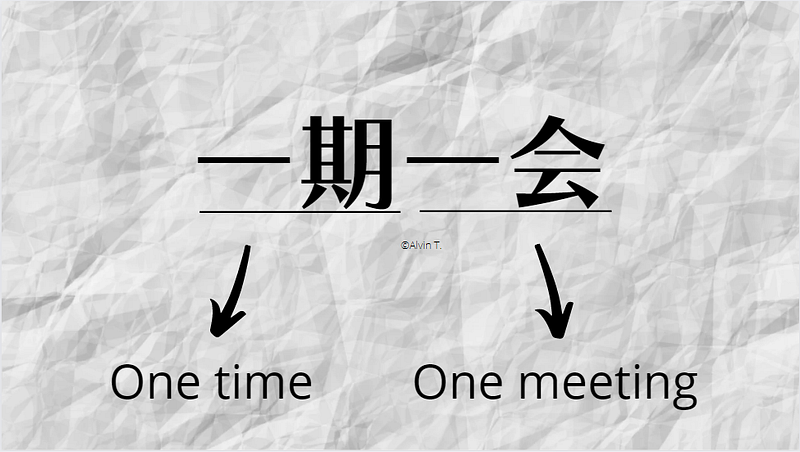
It is precisely the feeling that each moment is precious that is captured in the Japanese idiom, “ichi-go ichi-e” (一期一会). It’s not a phrase that can be directly translated, yet the Chinese characters that make up the expression are simple and revealing.
Literally meaning “one time, one meeting,” the phrase poignantly highlights that every gathering and meeting of people — although fleeting — is unique, and therefore precious.
Every Moment is Unique
The lesson: treasure every moment, and embrace every single encounter in your life, because the very same moment will never repeat.
The term can be traced back to the tea master Sen no Rikyū, who is perhaps the most important and influential figure in the Japanese tea ceremony as we know it today. Unsurprisingly, the philosophy that underlies this term also finds its full expression in the tea ceremony.
Despite the ritualistic and formalistic elements of the tea ceremony, every occasion is unique — the participants are always different, the interactions are different, the seating location may be different, the time and season may be different, and so on.
As participants crawled through the tiny door separating the outside from the inside of the tearoom or the chashitu (茶室), everyone became equals — feuding samurai lords put aside their swords to enjoy the tea, even if they would leave the room to become enemies again after leaving it.
The Ephemerality of Human Existence
Perhaps this is all make-believe that tea masters would have us believe — still, I love this expression because there is a true sense of the ephemerality of human life. Every moment passes, like a grain of sand in an ever-shifting dune of time.
And we are but passengers riding through the sand cloud, watching every moment, from the beginning to the end.
The author is an editor of Japonica, a Japan-focused publication, but also writes more generally about culture and society. Discover his most-read stories here.