
This Is Life in the Amphitheater
Staying present in the chaos of the world.
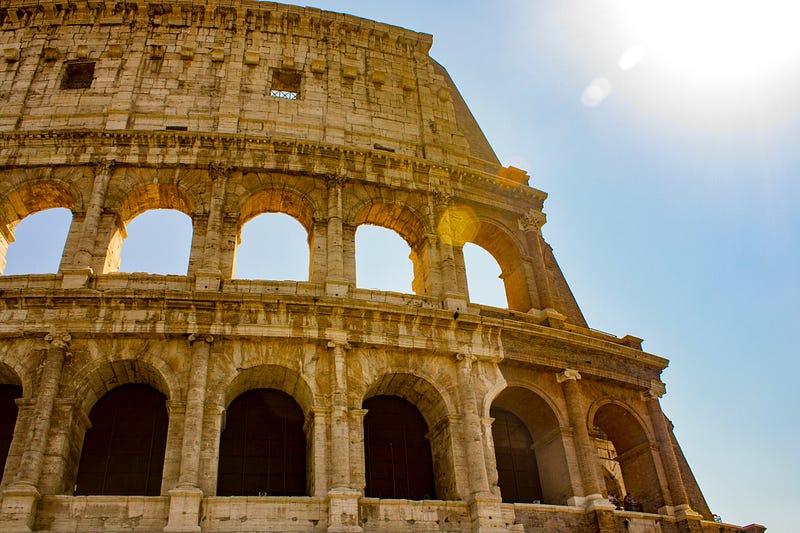
I remember it as though it happened to me.
The heat rising in thick somnolent waves from the sand. The roar of the crowd. The smell of wine and the smell of blood. The weight of the weapon in a sweating hand.
All life should be like this. Gladiators greeted with a roar, either of encouragement or bloodlust. It doesn’t matter which. Just so long as there is a roar.
But it didn’t happen to me. By the time I stepped into the arena, the crowds were gone. As dead and vanished as the combatants they cheered for. Along with the servants and slaves, the vendors of dormice and wine, the plebeians and the patricians, dead Caesar on a vanished throne. We were alone and as silent as the bats sleeping under dark stone arches.
It doesn’t always happen the way you want it to.
You can travel a thousand miles and still see nothing. The buzz of the airport. The growl of the bus. The whole blazing universe reduced by the heat of our hearts to a series of joyless obligations. It’s too easy. It’s too fast. Our default setting, the naming and numbering that allows us to triumph over the material world. A triumph that costs us everything.
It’s smaller than it feels.
The emotional center of your brain is in the amygdala, an almond-shaped lump of gray matter buried deep down near the brainstem. It’s a word you would’ve heard in the amphitheater, coming as it does from the Latin for almond. And it’s that little almond I’m aiming for with the blunt point of the weapon I hold, trying to reach you where all art is supposed to hit.
Mindfulness is the latest philosophical trend we all pay lip service to, even if you don’t see much evidence of it in the wild. But it’s not a belief system or philosophy. At its heart, it means nothing more complicated than paying attention to the present moment.
Sounds easy? It’s not always. We live in a net of fears and doubts and dreams, our minds constantly shuttling back and forth between past and future.
That’s what our emotions do to us. Going back over old arguments or dreading tomorrow’s meeting. It’s not that emotions are necessarily bad; they exist for a reason. To help us avoid things that are harmful and go after what’s beneficial.
It’s a question of balance. Like the Greeks they stole the idea from, the Romans believed in harmony. No one aspect of body or brain should rule over the rest. The whole organism works best when each part plays its role without taking over.
By keeping you focused on the moment, mindfulness practice helps you to control your emotions. Practitioners showed reduced activity in the amygdala and activation in the insular cortex and prefrontal cortex. From a purely practical perspective, this can help you make better decisions, unswayed by emotion the way the ancient Stoics used to advise.
But also, staying mindful allows you to have a richer experience of life. Every second, fully inhabited, contains the entire universe. To Goethe, every second was of infinite value. You can experience this for yourself by paying attention.
We’ve all had the experience of time flowing more quickly or more slowly sometimes than it does at others. It’s a function of what you pay attention to. When focusing deeply on some absorbing task, time can seem to disappear. You look up from your desk to find a whole night has flown by.
But paradoxically, this same kind of deep focus can make time pass more slowly too. In the long run, when your days are packed with sensation and experience, months will feel like years. And you’ll want them to. Staying mindful, staying awake in a world that wants nothing more than for you to close your eyes and stop paying attention, can make even the most mundane life glow with inner radiance.
How can you experience this for yourself? In a word, granularity. In this post by Jordan Gross, the author describes being led in a mindfulness meditation by being asked to feel the skin of his feet pressing against his socks, and the movement of air around his scalp. These are sensations we all feel every day and pay no attention to. By choosing to focus our attention on the specific details of our existence at the present moment, we gain a fuller experience of being alive. That, ultimately, is what mindfulness is about.
Shattered statues lined the path that led away from the abandoned amphitheater.
Stone feet. Stone hands. Limbless torsos and severed heads. A junkyard for broken gods.
Through the iron gate and down the street that leads to the sea. The trees hold manicured crowns on the tips of outstretched fingers. They’re going somewhere, twisting up into the sky, to slowly for us to see, too beautifully for us to mimic.
A slow train pulled us back to the city, groaning along smiling steel rails while the trees marched past. The sudden black gulf of a tunnel glowed with firefly phone screens. The sun returned with a yell. Why shouldn’t it yell? Why shouldn’t we tip back our heads and sing? We only recognize beauty when we see it infrequently, but it surrounds us everywhere. It’s the water we swim in.
No bullet points. No numbered list. Good SEO makes for bad writing, and today, I would rather share than teach. The gloom under the haunted amphitheater arches is no different from the sun in the square or the walls that close you in, that keep the world out.
To see it, you only need to look. The movement of air against your cheek. The roar of your heart’s blood. The surging crowd and the sighing sea.
Nothing is small. Nothing is insignificant. The deeper you look, the more beautiful each moment becomes.
How beautiful that the gladiators are all gone! How beautiful the way that life renews itself forever, a different river carving out the channel with every passing moment. We fade away so that others can emerge, fresher and brighter and more alive than us, so that the world becomes new again. And our ghosts wander the amphitheater’s haunted halls with the lions and the gladiators, smiling invisible smiles under a reborn sun.


