
‘This Is How You Lose The Time War’ by Amal El-Mohtar and Max Gladstone
A Counter Arts Book Club review
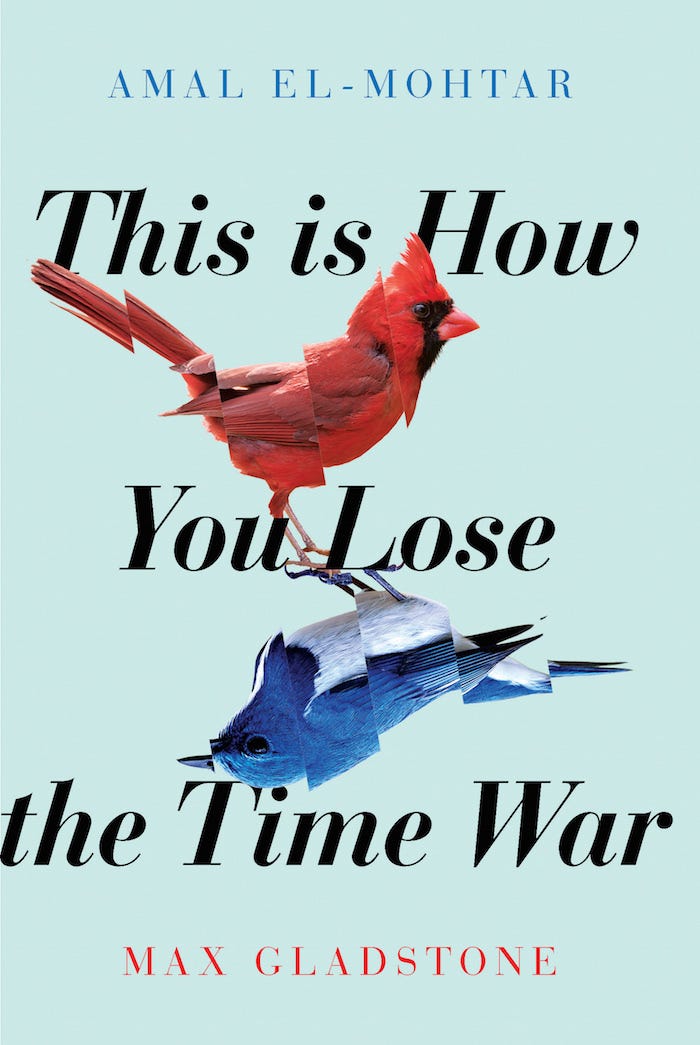
WINNER OF The Hugo and Nebula Awards for Best Novella, AND The British Science Fiction Association Award for Best Novella
I Loved This Story!!!
That’s the short and sweet version anyway, I loved this story.
Read not long after publication in 2019, I still remember this book so vividly and when considering titles for a new Book Club list, this one absolutely had to be included.
A sci-fi and a romance, ‘This Is How You Lose The Time War’ is inventive, engrossing, exhausting and glorious.
Written by two authors, each of whom takes on one of the two main characters in alternating chapters — both time travelling agents, from opposite sides of a war, who move up and down the time stream attempting to alter history in favour of their side.
“In the ashes of a dying world, Red finds a letter marked “Burn before reading. Signed, Blue.”
So begins an unlikely correspondence between two rival agents in a war that stretches through the vast reaches of time and space.
Red belongs to the Agency, a post-singularity technotopia. Blue belongs to Garden, a single vast consciousness embedded in all organic matter. Their pasts are bloody and their futures mutually exclusive. They have nothing in common — save that they’re the best, and they’re alone.”
Only known as ‘Red’ and ‘Blue’, these two warriors first begin to notice and observe each other’s presence; then taunt and mock each other’s efforts:
“Engine trouble, a good spring day, a suspiciously effective and cheap remote-access software suite her hospital purchased two years ago, which allows the good doctor to work from home. Thus we braid Strand 6 to Strand 9, and our glorious crystal future shines so bright I gotta wear shades, as the prophets say.”
El-Mohtar, Amal; Gladstone, Max. ‘This is How You Lose the Time War’ (p. 13).
Very quickly however, taunts turn to affectionate teasing and letters become more personal as the two protagonists begin to appreciate and then fall for each other.
As Marc Barham said in his review (here), this short novel is certainly William Shakespeare’s ‘Romeo and Juliet’ in a different skin, to at least some extent.
Knowing that they risk their lives, communicating with ‘the enemy’, letters are exchanged in ever more creative ways:
“The letter begins in the tree’s heart. Rings, thicker here and thinner there, form symbols in an alphabet no one present knows but Red. The words are small, sometimes smudged, but still: ten years per line of text, and many lines. Mapping roots, depositing or draining nutrients year by year, the message must have taken a century to craft. Perhaps local legends tell of some fairy or frozen goddess in these woods, seen for an instant, then gone. Red wonders what expression she wore as she placed the needle. She memorizes the message. She feels it ridge by ridge, line by line, and performs a slow arithmetic of years. Her eyes change. The men nearby have known her for a decade but have never seen her look like this. One asks, “Should we throw it away?” She shakes her head. It must be used. She does not say, Or else another might find it and read what I have read.”
El-Mohtar, Amal; Gladstone, Max. ‘This is How You Lose the Time War’ (pp. 33–34).
A romantic relationship develops between Red and Blue and as both characters are defined as ‘female’, called ‘she/her’ despite biological manipulation, implants and the ability to shift and change appearance, the novella becomes something of a triumph for Sapphic literature among all of the other ways it can be held up as a masterful piece of writing:
“After a mission comes a grand and final silence. Her weapons and armor fold into her like roses at dusk. Once flaps of pseudoskin settle and heal and the programmable matter of her clothing knits back together, Red looks, again, something like a woman”.
El-Mohtar, Amal; Gladstone, Max. ‘This is How You Lose the Time War’ (pp. 1–2).
And Blue:
“I have been birds and branches. I have been bees and wolves. I have been ether flooding the void between stars, tangling their breath into networks of song. I have been fish and plankton and humus, and all these have been me.”
El-Mohtar, Amal; Gladstone, Max. ‘This is How You Lose the Time War’ (p. 72).
What is quite a refreshing change is that there is no Big Thing made about this being a lesbian romance. Don’t get me wrong, it’s always great to see representation of pairings other than heterosexual ones. The more same sex/queer/nonbinary relationships people encounter in their literature, the more normalised the variety will begin to seem. It’s the road to acceptance paved with words and punctuation!
However, what I’m liking in this novella is that the characters being two people who look “something like a woman” (as in the quotation above) is treated as no big deal. Incidental. Normal.
It’s the road to acceptance paved with words and punctuation!
So, along the way, a third player emerges with an interest in ‘winning’ this time war. These two, Red and Blue, as a couple, a single entity. They are separated by opposing sides (‘The Agency’ and ‘Garden’) and cannot be together or even meet in person because they will be caught and executed for treason. So they begin to work together, in secret, to try and find a way of manipulating a third possibility. An outcome where the two of them, together can emerge as the winners, united at last.
“I sought loneliness when I was young. You’ve seen me there: on my promontory, patient and unaware. But when I think of you, I want to be alone together. I want to strive against and for. I want to live in contact. I want to be a context for you, and you for me. I love you, and I love you, and I want to find out what that means together.”
El-Mohtar, Amal; Gladstone, Max. ‘This is How You Lose the Time War’ (p. 130–131).
I don’t read sci-fi that often, as I’ve said before — and this story, the intricacies of the actual plot: of the strands and threads and streams of how the time war is being played out; the identities of the two protagonists and their organisations; the description of the historical times which we might recognise as true to our own lives, with just enough detail included to make them accurate; yet still succeeding in the sparse rapidity with which this short two hundred page novella crams so much within it’s pages……
It’s captivating. It’s intriguing.
The best part of ‘This Is How We Lose The Time War’ though, in my opinion, is the use of language — which is poetic and thoroughly beautiful, in the letters between Red and Blue particularly.
You don’t have to take my word for it though. Read this novella yourselves and see! Even better, when you’re done, write something pertaining to it for our Book Club.
Come on in, the tea is hot, the cushions comfy and the books …well, you tell us!
“Tell me something true, or tell me nothing at all.”
El-Mohtar, Amal; Gladstone, Max. This is How You Lose the Time War(p. 37).
Thank you for reading. If you’re interested in joining in with our monthly reads, see the full list for this year in the piece linked below:
Or if you haven’t seen them already and could use a little inspiration, Here are our monthly prompts for January 2023:
For Counter Arts (ie. nonfiction):
For Rainbow Salad (ie. poetry and fiction):
If you enjoy my writing, you might consider leaving a ‘Tip’, or signing up for Medium membership through my referral link here. Many thanks and much love — Sadie