
This is How We Often Discourage Newbie Creatives and Professionals
We can do better.

The joy of everyone is to make an impact in their fields. Our legacies also extend to those who have gained clarity from our expertise. I mean, we have succeeded when we have mentored and extruded excellence from the newbies we meet.
Remember, we all have been newbies at one time or another. The level of excellence we now command shows that we’ve stood on the shoulder of so many who invested their time and guidance in us.
Therefore, we also have the onus of raising people. Art flows in us, so let’s spread the current everywhere. If you want to see more fantastic writers, train those young boys and girls around you to be one.
Perhaps you want to see more amazing Fullstack Engineers, start mentoring some people too. Whatever area you want more awesome people, help them secure mentorships and good internships.
Have you ever noticed some energetic newbie Designers or Devs who suddenly zoomed into the thin air? And you would wonder what went wrong. I have seen some new writers who after a week of publishing their first piece disappeared from the world of art.
I was as baffled as you are.
As much as some of us want the newbies in our industries to grow, I’m sad to say we’re doing one thing against that goal. There is this particular way we discourage newbie creatives and professionals, and it makes some of them give up totally.
No, no. I’m not saying it’s your fault. This is not a "blame-game." But what I’m trying to correct is how we are not humane enough. Or that we are not pretty sensitive. But I guess we all are here to learn, right?
F-E-E-D-B-AC-K
I came across a tweet last week. You can read it below:
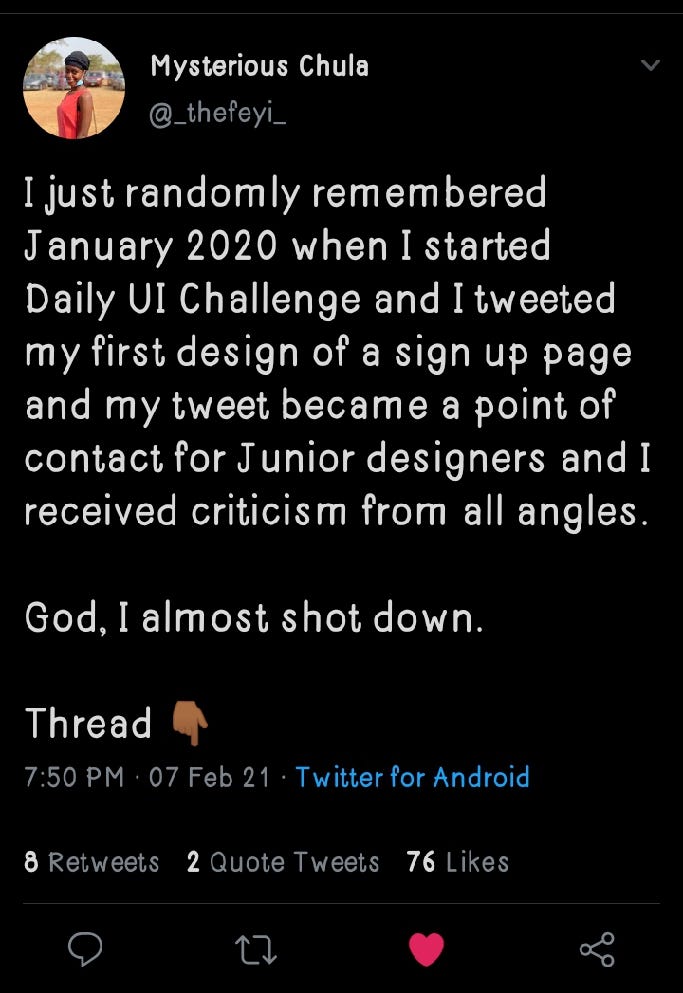
So the girl above started learning UI design, you know, as a complete newbie. And the truth was that her first sets of designs were not good enough - she was just starting anyway.
Everyone hurled [destructive] criticisms at her. You can imagine that feeling when the whole of Design Twitter is making your work a point of reference and all that. She felt completely discouraged.
Now, am I saying we shouldn’t be blunt when we are giving feedback? You know I’ll never support mediocrity. That’s not what I’m saying. If a design is crap, let’s call a spade a spade.
But this is my point: Let’s know the best way to communicate feedback. People don’t have the same emotional strength to absorb raw criticisms. That’s the truth. And we should also bear in mind that these newbies are just coming up - meaning that they’ll make mistakes. And that’s fine.
So when giving feedback, let’s put in a flavour of humane tone. Let’s encourage them. And just like bread and sardines, enclose the raw criticisms between encouraging words. Someone gave me a template of criticizing, and I feel we all might need it. Here we go:
Hey Francisca, I just read your first Medium post, and I must say that your creativity impressed me. The way you connect with your readers and garnish your content with humor stands you out. However, I feel you can improve on these areas to be better: - You didn’t format well. You can learn it on YouTube. - Master your punctuations well. You can download books on it. - You are wordy sometimes. Don’t use 1000 words for what 400 can communicate. - I don’t know, I feel you kind of condemn the readers in your Self-improvement content. You can be more compassionate. I trust you. But all in all, you’re one unique writer with a strange amazing aura and voice. If you are consistent, you’ll be a huge force in this industry. I can’t wait to read more of your works. And feel free to reach out to me.
The essence of what I’m communicating is that we shouldn’t just give newbies raw feedback. Let’s try and surround it with encouraging words. I’m not saying we shouldn’t be blunt, but let’s garnish it with encouragement.
You too, was your first piece, not crap? Let’s not pretend. We’re only this good today because we are consistent and we keep implementing feedback.
Thank you for reading. Please join my bi-weekly newsletter here. I’m grateful.