
This Is How Startup Thinking Will Accelerate Your Writing
Don’t think of your writing side hustle as a business. It’s a startup.

I‘ve lost count of the times people throw the advice to “treat your writing like a business” around. It’s a Medium cliche.
I get that the advice is meant to get new content writers to become more disciplined with their process. However, I think it’s misguided.
“Treat your writing like a business” is the sort of advice that leads to more questions than answers. Chances are, a new content writer already intends to treat their writing as a business, they just don’t know how!
I’ve been on Facebook groups filled with aspiring writers who ask questions like where and how they should market their work, how they should pay their taxes, or if they should be incorporating an LLC as a professional entity for their writing business.
It’s not their fault. They’ve been told to treat their writing like a business. This is what businesses do, right?
Instead of thinking of their writing as a business, budding content writers should think of it as a startup. This isn’t mere semantics. New content writers would benefit from thinking of their role as a startup founder, instead of the CEO of a mature business.
If you put on your startup founder hat, you’ll find it easy to visualise what you need to do if you’re a new content writer.
Start by Defining Your Purpose
Laurence McCahill, who started the Happy Startup School to infuse more meaning to entrepreneurship, emphasizes the importance of clarifying the purpose of the startup before moving on to building it.
As a content writer, your purpose is likely the reason why you’ve decided to spend so much of your time writing.
Your purpose anchors you. Your writing will evolve as your skills improve. The topics you write about will change as you learn more about what you enjoy writing and what your audience enjoys reading. But your purpose should never change.
If your purpose is to enjoy writing for its own sake, you will probably be happy to focus wholly on publishing the best article you possibly can.
But, if you intend to transform your writing efforts into a profitable side venture, you will need to make other considerations. You’ll need to redirect some of your attention to your audience’s needs and wants. You’ll need to tailor your writing to their reading level.
In short, you’d need to compromise with some of your personal preferences to appeal to your audience.
So, unless you are crystal clear about your purpose for writing, you risk frustration. Without having clarity of purpose, you risk the worst possible outcome: writing content you don’t enjoy, and earning peanuts doing it.
Figure out What Product You’d Like to Put out
The initial stage of product development resembles a “drunken walk”, according to Nikhyl Singhal, formerly Chief Product Officer at Credit Karma and the PM who launched Hangouts for Google. At the start, your only goal is to experiment as much as possible to find product-market fit.
In the content writing game, product-market fit is that sweet spot where you’re writing what you love for an audience who loves to read your work. It’s a win-win for everybody involved.
However, before you begin your experiments, you’ll need to take stock of your capabilities. You’ll also need to understand the environment around you to figure out what works and what doesn’t.
Perform a resource audit to understand what you are good at
When you do a resource audit, you engage in introspection to understand what knowledge or experiences you have to draw on for your writing.
To do a resource audit, start by drawing up a list of topics that interest you. Figure out your favourite two topics on that long list. These will be your primary subject areas. A good test to determine if these topics are truly your primary subject areas is to imagine what it would be like to write 100 articles on that topic.
If you can’t see yourself writing 100 articles on the topic, you might not be sufficiently interested in it to make it your primary subject area.
Do an environmental scan to understand the world around you
The next step is to analyse the critical factors in the external environment that directly impact your chances of success.
In practice, this means reading the articles with similar tags to your primary subject areas. You’ll find that the most popular subjects differ between platforms. For instance, mental health articles seem to do better on News Break than Medium.
Social media algorithms work in mysterious ways. There’s no obvious reason why mental health articles perform better on News Break than Medium. However, if you plan to establish a content writing business, you would do well to understand these quirks and use them to guide your decisions.
Keep Coming up With Ideas and Testing Them to See What Sticks
Product managers would call the next step the “ideation” phase. At this stage, you’re ready to begin coming up with article ideas.
Product managers have catalogued many techniques for effective ideation. Mark Barnes concisely describes seven of the most successful approaches to generate product ideas, which include brainstorming, focus groups, mindmapping, storyboarding, reverse thinking, sketching, and SCAMPER (Substitute, Combine, Adapt, Modify, Put to another use, Eliminate, Reverse).
I think some of the best places to look for ideas are in (i) topics adjacent to primary subject areas and (ii) intersections between primary subject areas.
Adjacency means applying your expertise in one subject area to a similar area. I did a Masters in finance, but I figured out early on that academic finance will likely have a limited audience on Medium. Instead, I’ve used that background to communicate theoretical ideas in personal finance articles that (hopefully) resonate better with a general audience.
Intersections are even more fascinating. Intersections provide a rich seam of opportunities to create truly differentiated content.
In taking advantage of intersections, you combine your primary subject areas to come up with new ideas. For instance, I’m interested in psychology and finance.
I might write articles about psychological hacks to improve personal financial outcomes.
Or I might — and this is just a wild example — create personal finance material tailored specifically to the needs of individuals on the autistic spectrum.
I’m not saying I have the qualifications to do this. My point is you can devise all sorts of creative mashups between your primary subject areas.
Whatever you come up with, the proof of the utility of your ideas comes from validating them. The only way to do this is to write and release a few articles to assess their reception. You’d then use this information to refine your product ideas, go out to test the new articles, and keep iterating between these two phases until you achieve traction.
Final Thoughts
Product Dave 💡 summarised the product lifecycle succinctly with this simple diagram.
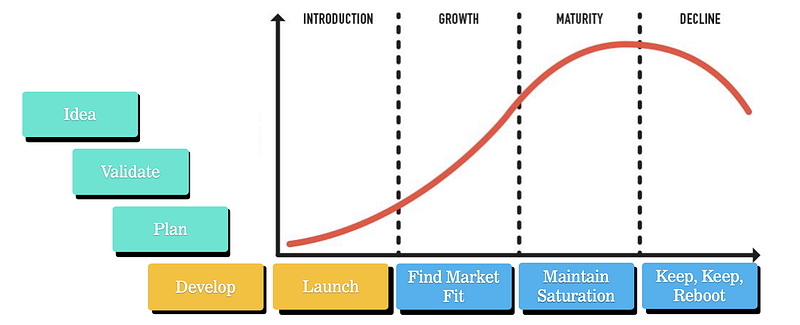
By framing a writing side hustle as “building a startup”, instead of “treating it like a business”, new content writers would focus their efforts entirely on the phases in those cyan boxes, especially “Idea” and “Validate”.
By thinking like a startup founder, new content writers would accelerate iterating between the ideation and validation phases to develop truly differentiated content. This would take their prospects further than if they were side-tracked by other issues, like marketing or company incorporation, more suitable to content writers further along in their careers.