
Don’t Shop at IKEA Without Reading This First: The Psychology of How They Persuade You to Buy More
If you’ve ever been to an IKEA store to browse or buy a trinket but left with a pile of things, you’re not alone. Every time you purchase something at IKEA, you are a “victim” of the so-called IKEA Effect.
To explain what this is and what tricks they use to become and remain the biggest furniture producer in the world, we need to go back a few decades.
IKEA is an acronym that represents several things.
The first two letters are the initials of Ingvar Kamprad, while E stands for Elmtavrd, the family farm where the founder of this company was born, and the last letter A stands for Agunnaryd, the village where Kamprad lived.
He founded the company at the age of only 17, in 1947.
Although under the same name, the company was then involved in Mail Order Business, primarily selling fish and other goods in southern Sweden.
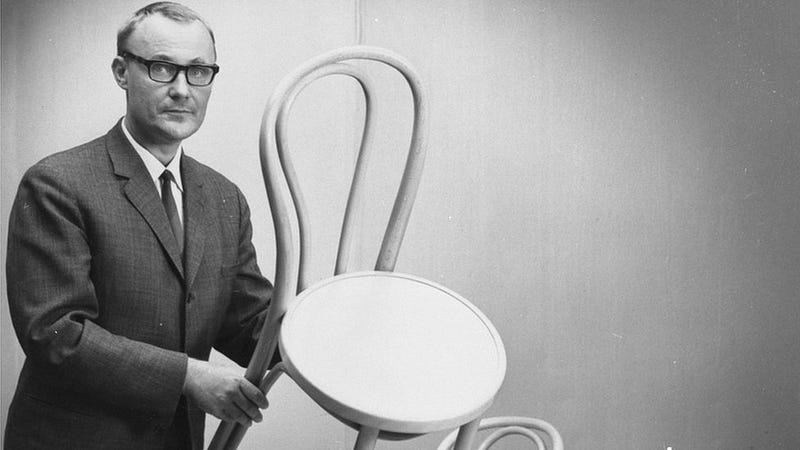
The following year, seeing the high prices of furniture, Kamprad decided to try his hand at that business, but he came up with several ideas on how to reduce production and transportation costs and offer furniture at very affordable prices.
This is where we come to the IKEA Effect.
At that time, furniture was produced, assembled, packaged, and stored in one place. Furniture took up a lot of space in warehouses and was complicated to transport (little goods fit in trucks and often resulted in damage), so Kamprad decided to change that.
Furniture began to be packed in compact and cheap cardboard boxes, people mostly took the furniture they bought themselves, transported it themselves, and finally assembled it themselves.
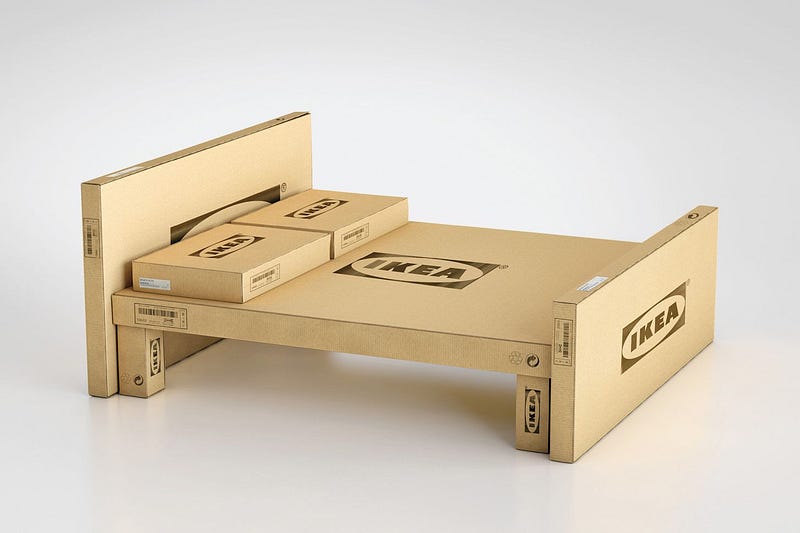
You may be wondering what is the logic in passing on so much work to the consumer, isn’t it in your interest to provide them with the best service possible? No. People are often confused that they are very rational and pragmatic beings, but they are not.
An example of this is General Mills, which in the 1950s introduced instant cake mix into its assortment.
Housewives of that time no longer had to spend hours preparing sweets, it was enough to mix the mixture with water, put it in the oven and bake the cake. It sounds like a revolutionary idea that would sell well. But no, at least not at first.
General Mills then gathered a team of psychologists whose task was to solve that mystery. In the end, they concluded that women felt guilty because the process that had the ultimate goal of making their family happy was simplified so much. These women had the impression that they did not pay enough attention and love to their loved ones, that is, they felt as if they were cheating.
After that, the team of psychologists came up with the idea of adding an egg to the recipe along with the water and the mixture for the cake.
Believe it or not, after just that small detail, sales literally exploded.
Interestingly, before I started writing this post, I made Dr. Oetker instant muffins and in addition to the mixture I received in the package, it said to add 2 eggs and a cup of oil.
People still stick to the same principle that obviously works. Anyway, you clearly understand how IKEA has turned its almost weakness into a strength and the main advantage of its sales.
Although you will probably struggle for several hours with assembling the furniture, they feel a sense of ownership and emotional investment in the product.
They feel a sense of accomplishment in having successfully assembled the furniture themselves, and this emotional attachment leads to them valuing the furniture more highly than they would if they had simply bought it pre-assembled.
Another way IKEA encourages customers to buy more is through the layout of its stores.
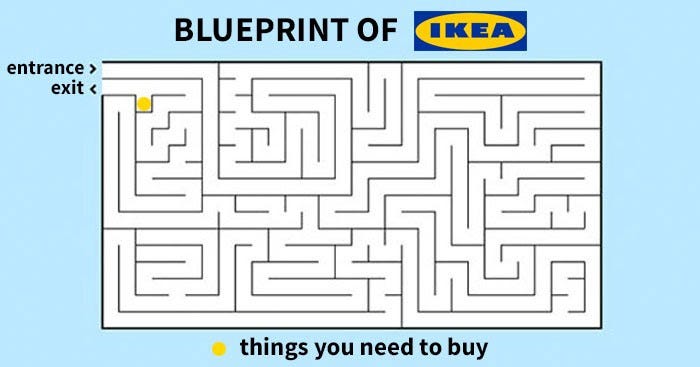
They are designed as a kind of labyrinth, with strategically placed displays and items to entice shoppers to make impulse purchases.
In addition, IKEA uses a technique called “bundling” to encourage customers to purchase more items. They often sell items in sets or bundles, such as bed frames, mattresses, and bedding altogether.
This makes it easier for customers to envision a complete bedroom set and encourages them to make a larger purchase.
They also use lighting to highlight specific products.
Mirrors are also common, as well as pre-set rooms that you can tour, and even try out a bed, sofa, or something similar. IKEA goes to such extremes that they even install sensors throughout the store to see where people are spending more time and which products interest them, and which do not.
Walls and backgrounds are most often in white to reduce distractions and increase contrast and focus on their products.
In addition to all of that, they have also experienced copywriters.
Instead of writing boring product features, they focus on how the product will make your life or living space easier and more beautiful.
They often use Swedish names for their products to convey and tell stories about seemingly small or forgotten places in Sweden and around the world.
The most important thing for them is how you feel, so they can’t afford to let hunger be one of the feelings that will make you leave the store before you planned to, so every IKEA store has a café and restaurant.
It is interesting to note that over 1 billion of their meatballs are sold annually, and Gred Diewald (IKEA Manager USA) once said, “Meatballs are the best sofa sellers.”
Although IKEA stores are much less represented in the US than, say, Walmart, due to their size and large assortment, they attract people who are even several tens of miles away from the store. So many families plan a trip there in advance and are willing to spend several hours shopping and exploring the store.
In conclusion, IKEA’s success in encouraging customers to buy more comes from a combination of factors, including the IKEA effect, store layout and design, bundling, product names, and affordable prices. By using these techniques, IKEA has become one of the world’s largest furniture retailers and a household name.