avatarMelissa Coffey

Free AI web copilot to create summaries, insights and extended knowledge, download it at here

3143

Abstract

’s</i> large dimensions magnify the atrocities of war and dwarf the viewer — part of the painting’s power.</p><p id="60cd">In responding to this painting, the current war waging in the Ukraine, and the loss and devastation of life was never far from my mind.</p><h2 id="e7d2">Ekphrastic Approaches</h2><p id="0565">In finding ways into the image, I used two exercises from <a href="https://www.ekphrastic.net/ebooks.html"><b><i>Fifty Ekphrastic Approaches</i></b></a><b><i> </i></b>by Lorette C. Luzajic. Having purchased the book, I can say it provides a wealth of creative exercises to inspire writing from art. The first was to examine the signs and symbols in the work — on “personal, cultural, religious, or historical” levels. As Lorette observes:</p><blockquote id="dcc7"><p>Some paintings are best read as codes, and some eras of art history have recurring signs and hidden (or not so hidden) messages.</p></blockquote><p id="7932">I looked at the bull, the terrified horse, and the broken weapon, asking what they wanted to say about war.</p><p id="e818">The second approach was taken from “Make Use of the ism’s” where Lorette suggests that you “use the qualities that define that movement to direct your poetry.”</p><p id="b491">Cubism, with its sharp lines and fractured perspective directed many of my word choices and images. It also informed my decision for free verse with no rhyme or metre, consisting of a series of short stanzas. I chose an uneven number of five lines per stanza to reflect the assymetry in the composition, but also the chaos of depicted events. If I was publishing this elsewhere with more options for typographical lay-out, I’d experiment with placing the stanzas randomly across and down the page, like falling pieces of slate. As Lorette encourages:</p><blockquote id="c52e"><p>Learn something about the ism if you’re unfamiliar with it, and let the goals and elements of the style inform your style.</p></blockquote><p id="7ec9">Lorette is also founder of <b><i>The Ekphrastic Review</i></b><i>,</i> a well-known online journal for ekphrastic writing. I discovered this site a few months ago, deciding to submit to one of Lorette’s fortnightly ekphrastic challenges — and was delighted when my flash fiction response “The Dream of Fly Agaric” was selected for publication. Since then, I’ve also participated in one of her workshops. The link below is also an example of how the challenges work:</p><div id="65e9" class="link-block"> <a href="https://www.ekphrastic.net/the-ekphrastic-challenges/ekphrastic-writing-responses-edward-okun#comments"> <div> <div> <h2>Ekphrastic Writing Responses: Edward Okun</h2> <div><h3>Mother Mushroom and Her Children, by Edward Okun (Poland) c. 1900 As the third night fell, the six girls huddled…</h3></div> <div><p>www.ekphrastic.net</p></div> </div> <div> <div style="background-image: url(https://miro.readmedium.com/v2/resize:fit:320/0*rpbt3fJ5WqqHoqhv)"></div> </div> </div> </a> </div><p

Options

id="bf57">An artist and longtime practitioner of ekphrasis, Lorette has a great depth of insights about the practice, stating:</p><blockquote id="428e"><p>We believe that art is enchanted. In a world saturated with imagery, slowing down to contemplate images can give us a wealth of experiences, insights, therapeutic benefits, creative expression, and play … We believe that art inspires art and we can enrich and deepen our own writing and find ourselves in surprise territory, a gift that keeps on giving as we practice ekphrasis.</p></blockquote><p id="5f6d">I asked Lorette if I could share information about her book and her site for those interested in ekphrasis here, which she has graciously allowed me to do. She said:</p><blockquote id="e9cd"><p>The bimonthly prompts attract writers around the world to respond to a specific image. We aim to show off a diverse range of perspectives and experiences from these prompts. I invite everyone to participate in the challenges, to read the daily features, to try our contests and inspiring workshops.</p></blockquote><p id="0ea9">As I’ve mentioned in my own <a href="https://readmedium.com/poetry-exploring-ekphrasis-1149c623cfd3">ekphrastic prompt</a>, the process of writing from imagery can yank you out of your comfort zone, and this image certainly did that. I’ve never written a poem about war before. So, if you’re stuck for writing ideas or want to stretch yourself poetically, give ekphrasis a go! This is my fifth “arty ekphrasis” poem. I created the tag “Ekphrasis” here nearly three years ago and I see it has 109 entries as at the date of this post — 110 now!</p><p id="91f6">And perhaps, I’ll see you on <a href="https://www.ekphrastic.net/"><b><i>The Ekphrastic Review</i></b></a> too …</p><p id="f6d6"><b><i>Fifty Ekphrastic Approaches</i> & more inspiration:</b></p><div id="8b58" class="link-block"> <a href="https://www.ekphrastic.net/ebooks.html"> <div> <div> <h2>Ebooks</h2> <div><h3>Thank you for purchasing one or more ebooks. Your purchase is a great way to support The Ekphrastic Review while…</h3></div> <div><p>www.ekphrastic.net</p></div> </div> <div> <div style="background-image: url(https://miro.readmedium.com/v2/resize:fit:320/0*4yXv3EjPagTvMezA)"></div> </div> </div> </a> </div><p id="9913"><b>My most popular Ekphrastic poem (from my own photo):</b></p><div id="a269" class="link-block"> <a href="https://readmedium.com/the-seat-of-improbable-contemplations-4ca33a50d9ef"> <div> <div> <h2>The Seat of Improbable Contemplations</h2> <div><h3>Dreaming silent on the street of memory — a poem</h3></div> <div><p>medium.com</p></div> </div> <div> <div style="background-image: url(https://miro.readmedium.com/v2/resize:fit:320/1*cs1irxjPq0-D5x_yIyoY4w.jpeg)"></div> </div> </div> </a> </div></article></body>

This is Guernica: A Poem

An ekphrastic response to Picasso’s famous painting
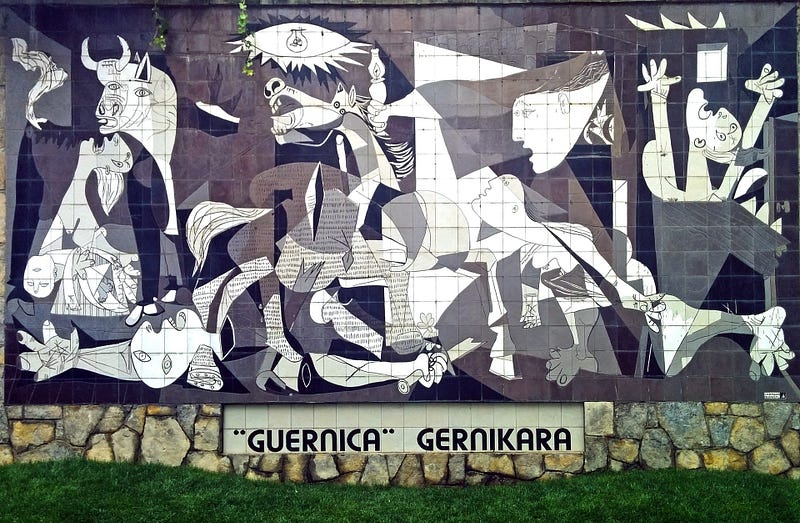
A mural version of Picasso’s “Guernica” (orig. 1937) — Image by Almudena Sanz from Pixabay

Dropped from an April sky, did the first bomb wound a workhorse, carting coal and olives back home from the market?

Its agonized screams, ricocheting through the streets like schrapnel, heralding the sharp-splintered explosions soon to be decimating shopfronts and houses into irredeemable rubble

A fence-post pierces its flank, tongue like a missile shoots out from the gaping mouth in terror it is the waking night-mare of war, rearing at the centre of strategic carnage

Perspective fractures the subjects into geometric fragments, like shards of shattered glass and mortar, like the market vendor’s screams, guillotined mid-cry —

As the sky darkens with smoke, a man trapped in a building burns alive, a woman drags her leg, half-severed above the knee, along the ashen ground, like a ham hock

No light can shed relief on this deliberate dismantling of an ordinary Monday in 1937 in Guernica, as men lie, dismembered on rough cobblestones

Clutching broken weapons, futile as toy swords against this deadly blizzard of bombs, the men of Guernica are not fighting bulls from the field today in spectacles of bravado

But a mother, cradling her dead child on her knees howls in grief, as she bares her throat to the monstrous Minotaur of war

This is Guernica, and anywhere where war unmakes life and the living, where pride and power obliterate humanity in senseless machinations

© Melissa Coffey, March 2023

The Making of Picasso’s “Guernica”: Background

On Monday 26 April 1937, the Basque town of Guernica was bombed by German and Italian air forces at the request of the Spanish Nationalists under command of General Francisco Franco during the Spanish Civil War. It was known that Monday was “market day” in Guernica, a day when more people would flock to the town and the population would be concentrated in the city square. The attack attracted much controversy, due to the death and injury of many civilians.

Over a period of 35 days, Pablo Picasso created this striking monochromatic oil painting bearing distinctive elements of Cubism to draw public attention to the bombings and the plight of Guernica. Nearly 4 metres high and almost 8 metres wide, Guernica’s large dimensions magnify the atrocities of war and dwarf the viewer — part of the painting’s power.

In responding to this painting, the current war waging in the Ukraine, and the loss and devastation of life was never far from my mind.

Ekphrastic Approaches

In finding ways into the image, I used two exercises from Fifty Ekphrastic Approaches by Lorette C. Luzajic. Having purchased the book, I can say it provides a wealth of creative exercises to inspire writing from art. The first was to examine the signs and symbols in the work — on “personal, cultural, religious, or historical” levels. As Lorette observes:

Some paintings are best read as codes, and some eras of art history have recurring signs and hidden (or not so hidden) messages.

I looked at the bull, the terrified horse, and the broken weapon, asking what they wanted to say about war.

The second approach was taken from “Make Use of the ism’s” where Lorette suggests that you “use the qualities that define that movement to direct your poetry.”

Cubism, with its sharp lines and fractured perspective directed many of my word choices and images. It also informed my decision for free verse with no rhyme or metre, consisting of a series of short stanzas. I chose an uneven number of five lines per stanza to reflect the assymetry in the composition, but also the chaos of depicted events. If I was publishing this elsewhere with more options for typographical lay-out, I’d experiment with placing the stanzas randomly across and down the page, like falling pieces of slate. As Lorette encourages:

Learn something about the ism if you’re unfamiliar with it, and let the goals and elements of the style inform your style.

Lorette is also founder of The Ekphrastic Review, a well-known online journal for ekphrastic writing. I discovered this site a few months ago, deciding to submit to one of Lorette’s fortnightly ekphrastic challenges — and was delighted when my flash fiction response “The Dream of Fly Agaric” was selected for publication. Since then, I’ve also participated in one of her workshops. The link below is also an example of how the challenges work:

An artist and longtime practitioner of ekphrasis, Lorette has a great depth of insights about the practice, stating:

We believe that art is enchanted. In a world saturated with imagery, slowing down to contemplate images can give us a wealth of experiences, insights, therapeutic benefits, creative expression, and play … We believe that art inspires art and we can enrich and deepen our own writing and find ourselves in surprise territory, a gift that keeps on giving as we practice ekphrasis.

I asked Lorette if I could share information about her book and her site for those interested in ekphrasis here, which she has graciously allowed me to do. She said:

The bimonthly prompts attract writers around the world to respond to a specific image. We aim to show off a diverse range of perspectives and experiences from these prompts. I invite everyone to participate in the challenges, to read the daily features, to try our contests and inspiring workshops.

As I’ve mentioned in my own ekphrastic prompt, the process of writing from imagery can yank you out of your comfort zone, and this image certainly did that. I’ve never written a poem about war before. So, if you’re stuck for writing ideas or want to stretch yourself poetically, give ekphrasis a go! This is my fifth “arty ekphrasis” poem. I created the tag “Ekphrasis” here nearly three years ago and I see it has 109 entries as at the date of this post — 110 now!

And perhaps, I’ll see you on The Ekphrastic Review too …

Fifty Ekphrastic Approaches & more inspiration:

My most popular Ekphrastic poem (from my own photo):

War
Art
Ekphrasis
Poetry
Prompt
Recommended from ReadMedium