
This is Bitcoin’s Biggest Secret, the Great Tether Ponzi Scheme
When will the Tether ticking time bomb explode?

Shortly before Christmas, prolific Medium writer Jared A. Brock sent me an email titled “When will Tether crash and burn?”
I let out a great big laugh as soon as I saw it.
It’s crazy how Jared can make a more compelling article out of an email than half of the professional journalists I read in an afternoon.
But was he right?
Were my bitcoins going to zero and was the entire crypto market finished?
It’s hard to say.
Because Tether does have many problems. But how deep does this rabbit hole really go? Let’s find out.
Why do we need Tether?
“This is your last chance. After this, there is no turning back. You take the blue pill — the story ends, you wake up in your bed and believe whatever you want to believe. You take the red pill — you stay in Wonderland, and I show you how deep the rabbit hole goes. Remember, all I’m offering is the truth — nothing more.” -Morpheous
Bitcoin has crashed 80% or more three different times since 2012.
Investors look forward to it at this point — it’s like a crypto Christmas with chances to buy your favorite projects on sale.
Unsurprisingly, not everyone looks at it this way.
Sudden price drops scare off less experienced investors and tend to leave a bad stain on Bitcoin’s reputation as a currency.
Thus, in 2014 (five years after Bitcoin’s creation) stablecoins were born as cryptocurrencies that never fluctuate in price and are pegged to the dollar, or other stable assets as a safety barrier against volatility.

It wasn’t long before Stablecoins took the crypto market by storm.
Stablecoins, especially the most popular, Tether (USDT), became the primary way the markets were fueled. USDT quickly skyrocketed to the third most valued cryptocurrency by market cap and today is the fourth most valuable.
This heavy reliance on Tether is what Bitcoin bears call the “ticking time bomb” that could destroy Bitcoin.
Because, while most stablecoins are safe, Tether is one of the most controversial stablecoins on the market.
Tether is a Ponzi Scheme waiting to explode
The SEC’s number one enemy isn’t Bitcoin, Ethereum or XRP.
It’s Tether.
This is because Tether acts as a fractional reserve bank for Bitcoin, meaning Tether’s reserve dollars aren’t backed 1-to1- in their supply.
In fact, an investigation by the Commodity Futures Trading Commission (CFTC) found that Tether only had .74 backed of their US dollar reserve. So when you or the exchanges trade in their one Bitcoin for its worth in Tether, you’re really only getting .74 of that Bitcoin when accounting for its backing.
Here’s an excerpt from the suit —
Tether order finds that from at least June 1, 2016 to February 25, 2019, Tether misrepresented to customers and the market that Tether maintained sufficient U.S. dollar reserves to back every USDT in circulation with the “equivalent amount of corresponding fiat currency” held by Tether and “safely deposited” in Tether’s bank accounts. In fact Tether reserves were not “fully-backed” the majority of the time.
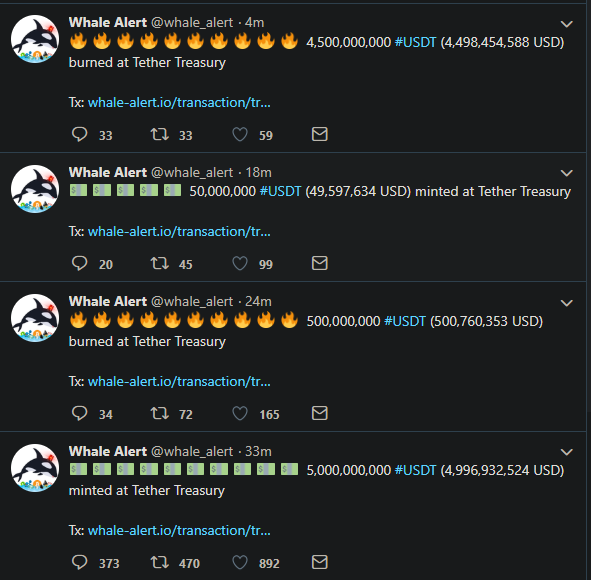
Moreover, exchanges that work together with Tether like Bitfinex were able to print Tether out of nothing; with literally a keystroke they pumped the crypto markets in the same way that stimulus packages pump stocks.
Even Vitalik Buterin disclosed to Tim Ferris the dangers of Tether:
On The Tim Ferriss Show, Vitalik Buterin said:
“I think the Bitcoin ecosystem does have its own […] ticking time bomb demons too, like Tether is one example.”
The worst-case scenario for Tether, and Bitcoin
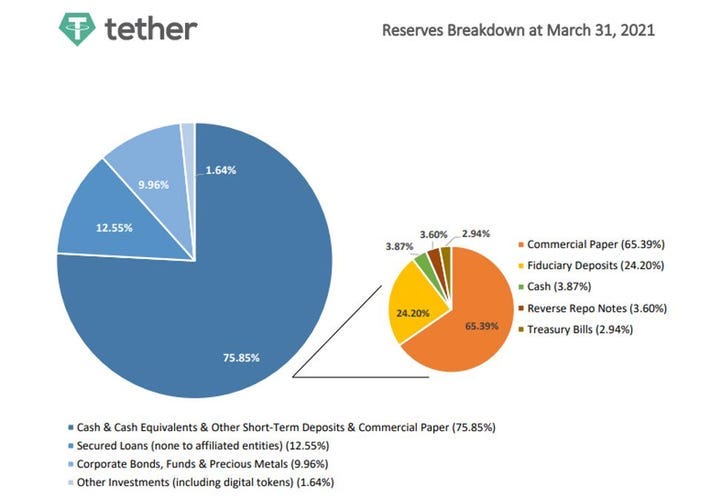
Today, Tether is much more transparent about their holdings and even conducted an audit of their assets.
Tether Holdings Ltd. has assets totaling at least $69 billion as of Sept. 30. That includes $30.6 billion in commercial paper and certificates of deposit, $7.2 billion in cash, almost $1 billion in money market funds and $19 billion in Treasury bills.
Here’s what scares me most about Tether.
They lied. They lied in a market that is already facing intense scrutiny from the American government.
This alone is grounds for the Fed to kick down the door and seize their entire operation. The Tether executives even faced criminal charges earlier this year from the DoJ.
It’s not an open and shut case, however.
Some Federal Reserve representatives including the former Fed Vice Chair under Jerome Powell said “we should be saying yes” to Stablecoins. So anyone that tells you Tether’s fate is sealed is either ignorant or trying to spread misinformation.
Bitcoin critics are wrong about this
One other possibility Tether and Bitcoin critics bring up is the possibility of every crypto investor cashing out their Tether and not receiving their full due.
This is a crypto bear’s wet dream. It’s very unlikely.
Even after the Tether fraud went mainstream this year, Bitcoin holders fought to buy BTC as fast as they could.
The fundamentals of Bitcoin are not reliant on Tether.
Crypto bears like Mr. Whale tends to sound like a homeless guy yelling about the end of the world with the number of crashes he’s predicted.
But he is right about one thing: The SEC and Fed are a real threat to Tether. How that impacts Bitcoin, however, is tantamount to fortune-telling. It’s misrepresenting the data to conform to your confirmation bias.
Shadow banking vs. Tether
What is the difference between Tether printing money and a private organization like the Federal Reserve printing money?
Nothing.
Except the Fed is much worse.

When you put your money in the bank, it only holds something like 1/30th of that and invests the rest for its own gain. Welcome to reality. They arent even 2x leveraging your money like Tether is.
The banks 30x before they rehypothecate it into like 200x. This banking scam is called the derivatives market and the shadow banking system.
Here’s how much it’s worth, but first —
- The entire cryptocurrency market is worth a combined $2 trillion
- The combined value of the whole world’s real estate market is $270 trillion
- The total stock market value is $95 trillion
All pennies compared to fractional reserve banking and the derivatives market which has a combined value of $600 trillion to $1 quadrillion.
The U.S. economy is a big bear spinning plates while balancing on a beach ball. It’s fun while it lasts, but tragic when the bear falls off and starts fucking eating people.
Bottom line
Tether FUD is nothing new.
People have been saying “TETHER PONZI SCHEME” since 2017, and it still hasn’t suffered this massive crash. I wonder if these are the same critics who erroneously claim that Bitcoin is dead?
Tether does have its problems, but it won’t be the end of Bitcoin.
There are two possible conclusions for Tether —
- Tether will fight a scathing legal battle with the US government that will end in USDT being disbanded. It will greatly disrupt the crypto markets. Eventually, a new Stablecoin (i.e. USDC, TrueUSD, Pax Dollar) will replace it.
- Nothing will happen. Tether critics will continue to cry “wolf” and Bitcoin will continue to be valued on its own fundamentals.
Bitcoin doomsayers have limited ammunition. Next week it’ll be how Bitcoin itself is a Ponzi Scheme or how there’s a better Bitcoin out on the market, or how the US government will regulate it out of existent.
If Tether does crash and burn, which I personally believe is unlikely, Bitcoin will find value based on its intrinsic properties.
Tether won’t take it down. Now go argue in the comments!
Ever since I was a child it was my dream to become a financial advisor. Unfortunately, it never came true. Therefore I am not a financial advisor and you should do your own research and not just listen to random people on the internet. Nothing contained in this publication should be construed as investment advice.
Join 1500+ people on my newsletter for a free copy of my eBook “Mind and Muscle.”


