This Guided Meditation Helped Me Break My Trauma Bonds
I don’t normally do this but…I said goodbye to my father
The hardest part is letting go
I feel good. Real good.
My video at the end won’t make sense unless I tell you why.
Spending time with the things I forced myself to forget has been the rewarding experience my family told me it never would be.
The experience they told me it never could be.
“Focus on the positive,” my dad would say.
My only wish is that I could stop
“Water under the bridge,” Dad insisted when I asked if he remembered taping over my only performance as Scrooge in A Christmas Carol for my second grade school play at Southwest Academy in Jackson, MS.
My dad had needed a tape for that Sunday’s football game and grabbed whatever was nearest.
The nearest was the only recording of the play.
I don’t think it was deliberate…
I hope it wasn’t.
I wish it was that easy to stop wishing I could understand why he did it (even if he didn’t mean to).
I wish that for me, that one question didn’t represent so much else.
At least if he meant to hurt me, I could hope to reason with him. But how do you talk to a man who won’t admit he hurt you in the first place? Wouldn’t that just open myself to getting hurt by that same man again?
True courage
Is it true that courage isn’t the absence of fear?
Is it true that courage is simply persisting in the face of it?
The people around me promised my dad would never hurt me like that again. But a part of me believed I’d never know for sure unless I faced him one last time.
So after years of thinking I’d never talk to him again, I followed the breadcrumbs to the nursing home that will probably be where Bruce Wayne offers his last breath.
I called and asked to talk to him.
After a few seconds, his voice came on the line.
My heart froze
I disconnected from my dad when my body refused to forget what my mind had forced into amnesia. He hurt me in ways that, well, now that I remember…
I knew he could never explain, but wouldn’t he at least try?
And if he couldn’t (or wouldn’t)…would the simple act of asking be enough to free me?
As the father, so the son
I held off asking him for thirty years. He has dementia now. The chances of him remembering are slim. The chances of him giving an honest answer are even slimmer.
They always were.
Until I heard his voice again, I’d forgotten how alike he and my twin brother are in their compulsions to manipulate and control women. To use us — be they their wives, their daughters, or their sisters — as fuel to slake their endless need.
Was it my dad who taught my brother how to get away with so much by using fake identities?
I never knew my dad. Not really. Just like I never knew my brother. They both present the face that gets them what they want. Catch them in one lie and they just pivot to another.
I worried I’d made a stupid decision. No matter how promising it might seem at first, hadn’t trying to talk to my dad only ever led to more lies? To more denial? To more pain?
But then again…hadn’t I come here to finally let the source of that pain go?
Just ask the question
My dad remembered having twins, but he laughed when I reminded him one of those twins had been his daughter.
At first, I thought he laughed because he was too nice to call me a liar. I couldn’t be his daughter. He’d had only one daughter. The other two had been twin boys.
I only recently remembered what made him pivot to that lie. He knew I was the girl between me and my twin brother since the beginning. Until the son of his best friend promised to make me his wife — at least whenever we were left alone.
Had my dad forgotten? Had he ever remembered? The best liars believe their own spin.
But what he said next told me the truth.
He remembered that I’m a girl. I’ve always been a girl.
He also remembered why I’d finally called.
He’ll never have an answer
He told me he couldn’t talk about it.
His voice shaking with the palpable wetness of his tears, he murmured the words that betrayed how much pain he’s still in from the memories of what he did to the women in his family.
“I need to forget,” he whispered.
“What?” I said, even though I’d heard him clearly.
“There’s no reason I should have done that.”
“But you remember doing it?”
Family means familiar
When the man I used to call my father said he looked forward to talking to me again, I told him that was never going to happen.
He said that was okay. I was family. I always would be.
I told him I was not his family. Not now. Not ever.
His tone shifted as quickly as when he’d admitted just how much he remembered.
“Fine,” he said.
“Good luck,” I said, just as unprepared to say goodbye.
“I don’t need luck.” The line went dead.
Forgetting isn’t forgiveness
My need to remember is as stubborn as my dad’s need to forget.
For him, those memories are water under the bridge. Maybe once upon a time, he stood on the bridge and watched them pass by. Now he looks up at the sky. The water lightly echoes as it breaks over the rocks, almost like the sound of a young trans girl pleading for her father to meet her for once on terms other than his own.
The sound, like the sight, is too much for him. He turns away from both and walks off.
If he won’t go down there, I’ll have to go myself.
What I found among the rocks, dirt, and sand
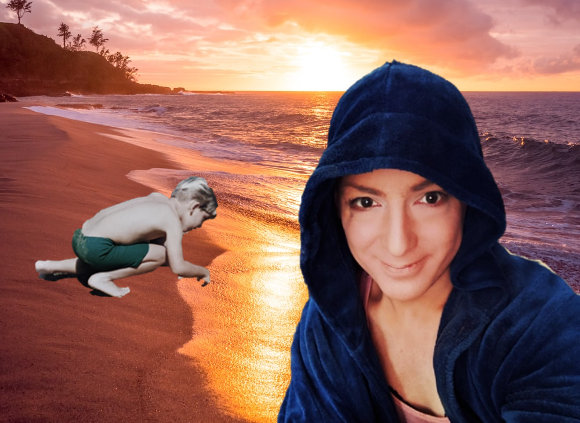
I walk among the rocks and dirt and water until it turns into sand and surf.
I used to worry going to that part of the beach — that part of my memories — was dangerous. It’s where my parents take up the most space.
But this time, I will keep walking no matter what or who I find.
Keep walking
If you’re struggling to walk down your own beach —
If the feeling of water sends you scrambling back —
If you meet people along the way and can’t help but give them your power —
If all you ever needed was just one person by your side to help you say no…
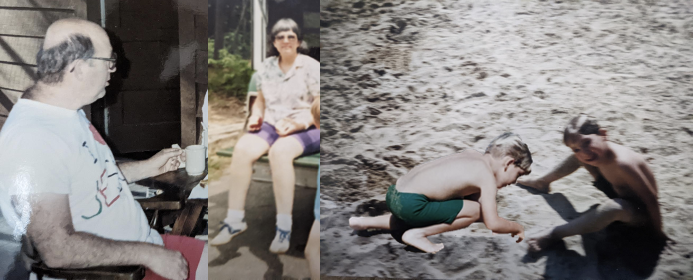
This guided meditation taught me to find my inner child, hold my own hand, and let go of the people who hurt me.
Note: This guided meditation is taken from “The Twelve Steps of Adult Children” workbook (a.k.a. the “yellow book”) part of the collection of literature produced by the 12-step recovery program Adult Children of Alcoholics & Dysfunctional Families World Service Organization.