
Run Long, Run Healthy — November 30, 2023
This Form Fix Will Help You Run Faster, Do “Rocker” Shoes Boost Performance? How To Beat GI Distress
PLUS: The best training tool costs $0.00, Parker Valby proves that cross-training WORKS, Lifetime running secrets, Heinz Ketchup energy gel?
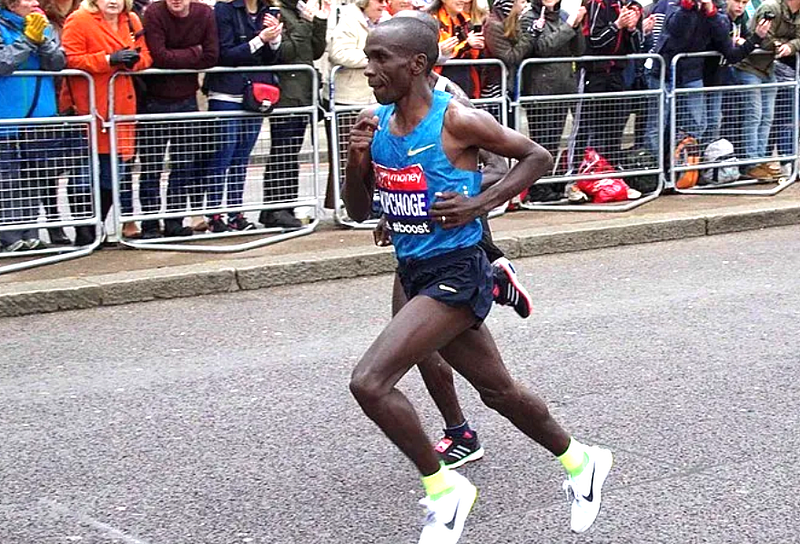
This simple form fix will make you faster and more efficient
I’ve received personal arm-carriage instruction from Golden Harper and Tom Miller, both of whom are referenced in the below article. Both are true running experts and record-holders of different stripes, and both made me a believer in their systems.
And the best thing about this: There’s nothing to buy. You don’t have to pay a cent. (Although I’ll link to one $12 item.) You just have to practice on your own.
Basically, the system could be called: “Run with your elbows.” Or: “Pull your elbows back.” The article claims that driving your arms backward shifts your balance more upright and forward. In that position, your feet can land closer beneath your body, and push backward more efficiently.
In fact, coach Andrew Kastor says the one thing he typically yells in a race, where a runner can only hear and implement one simple thing, is: “Elbows Back!”
That’s what I see whenever I watch a video of Eliud Kipchoge heading toward another marathon finish tape. Look at the side view of Kipchoge 20 seconds into this video.
You’ll also enjoy this webpage that promotes a $12 elastic band you can buy to practice Kipchoge elbow running. Click down the page once or twice for an adorable, short video with a young girl runner who’s about 10 years old. (You can fashion a similar device on your own by grabbing a length of elastic resistance band, tying the ends together, and sliding the loop over your shoulders like a coat. Once it’s on, simply tuck your thumbs or whole hands into the front of the loop, and start running.) More at Outside Online.
Rock and roll: Do “rocker” shoes boost your performance?
Recently I’ve had several strong runs at a pace faster than I anticipated. This is always nice. But it makes you wonder: Why? Since my fitness didn’t change in any dramatic way from last week to this week, what was going on?
I wondered: Is it the shoes? As it happened, I had dug to the bottom of my shoe pile and pulled out a pair that I hadn’t worn in close to a year. And these were the shoes that produced the two fast workouts.
I won’t name them, as this is hardly a controlled experiment. I’ll only say this: I was wearing a well-known brand that isn’t among the top 3 (or perhaps even 5) when people talk about their favorite, fast running shoes. Yes, the shoes have a super foam and a stiff midsole plate like most of the other shoes I’ve been wearing.
They also have quite a dramatic rocker sole. That’s why I ended up at the article linked below, which looks at the pros and cons of rocker-sole running shoes. The article defines and presents photos of rocker shoes — some have both a toe and heel curve; some just a toe curve — and includes all the usual warnings about individual differences and knowing your own style of running.
In general, it implies that rocker shoes are more likely to work for healthy heel strikers and for those with heel/Achilles problems. And less suitable if you have knee/hip issues.
A related note regarding those new $500 Adidas super shoes. You know — the ones worn by Tigist Assefa to a world record in Berlin and by Tamirat Tola in a course record at New York City. In its press release, Adidas claimed the shoe “features a revamped geometry with a first-of-its-kind forefoot rocker, placed at 60% of the length of the shoe. This innovation is lab-tested to trigger forward momentum and improve running economy.”
That’s promotional copy, not scientific text. Still, it seems safe to assume that we’ll be reading a lot more about rockers as well as foams and plates in future shoe releases. More at Run Repeat.
The training tool that gives you the BIGGEST bang for your buck ($0)
You can use a wrist or chest monitor to measure your heart rate while training. You can approximate your power output on the run. You can measure a lot of things these days with different types of “wearables.”
But it remains true that your RPE, or Relative Perceived Exertion, may be your most effective gauge of training intensity. If only you can learn to trust yourself rather than the nearest digital display. As this article notes: “Sometimes, the most intuitive solutions are the most effective.”
Some have little faith in their “intuitive” reactions precisely because they don’t display a blinking number. That doesn’t mean that RPE has no value. In fact, your subjective exertion can be linked to training zones, goal race paces, environmental conditions (heat, altitude), and the like. See the end of the linked article for a handy chart that could boost your confidence in RPE training.
You don’t have to throw out your digital devices. They can be both fun, and instructive. But don’t forget the oldest and best running advice: “Listen to your body.” More at Trail Runner.
Nutrition strategies that defeat stomach distress
If you’re searching for the best way to maintain energy during a long run or marathon race, you can’t do much better than looking to ultra runners. After all, given the distances they cover, they have to figure a way to maintain energy.
This systematic review investigates ultra runners, and how they cope most successfully with fueling requirements. “Consistent with other research, nausea, cramps, bloating, vomiting, and diarrhea were the most commonly experienced symptoms.” Oh, my. Not good.
And the best solutions? Reduce FODMAPs. Also, limit dairy, stay away from medium-chain triglycerides, and practice, practice, practice.
FODMAPs are sugars, or “Fermentable Oligosaccharides, Disaccharides, Monosaccharides And Polyols” that the small intestine absorbs poorly. “Restricting the intake of FODMAPs has proven a successful method of alleviating gastrointestinal symptoms in approximately 70% of individuals” troubled by stomach issues.
Finally: “With practice, increased carbohydrate intakes can be tolerated by athletes and may enhance athletic performance without major attenuations [drops] of GI comfort.” More at Nutrients with free full text.
NCAA champ Parker Valby proves the value of cross-training
Many runners cross-train to avoid injury and prolong their healthy running, but few big-time race winners credit their success to cross-training. Parker Valby of Florida State University is the rare exception. She was second in last year’s NCAA Cross Country Championships, and first this fall.
We still don’t have a lot of specific information about Valby’s training, but she apparently covers only 25 to 30 miles a week with on-the-ground running. That’s less than half what many top collegiate runners do. When not running, she’ll log an hour or more per day of cross-training on an elliptical machine named the Arc Trainer (a favorite of many runners) and/or an indoor bike or other equipment.
Here her coach of a year ago describes how fiercely Valby attacks workouts when cross-training. And here members of the LetsRun message board debate their views on cross-training for runners.
The linked article below summarizes several studies of cross-training for runners — how it can help you maintain fitness, and maybe even improve. Cross-training can be particularly helpful for masters runners, and for young runners battling injury.
A key issue: When you do hit the roads, trails, or track, you’ve got to devote some hard workouts to race pace preparation. I think it’s a good idea to also include some modest downhill running, because it’s hard to simulate eccentric muscle contractions of the legs on most cross-training machines. More at Trail Runner.
Unexpected result: High heat produces few health risks to endurance athletes
The upcoming U.S. Marathon Trials (Feb. 3, Orlando FL) have been embroiled in controversy for several months now, long before the runners get to Florida. The Trials qualifiers protested the announced noon time start, claiming it could prove dangerous to their health. The Local Organizers said they had been told that a noon start was non-negotiable. The national governing body, USATF, tried to duck its head and hide, as it usually does.
Most recently, a new start time has been announced: 10 a.m. That seems a minor change that will make little difference if the temperature or humidity are high on February 3.
But what about the runners’ safety claim? Is it evidence-based? Perhaps not.
A new paper investigated “core body temperature responses during competitive sporting events.” Conclusion: Top athletes racing in the heat do “not have impaired health during real-world sporting competitions, likely due to being heat acclimatised from their training and their perceptual tolerance to the heat.”
Make no mistake: Everyone feels worse in the heat, and runs slower. But these don’t necessarily create health emergencies. Indeed, “The prevalence of exertional heat injury/exertional heat stroke was low” in the reviewed research. More at Biology of Sport with free full text.
Is Heinz Ketchup the next replacement gel of choice?
No, of course not. But the company has gotten good PR mileage from their recent campaign. I suspect they did it because nutritionists point out that ketchup isn’t a vegetable, and contains too much salt and sugar.
Or maybe someone at Heinz is a serious marathon runner, and simply got a bit wacky-inspired. If so, I give her/him credit for that.
The campaign seems aimed at urban folks who live in a neighborhood with lots of fast food joints. You know — the kinds of places where they pile up those little red Heinz ketchup packets with all the other condiments, utensils, and napkins.
Being the analytical type, I decided to check how much fuel you actually get from one of the tiny red packages. Turns out, they only contain 8 to 10 calories vs 100+ calories in a typical runner’s gel. So, if you want to fuel your long run or marathon with Heinz, you’ll have to order a burger or french fries as well. (Just kidding.)
“I’m totally skeptical,” said one sports dietitian to the NYTimes. Others agreed.
Run for your life with endurance and gratitude
This newsletter, “Run Long, Run Healthy,” exists because I believe the running you did yesterday is wonderful, but the running and other movement you do tomorrow is more important. Yes, you’ll probably be slower tomorrow (next year; next decade), but your personal fitness contributes more to your overall health and well-being with increasing age.
To serve this end, I have now run Connecticut’s big annual Turkey Trot, the Manchester Road Race (4.748 miles) 61 years in a row — an unofficial world record for road race streaks. I know this streak won’t continue infinitely, but I can’t see any reason to stop now.
I won Manchester 9 times in my 20s. That was fun. But the race is more meaningful to me now than it was then. Even though it takes me twice as long to complete the course as it did in the 1970s.
Two women are not far behind me. This year Janet Romayko and Beth Shluger finished Manchester for the 51st year in a row. That appears to be a world-record road race streak for women.
Romayko says: “I will continue running Manchester as long as I can. My aunt walked the course on Thanksgiving at age 93. I’d like to beat her record.” That’s the attitude we need.
Shluger: For 50 years I have had the gift of knowing exactly what I’ll be doing on Thanksgiving morning, and it’s a gift of love, family, community, and the Manchester Road Race. In this sometimes-crazy world, that is a mighty precious gift.” That’s the gratitude we need to express. More at AmbyBurfoot.com
SHORT STUFF you don’t want to miss
>>> Feet first: Footstrike pattern is more important than footwear” when it comes to injury prevention.
>>> Successful surgery: For runners with serious iliotibial band problems, the PLAR technique allows “a return to previous sports performance in a short period of time.” (free full text)
>>> Stride right: The Stryd foot pod is effective to “delineate exercise intensity domains, guide training intensity, and assess aerobic fitness.”
GREAT QUOTES make great training partners
“It’s only cold outside if you’re standing still.”
— Anon
That’s all for now. Thanks for reading. See you again next week. Amby


