
This Entrepreneur Made $10M in 4 Years — With 10 Income Streams
He also missed his revenue target in 2022
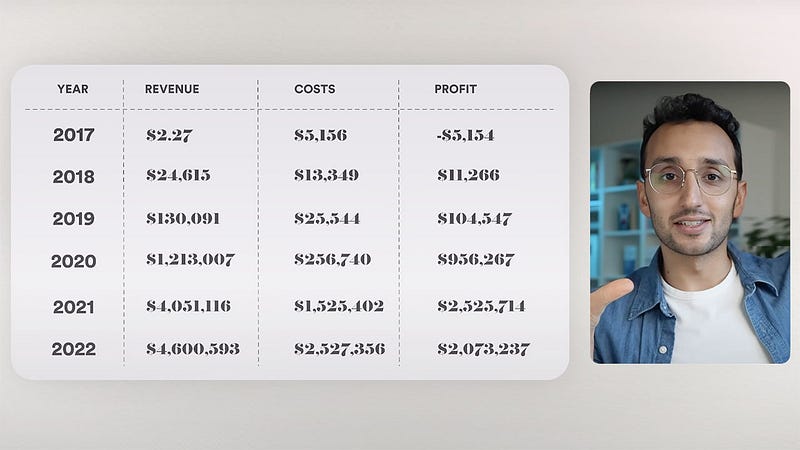
2 years ago, I wrote about how Ali Abdaal went from being a 27-year-old junior Doctor to making over $1M through 5 different income streams. At the end of 2021, he uploaded a new video I also covered, where he explains how he made $4.5M through 15 income streams. In 2022, his already impressive numbers have grown even more.
We’ll cover the 10 income streams Abdaal created to generate $4.6M in revenue in 2023, along with a few critical entrepreneurship lessons. We’ll also look at how each income channel has grown over the past 3 to 5 years for Ali’s business when data was made available.
Note: Numbers in this article may vary from Ali’s numbers back in December 2022 due to the change in exchange rate (GBP/USD). Some numbers in the video were provided in GBP, others in USD. For some income streams, the month of December was estimated or not provided due to account statement reconciliation (the fiscal year hadn’t ended yet).
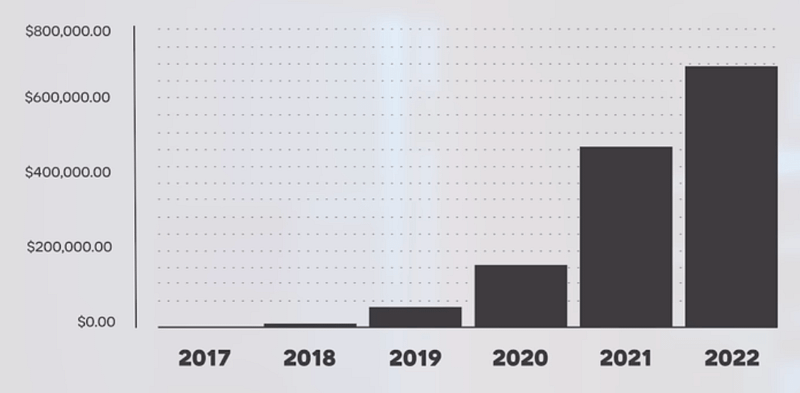
YouTube Adsense — $653,299
Ali gives us some insights into his YouTube dashboard, and it’s interesting to note that a third of his all-time YouTube earnings ($1.2M) comes from 3 videos only, and that’s across 5 years of creating content and more than 500 videos published.
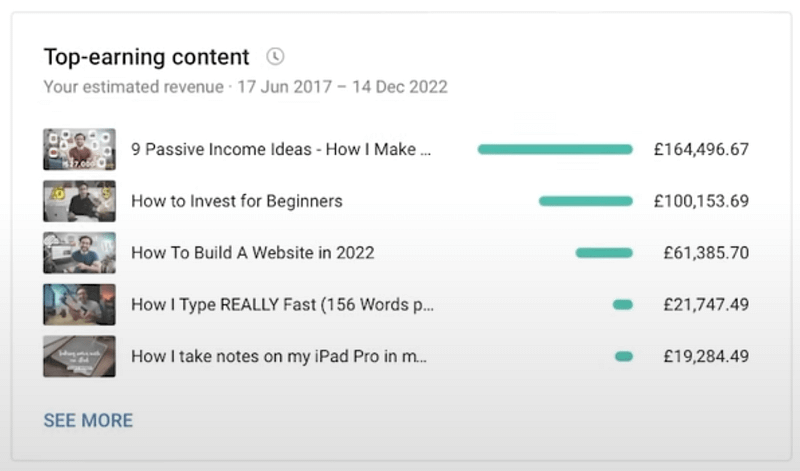
This is a great example to illustrate the power of the 80/20 rule:
“The 80–20 rule, also known as the Pareto Principle, is a familiar saying that asserts that 80% of outcomes (or outputs) result from 20% of all causes (or inputs) for any given event. In business, a goal of the 80–20 rule is to identify inputs that are potentially the most productive and make them the priority. For instance, once managers identify factors that are critical to their company’s success, they should give those factors the most focus.” — Investopedia
Speaking about identifying “success factors”, Ali noticed that his videos making the most money often tend to revolve around the topic of… finance. The CPM for this niche (the amount of money he gets paid per 1,000 views) is much higher, and he calculated that if he focused only on finance-related content, he could get the same amount of money for 10 times fewer videos, or 10 times less work.
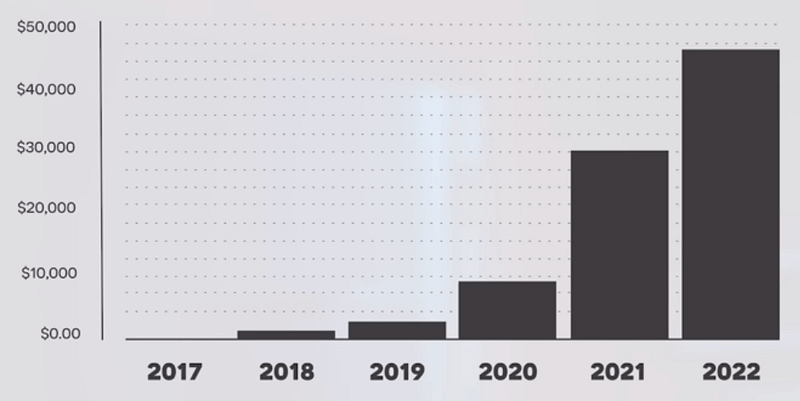
Amazon associates — $44,163
Amazon Associates is the largest affiliate program in the world, allowing content creators to earn money on every sale they generate on the platform. The beauty of it is that you don’t need a huge audience to make money there, you just need an audience that’s engaged. If people trust you and your content and can relate to the stories you have to tell, they’ll most likely be willing to try the products you recommend and/or review for them.
For this reason, Ali advises content creators to sign up for Amazon associates as soon as they start creating content. In the beginning, you’ll only make a few dollars, if not a few cents. But as your audience grows and/or becomes more engaged, you’ll reap more profits from recommending products. Ali has doubled his earnings from the program every year since 2019.
To illustrate the power of an engaged audience versus a large one, Ali mentions a video he did about his skincare routine, which didn’t perform particularly well on his YouTube channel. However, he included the links to the products he reviews in the video description, and ended up making thousands of dollars in commissions, thanks to the authenticity of his content (those are products he actually uses on a daily basis).
Always remember you don’t need 1 million fans, you need 1,000 engaged ones.
Affiliate income — $235,665
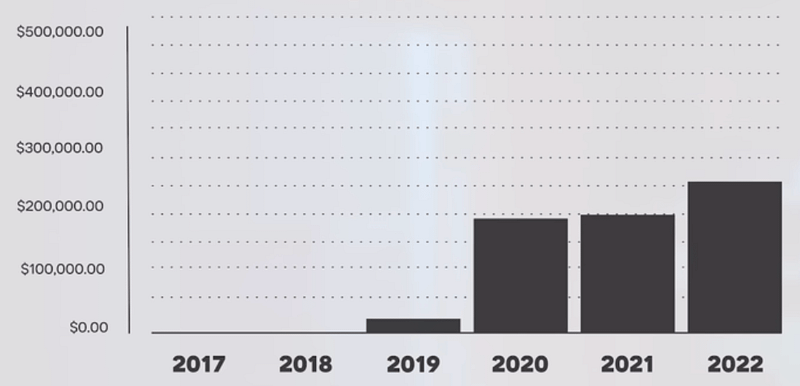
Affiliate income is an alternative version of referral programs like Amazon, because they’re usually deals you negotiate on your own, so they’re more lucrative. Typically, a content creator will get a custom referral link from a company, and they’ll agree on what percentage of the sales he/she will be allowed to keep.
Ali has deals with around 10 different companies in many different niches:
- Epidemic Sound — A royalty-free soundtrack company Ali uses for his videos
- Ghost — A suite of tools to build a website, publish content, send newsletters & offer paid subscriptions to members
- Paperlike screen protector — An iPad screen protector
- IQunix Keyboard — A premium mechanical keyboard with great typing quality
Like Amazon associates, this type of partnership doesn’t require a big audience, but an engaged one.
Sponsorships — $598,744
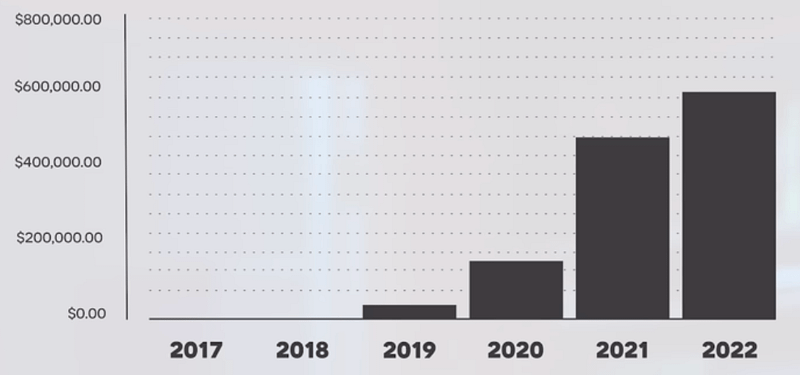
Sponsorships are a huge source of income for many Youtubers, because they pay a lot of money due to their format. Instead of having a YouTube ad before the video, content creators will create and embed an ad themselves into the video, often tying it to the topic they’re dealing with. This brings a lot more value to the advertising brand and usually converts really well. CPM will vary here, but Ali mentions $15 as an average base rate. He also emphasizes that the more you do those deals with your videos, the more you can get an idea of how much your channel is worth.
Podcast — $153,461
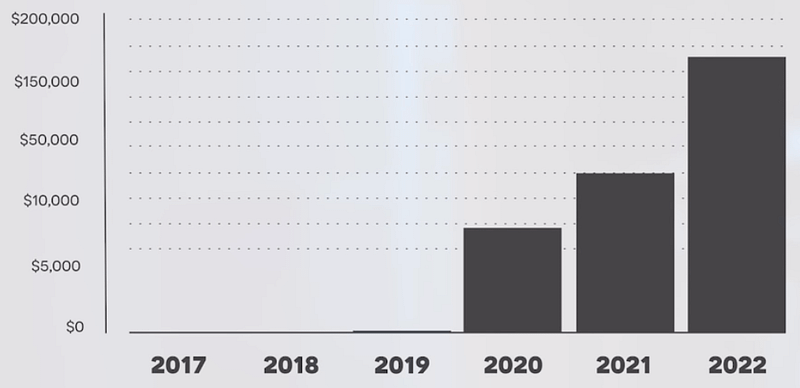
Ali runs 2 podcasts
- Not overthinking — A fun, sporadic side project with his brother
- Deep Dive with Ali Abdaal — A full-fledged podcast with regular guests and a production team
It’s interesting to note that the Deep Dive podcast made $29,258 in 2021 but was essentially losing money due to staff and production costs. Ali said back then that he kept doing it because it was incredibly fun to interview like-minded people in the field of entrepreneurship and content creation, and it paid off. In 2022, the podcast is profitable thanks to brand deals, and it’s even in the top 1% of podcasts according to Spotify. More on this later.
Email newsletter — $97,739
Ali has been running his newsletter for a while but only started monetizing it in 2022 after reaching over 200,000 subscribers. Again, for this kind of medium it doesn’t matter how big your audience is, it’s more about the engagement. In other words, a 10% conversion from 1 email to 1,000 people (100 sales) is better than a 5% conversion rate from 10,000 people (50 sales). If people care about what you have to say, you have a valuable brand.
Ali doesn’t get into the details of how much he charges to be featured in the sponsor section of his newsletter, but he discloses that this part of the business alone generated $97,739 in 2022.
Instagram and Tiktok — $37,061
This is a rather minor income stream for Ali because he doesn’t focus his energy on those platforms. He still managed to make an impressive amount of money considering he estimates he only did “1 or 2 sponsored posts in 2022”. He also explains that those deals were “upsells” from existing sponsors from the newsletter and/or YouTube channel, which is a great way to branch out the business.
Merch — $63,603
“This project was fun but not particularly profitable because the margins on physicial products are annoyingly low. We kept on getting comments saying “Oh my god I can’t believe you’re charging $25 for a notebook.” […] It costs us $15 to print the notebook because of the small quantities we’re dealing with.”
Ali and his team released 2 physical products in 2022:
- Part-time productivity planner
- Todo list/most important tasks notepad
However, for the reasons mentioned above, they won’t be releasing any more physical products in the near future.
Digital products — $462
Ali mentions the example of Grace Beverly, one of the first online fitness influencers. She started off selling fitness and nutrition plan PDFs for $30 to $40, and according to Ali sold more than 300,000 of them. That’s $10M in profit from selling a bunch of PDFs she only had to work on once. This is the power of digital products.
I myself have created a 75-interview guide on the topics of productivity and entrepreneurship. It took me hours and hours of work to put together, but now it’s out there, and I make money from it without having to work on it ever again. Every month, a few people buy it, and that’s 100% passive income.
In the same spirit, Ali started selling a Ghost website template in 2022, and made $462 from it.
Online courses — $2,716,395
Ali presents the last 3 income streams in 3 separate categories, but I thought of including them in one overarching group, since they’re all about the same thing: online education.
Skillshare — $778,131
Skillshare is the Netflix of courses. As a viewer, you pay a fixed membership per month and get access to all the content on the platform. As a creator, you get paid a small royalty for every minute your audience watches your course(s).
Since 2020, Ali and his company have made an absurd $2,000,000 in royalties, for a yearly average of $695,510. One course in particular took him 1 day to shoot, 2 days of freelance work to edit, and still brings in thousands of dollars every month, completely passively. Too good to be true? Ali thought the same.
Self-hosted courses — $179,026
“A couple years ago I realized this Skillshare thing was probably too good to be true, and that this was not going to be sustainable. I thought: ‘There is no way in hell Skillshare can continue to sustain paying us stupid amounts of money every month for us to host our courses on there.’”
Sure enough, a few months into 2023, Skillshare announced major changes to their monetization program, and that immediately took a 50% hit to Ali’s revenue on Skillshare.
The upside with platforms like Skillshare is that they can give you more exposure than you might get when you’re on your own website. Their recommendation algorithms are designed to show your content to exactly the type of people who would be interested in it, which is good for audience growth and watch time increase.
The downside of those platforms is that they make the rules, and rules can change overnight. If Skillshare or Youtube decided to stop paying its creators tomorrow, no one could do anything about it, and a lot of content creators would be left with a big hole in their yearly budget.
Owning at least some of your courses on a platform you create yourself (usually a website) is a great way to make sure you’ll always have a backup if other income channels diminish or disappear.
Ali has 2 self-published courses which generated $179,026 in sales in 2022:
- Creatorpreneur — A 3-module course for $800
- Camera Confidence — A lighter format for $149
Cohort courses — $1,759,238
This is the biggest revenue driver for Ali’s business, but also the most time and resource-consuming. This is what Ali had to say about making over $2M with his cohort courses in 2021:
“This is absoutely absurd. I think, it was the middle of the pandemic, people were flocking to online education, we had so many students take our course […] it just absolutely exploded beyond our wildest dreams.”
But then, they made 2 mistakes:
- They kept increasing the price. Since the course kept selling out, they figured “Why not make more from it?” They added more content and the cheapest course package now costs $2,000. That’s losing a huge portion of your audience that can’t afford to spend $2,000 on a course.
- Bad sales and marketing. In 2022, Ali focused less on “plugging” the course in his YouTube videos because he wanted to focus on a book he was working on. The conversion rate of the course sign-up page stayed the same, but fewer people came to the website, so revenue dropped.
Ali also mentions that 2022 is the year the world came back to life following the pandemic, so people started spending less on online education. All and all, he thinks that the investment in time and resources is huge for a cohort-based course (his numbers don’t include expenses):
“If we didn’t need to make money, I probably wouldn’t run any paid courses”
Now that we’ve covered all of Ali’s income streams for a total of $4,600,593 let’s look at the lessons we can learn from his success.
Allow projects to lose money first
“Gotta spend money to make money” is a well-known saying in the entrepreneurship world, but it has its limits. Ali lost money on its podcast the first year, just to see it become one of the best-performing podcasts on Spotify the year after.
It’s good to reinvest profits into growth and scale your company, but it’s also important to identify losing bets and cut losses when necessary. In Silicon Valley, many companies take years to become profitable, and 99% of them die before they ever do. For smaller businesses, the margin for error is usually tighter, so it all comes down to budgeting and risk management.
In 2021, Ali’s podcast made $29,258 and cost even more to produce. But even if we assume it cost him twice what it brought in, we’re “only” looking at a loss of -$30,000, which given the scale of his business is a reasonable risk to take.
Don’t scale too fast
Along with his 2022 income recap video, Ali published a video titled “How I failed in 2022”, where he lays out a few of the mistakes he made while wanting to scale too fast. As we saw earlier, although his business made more money in gross profit than the previous year, his net was lower, because he spent more on staff, production costs, and various expenses. Yet the result was not what he expected.
Here are the top failures he mentions in this video:
- Substantially missing revenue target: Ali and his business manager set up a target of £5M ($6.2M) in revenue, and missed it by a lot (they made $4.5M). Because they assumed growth was going to continue at the same rate, they raised expenses but income didn’t follow.
- Starting and scrapping many projects: “It’s really hard to be good at multiple things, let alone one thing,” says Ali. That’s why he hesitated and wasted a lot of resources on projects that never actually saw the light of day.
- Lack of vision: “Not recognizing the importance of me having my own vision for the business and hoping my team members would show me what to do next”. As a business owner, you can’t lack vision, because you’re the face of the company, the person people put their hopes in. The very reason you created a company is because you had a vision, and you should never lose sight of it.
- Not enough thinking: Ali mentions a tip from the book Traction by Gino Wickman. “One of the 5 hallmarks of being a good leader is having at least 1 hour every single week where you have a piece of paper and just think about business.” I run a small one-person company and spend a lot more time thinking each week, and I think 1 hour per week to think is nowhere near enough. I would recommend at least 30 minutes per day.
- Failure in delegation: It’s really hard to delegate when you’re the business owner, because you put your blood sweat and tears into your company. But realistically, there will come a point where the business will be too big for you to handle everything. That’s a good thing, and you should embrace it. If you find the right people to do jobs that will save you time, you’ll create a positive synergy around your business that will make you more productive by doing less.
Manage your time right
Even though Ali substantially grew his team in 2023, they filmed half as many videos as the year before, which is crazy, especially considering 3 videos accounted for 10% of his 2022 revenue (clear growth driver). Ali blames this on his poor time management skills, juggling too many projects at the same time, and micromanaging. He also points out that although he has a huge project in the form of a book deal, he’s made the least time for it in the past year.
All these problems are correlated and take their source in one overarching issue: time management. It’s hard to manage your time right as a business owner, which is especially ironic when your business is focused on productivity and time management content (Ali says it himself).
Conclusion
Building a business is hard, growing it consistently is even harder. Targets are great, but what’s most important is to identify what drives business the most and focus on key areas, the rest will usually follow.
There’s no point in setting a goal to make $10M within X amount of time if you have no idea how to get there. It’s much better to have a strong idea to make $100,000 and slowly scale it from there, and that’s done through vision.
Vision is what enables you to think ahead, see opportunities others may not, and most importantly scale in a way only you know how to do (that’s especially true in the content creation industry).
Thanks a lot for reading, and enjoy the journey you’re on.
I interviewed 50 productivity/business experts and made a 150+ page guide out of the project. This is road-tested advice from real people who get things done. Get it for free here.