
Life
This Diwali I Long to Go Home
But where’s home?
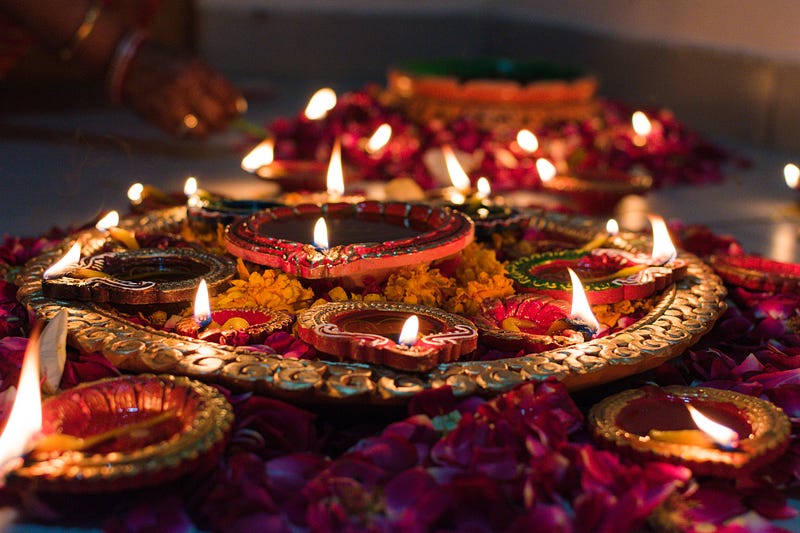
Growing up in India, October and early November was my most favorite time of the year. Not just because it was my birthday (well that was a reason too), but it was the festive season. All year long, I would desperately and eagerly wait for this magical time to come, year after year.
I was that child who noticed the change of seasons very minutely. October brought an end to the almost four-month-long monsoon season. The rains would finally stop and the skies would clear up. You could see clouds floating on the backdrop of a clear blue sky. I likened them to soft cotton balls floating in the sky.
This was the time when all the festivals would happen. Some of you might know about India and the great diversity in Indian cultures, regions, languages, religions, food, and festivals. As a Bengali, we would start our festivities with Durga Puja and end with Diwali — a month-long celebration.
We follow a lunar calendar and would start with our celebrations on the first day of the new moon in the autumn as the beginning of Durga Puja (or Navratri in other regions of India). It’s the celebration of good over evil.
The new moon would gradually change to a full moon and the full moon would then change to the next new moon — this is when we celebrate Diwali — the symbolic victory of light over darkness.
Preparing for the oncoming celebrations was the best. We would start with cleaning the house first, making sure every nook and cranny was thoroughly scrubbed and shining, even the places like behind the cupboard, under the bed, behind the sofa, or the dark corners of the loft.
I could feel the season of festivity with all five senses. While coming back from school, I would look up at the sky and imagine what each of the cloud formations might mean. Such a simple thing could take my breath away.
This was also the time of Kans grass, which we so lovingly call in Bengali — “Kaash phool”. Nature was resplendent in its abundance.
I would hear the drums playing already. The drummers used to come from far-flung villages. Playing drums during the festival time was their only (in most cases) source of income.
The sweet fragrance of the Shiuli (Night Jasmine) floating in the air would make my heart beat with unexplained longing and joy.
At home, my mother, along with my grandmother and my aunts, would start preparing sweets for the festive season. We would exchange these sweets as gifts with friends, family, and neighbors for the next month until Diwali.
The house would smell of milk boiling for hours on low heat, coconuts being desiccated, making butter and ghee, or extracting juice from a ripe palm (yes, we made palm fritters as well) and using them to make all those sweets.
I would lend a hand in shaping the sweets too, even though I would break some of them. It was hard work and many hands made it easier and more fun. The touch of the raw coconut, the palm, and the oil in your hand, while you are shaping the sweets, felt weirdly comforting and familiar. Perhaps because I was aware of the tradition for so long and felt good to be a part of it.
I didn’t quite have a sweet tooth though. I would rather wait for a savory, we call it Nimki — simple, crispy, crunchy snacks made with wheat/flour and cumin seeds, that would stay good for over a month if you kept them in sealed jars. I would impatiently wait for those crunchies to be deep-fried and ready to be eaten so that I could taste a handful.
The schools would close for a month and we as children would get to enjoy a month-long vacation, full of fun and frolic, without any rules. That was great!
The streets would be filled with decorations and lights. This is the time when all stores came up with amazing discounts and offers because people are buying gifts for each other. You could feel a sense of busyness but in a good way. There would be hawkers on some streets trying to sell their goodies before the festive season comes to an end.
The artists and craftsmen who created the idols in Kumortuli — the place where all the idols are still being made and exported worldwide — would be busy applying the finishing touches.
Every year, pandals — a temporary abode for the idols — would be painstakingly built out of cloth and tents. Food stalls would be built on the sides of the streets or on big grounds. Traffic would come to a halt.
Growing up, we didn’t have much. We actually had less when it comes to material possessions.
We didn’t have a telephone. I am not talking about smartphones or cell phones. We didn’t even have a house phone. There was a seven-year (yes you read that correct) long wait for a phone application for us to get the phone connection. Hah!
We didn’t have a television. How did we spend time back then?
And this was the only occasion in a year (along with a couple more) that we could afford new clothes. How did we survive the whole year without buying new clothes randomly? Didn’t we outgrow our clothes in every season?
Perhaps because we had so little, we appreciated these small things. A new dress for the festival was a cherished possession.
As a child, I was a bookworm (I still am). But I didn’t have access to that many books, we didn’t even have a good library nearby. This was the only time in the year when I was allowed to buy a few books.
Special edition books and magazines would be published this time of the year and I would wait year long to smell, touch, or hold these books finally in my little hands.
I was an introvert and didn’t quite enjoy pandal hopping which most people, including my entire family, loved to do. I would rather stay at home alone and go on a journey in my imaginary world with my favorite detective Feluda and his buddies solving a new mystery, written by my very favorite author Satyajit Ray.
Or perhaps I would be in Plaza Mayor in Madrid, or being mesmerized at the view of Mount Teide from Puerto de la Cruz in Tenerife, or sitting on someone’s balcony in Finland, soaking in the sunshine and watching the world go by — all in my wonderland.
Today I am everywhere, but I am not at home. I have been living the life of an expat in many countries for the last 15 years or so. But I have not been home for the festivals since 2006.
Honestly, I don’t know where my home is anymore. The world has become more global. All those familiar faces are gone, they have settled somewhere else. And if I were to return to that home, in reality, I don’t even know what my homecoming would be like. Writer Nick Cordovano writes aptly about his feeling in this article — The Feeling of Home.
The house where I grew up, where every Diwali, I would wake up to the sound of the firecrackers (they would start early in the morning), where we lit candles everywhere, even on the terrace, so that there is no dark corner, is today empty and dark.
I have a house now in the Netherlands, which I really love, and I am grateful for the sunshine in my garden (amidst the copious amounts of rain), for my amazing neighbors who give me timely advice on how to protect the wood of the fence, for the olive tree that I bought a couple of years ago from the local farmers market and is now fruiting, or for the uneven tiles in my backyard that I keep thinking of getting leveled.
But why doesn’t it still feel like home? Why do I keep reminiscing about all those little things that I didn’t give much value to then? Living abroad as an expat can seem like living in a bubble. I feel sad that my daughter is not growing up cherishing all these rituals and traditions along with close family.
I tried to bring back the tradition (only a part of it), by starting with fall cleaning, preparing my house for the festive season, and decorating with lights and candles at every corner and windowsill. Our yard takes on a fairy tale look as if Christmas came a bit early.
My Dutch neighbors know by now that Diwali is soon approaching. I take time to select, prepare and wrap some small gifts for them. I don’t forget to include a candle, because Diwali is the festival of lights after all and I want every home to be lit up.
Yesterday I made kheer. My daughter came home from school to the smell of boiling milk on low heat for a long time, and breathed deeply, with satisfaction and a big grin on her face, just like I used to as a child. That made me smile. That made me happy.
I wanted to travel the world and I have. But now I long to go home, which perhaps exists only in my memory. I don’t know where my home is, but I am trying to create one, right here with the people whom I love the most.
I invite you to join Medium by clicking my referral link. Join Medium to Become A Member