
This Article Will Feel Left Out If You Don’t Read It
What is anthropomorphism or object personification?
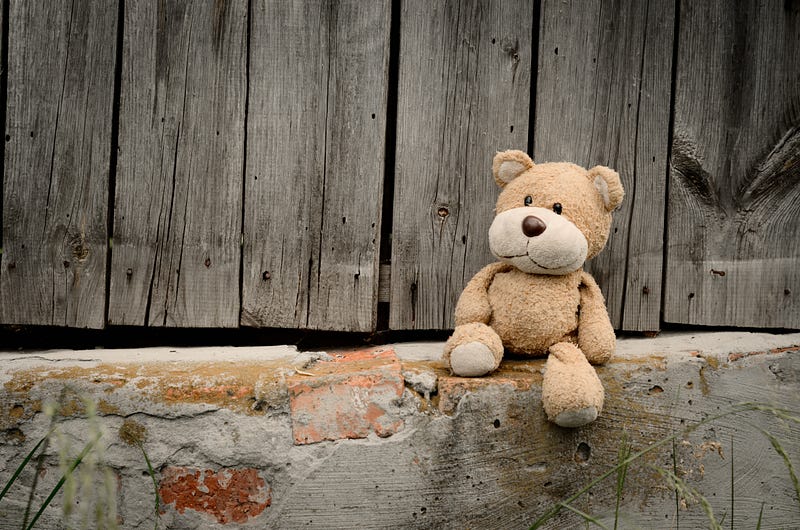
After reading Sara Larca’s short story and discussing in the comment section about Polly Pocket, I wrote a poem accompanied by a short life story about Polly Pocket. Before publishing it though, I thought I should explain first some things about anthropomorphism, also known as object personification.
Contents − What is anthropomorphism? − Why does it occur? − How is it used? − Anthropomorphism in adults − Conclusion
What is anthropomorphism?
The word “anthropomorphism” is derived from two Greek words: άνθρωπος (anthropos = human) + μορφή (morphi = shape, form). So, the word denotes something that takes on the qualities of a human.
Object personification is another word used to describe anthropomorphism, however it’s mostly used when discussing electronics and artificial intelligence. In Psychology, you’ll encounter “anthropomorphism” more frequently as a term of choice. In most cases though, the terms are used interchangeably.
Why does it occur?
Perhaps you too had thought at some point in your life that your toys had feelings. I did. I used to look after them, make sure that they’re not cold at night, or scared when the weather was bad. I also did that for other objects I was emotionally attached to, like books.
According to research, people attribute human qualities to inanimate objects as a result of their self-expression. Anthropomorphism helps us express ourselves on three main levels:
- Individual self-expression: Who we really are.
- Relational self-expression: How we form relationships with others.
- Collective self-expression: How we understand our place in the world.
Moreover, object personification helps us make sense of the world, find comfort, company, and security. It also gives us a sense of control and power.
Most children will go through a phase of believing their toys are alive or have feelings. When anthropomorphism carries on to adulthood, it usually denotes higher levels of anxiety, introversion, and social avoidance. People who are highly sensitive and have heightened empathy, are also more prone to anthropomorphism.
How is it used?
Psychology research is often used to help brands get through to us. Since anthropomorphism began being studied as a social phenomenon and not as a pathology, corporations started using it to their advantage.
The way a brand is promoted can create connections in our brains, depending on the target audience. For example, if a brand wants to appeal more to children, they will use toys or animals that appear to be talking or doing human-like things. Car advertisements show the car in such a way that makes you unconsciously feel that the car is alive and has your best interests in mind. You don’t notice it when it happens, but the trigger to think of it that way is there. Food in advertisements is often presented and described (with words or sounds) in such a way that evokes in us emotions another human would.
Anthropomorphism is also used to help teach children useful things, such as toilet training (e.g. using a teddy bear to demonstrate) or appropriate social interactions. Animal welfare services also use it to help raise awareness about the animals.
Anthropomorphism in adults
Earlier I said that I still think of inanimate objects as if they have feelings. I don’t do it for all objects though, just for the ones I am deeply emotionally connected with. I know that they are inanimate objects, but they helped me go through very difficult times.
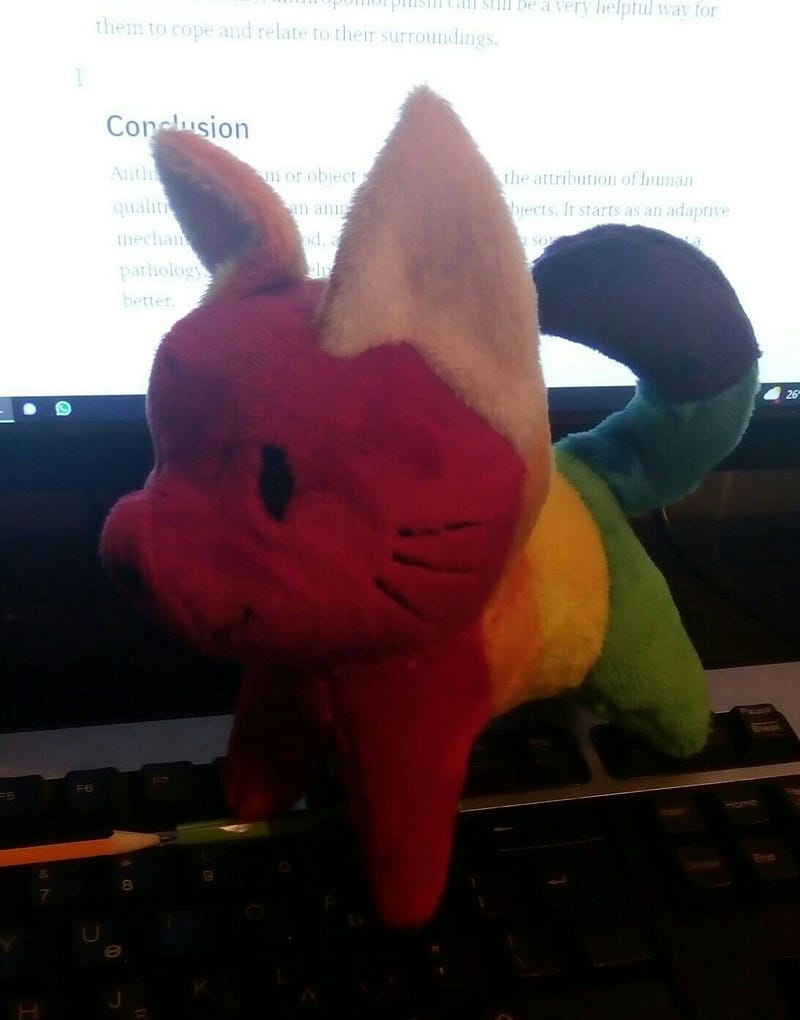
Going back to the three ways of self-expression, in my case object personification has helped me both as a child and as an adult to cope with anxiety, fear, sadness, heightened empathy and high emotional sensitivity. Rigatoni, a cat plushie in the rainbow flag colors, that was gifted to me by an ex-girlfriend, helps me with my collective self-expression as a queer person.
Many of us have such relationships with objects, and taking the time to understand what they mean for us can help us improve our three domains of self-expression. Even for those who can’t understand that the objects don’t really have feelings (e.g. in some cases of developmental and or/mental health conditions), anthropomorphism can still be a very helpful way for them to cope and relate to their surroundings.
Conclusion
Anthropomorphism or object personification is the attribution of human qualities to non-human animals and inanimate objects. It starts as an adaptive mechanism in childhood, and it is more frequent in some people. It is not a pathology, and it can help us understand ourselves and our relationships better.
So, what about you?
Do you experience anthropomorphism? Do you have any objects you can’t let go of, because you feel like you would hurt them?