This 19th Century Girls’ Novel Series Made Me Want To Throw Up
I’m not even going to lie, it triggered me on so many levels
Author’s Warning:
I’ll preface my article with this: I grew up cult-adjacent. I grew up in a childhood where playing with weapons, literally dueling with swords, and blowtorches was normal.
During that time in my life and a little later, I saw a lot of questionable content as part of both my upbringing and my rebellion from it. This week, I found a reason to praise my deities that I somehow did not read something.
Like, do you know how bad something has to be for me to actively thank multiple gods that I didn’t read it as a kid? So, for those who suffer from CPTSD as I do, I’m giving a HARD trigger warning for CSA, CA, suicide, extreme racism, spiritual abuse, and domestic violence.
Did you ever have a moment where you looked at books written in the past, only to be revolted by them? Or maybe you’re like me, and you were a huge fan of Ambrose Bierce’s The Devil’s Dictionary.
As a person who loves both history and literature, my interests often intersect. I want to see what pop culture was like back then. That’s why I love 19th-century cookbooks or the humor piece English As She Is Spoke.
Recently, I watched a book review influencer video (SavvyWritesBooks) that made me uncover a really, really unsettling and horrifying series that was once a major bestseller.
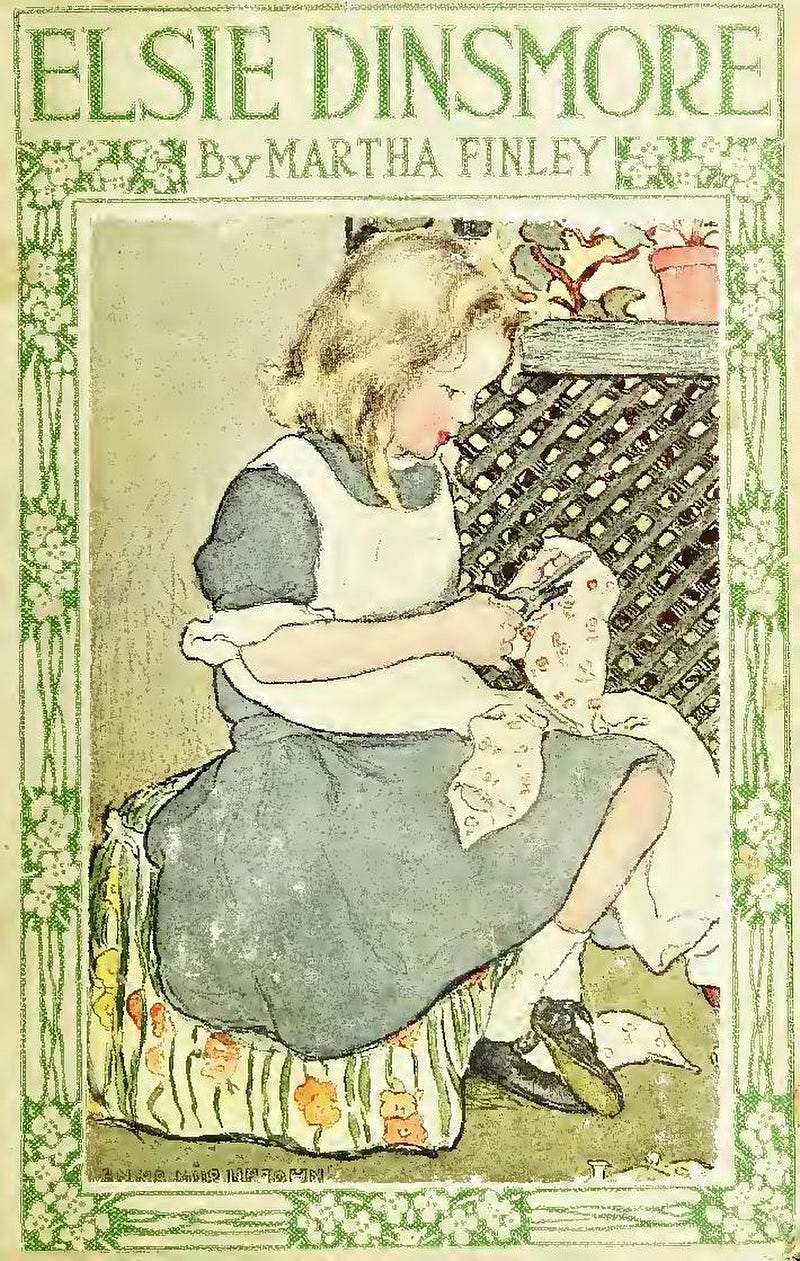
Before there was Nancy Drew or American Girl Books, there was the Elsie Dinsmore series.
Written by Martha Finley from 1867 to 1905, the Elsie Dinsmore series was once the top standard for young girls’ literature. It was a major bestseller that launched a book series with dozens of entries and spinoffs.
From what I’ve read, it is still a major hit among certain American Christian Fundamentalist sects. In fact, Elsie Dinsmore even had a doll line launched in the 90s. Her vintage paper dolls are also still sold today as reprints.
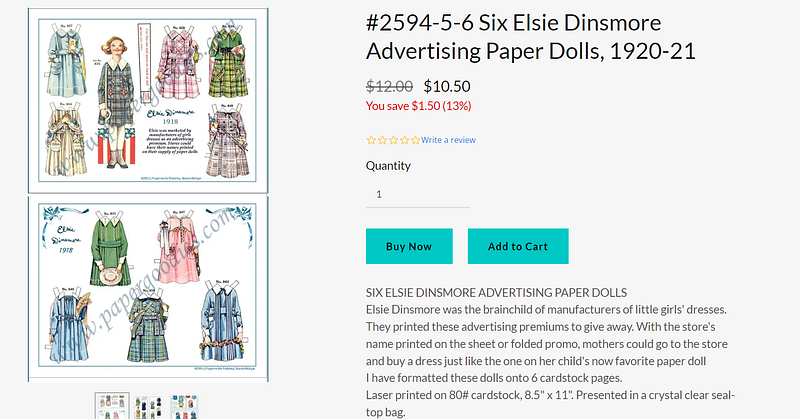
Elsie, it seems, is like herpes. She’s gross and she doesn’t ever go away.
You might wonder what Elsie Dinsmore’s books did that is so revolting.
Well, the concept of the book is really, really fucked up. I’ll section things off as needed.
Idealized Child Abuse
Elsie Dinsmore starts off as an eight-year-old girl who was abused by her step-grandmother. Her real mother died in childbirth, and her father Horace didn’t want to care for her when she was young.
Eventually, things come to a head, adding to the tragedy. Then, she is given to the charge of her non-Christian, barely-there father who also beats her.
Her father, Horace, hates that she’s pious and forces her to do “sinful” things like playing the piano or listening to music. When she says no, he locks her in a closet, whips her, and sends her to a Catholic school as punishment.
Catholicism, for some reason, is not “Christian enough” for the writer. So, the traditions are depicted as evil things — as inaccurately as possible. It apparently gets so bad, she has nightmares of demonic nuns.
Horace abuses her and isolates her to the point that she has a nervous breakdown, though that scene was edited out later. Oh, and he shaves her head at one point, because why not?
Despite this, Elsie worships her father and obeys him. She begs Horace to read the bible with her repeatedly. Eventually, Horace becomes Christian. They embrace and kiss on the lips.
Read that last paragraph again. That’s not a mistake. Horace, her father, and Elsie, an eight-year-old, basically make out.
Grooming
Oh, you thought what happened with her dad was bad? It was, but it’s so much worse. Horace has a friend by the name of Edward Travilla. Edward, at one point, bemoans that the eight-year-old wasn’t 10 years older.
Edward even tells Elsie that since she was seven years old, there was no other woman for him than her. Horace, for the record, was 16 when he had Elsie.
Actually, it wouldn’t be too far-fetched to say that Elsie was described in oddly sexual terms throughout the series. In fact, I’m going to leave this quote here:
“There are a number of passages that describe Elsie’s father kissing his grown, about-to-be married daughter, “fully and passionately, deep kisses on her ruby lips.” — Vision Distorting Blogpost
Later on, he proposes to her and they marry. They have eight kids, including one named after Horace.
Spiritual Abuse
Elsie is the most unrealistic child I have ever seen. Her entire personality is about Jesus. She doesn’t want to make music, she wants Jesus. She doesn’t want to look bad, so she cries about not being pious enough.
Truth be told, if I was a teacher who saw a kid who was so obsessed with religion like Elsie was, I’d call CPS immediately. Children, even well-behaved ones, do not cry about not loving Jesus enough without other signs of spiritual abuse.
Like, this kid Elsie was obsessed, and even fretted about not obeying her parents fast enough to please God. It wasn’t just obeying — it was borderline indentured servitude and brainwashing.
Everything Elsie does is about the bible, Jesus, or obeying her parents. She was forced to worship something she didn’t want to worship in Catholic School, but she also clearly had it drummed into her head that she had to keep sweet.
Saying she’s spiritually abused doesn’t do it justice. The abuse basically gave her two emotions: crying and robotically carrying out chores like a medicated zombie.
Racism Run Amok
Author’s Note: This is what broke me as a former house slave.
Elsie’s family lived on a plantation with about 200 slaves, including a woman who was her “mammy” by the name of Aunt Chloe. All the slaves talk in a backward, childlike way.
In one scene, both Elsie and her father explain to a slavemaster that slaves are naturally lazy due to their skin color. They then go on to suggest beatings as a result of the “natural laziness of the Negro.”
But what about Elsie’s loving Mammy, Chloe? Surely, that opened her eyes to the injustice going on, right? Maybe little Elsie will do the right thing and hand her some money from her allowance.
Nope. Fuck that, I guess.
Elsie does not need to give Chloe or her friends money. After all, they are “happy as they are” on the plantation. (As someone who experienced slavery, this is horrific. I don’t even want to begin explaining what’s wrong with this.)
When the slaves are freed, most of them stay on the plantation because they love pious Elsie so much. Those who leave are seen as “lost souls” while those who stay are seen as “saved.” The book even promises them they’ll turn white in Heaven.
Elsie and her guyfriend also avoid the KKK, but not for the reason you think. They just don't like how violent the KKK is. The politics? Not a problem for them. It was the violence.
This shit alone makes me hate Elsie as a human being. What a racist, entitled little turd of a human.
“Tell No Tales”
Abuse on this level of magnitude cannot happen without children staying silent about it — and that’s exactly what Elsie did. In fact, the books encouraged children to be like Elsie.
Oh, and they pointed out that Elsie didn’t complain and that she was one to “tell no tales.” In other words, Elsie was a character who saw the abuse that happened to her as a good thing and stayed silent.
If you look at it through a Victorian lens, then Elsie Dinsmore reveals a horrific past for women
Let’s say that you see things as a Victorian person. Back then, kissing on the lips might have been a very normal thing for parents to do with their kids — I don’t really know. I wasn’t alive back then.
Let’s say that you deal with the slavery aspect, which was so normalized, it was alarming. Let’s say you ignore the fact that Elsie was married off to someone roughly twice her age.
Are we going to ignore the fact that Elsie doesn’t change her stance on slavery? Are we going to ignore that her mother died in childbirth and passed the baby to Chloe, who was never given freedom or money?
Are we going to ignore how much these books glorify abuse and being “meek” as if it’s a good thing? Or how her fucking future husband was in already love with her when she was 7 and he was 23?
I’m not even going to touch the fact that she gave birth eight times. For me, that’s pure body horror several times over. But, maybe for some women, that’s heaven. I know a girl who wants to have nine kids or so. If that’s what you want, I can’t judge.
Elsie was considered to be the ideal female child — weeping, constantly worshipping, easily groomed, and prepped for abuse and slave-like conditions. That’s fucking sick.
And yet, so many of us forget that’s exactly what women endured during the 19th century. That was what was expected of them — to be chattel and unpaid slaves to be married off with a gift to an eligible bachelor.
If anything, these books should be a grim reminder of what horrors our society overcame — horrors that were once normal. But as for kids’ reading? Abso-fucking-lutely not.