Thirty-Six Years Ago, Our Country Overthrew A Dictator
Now, it feels like everyone seems to have forgotten.
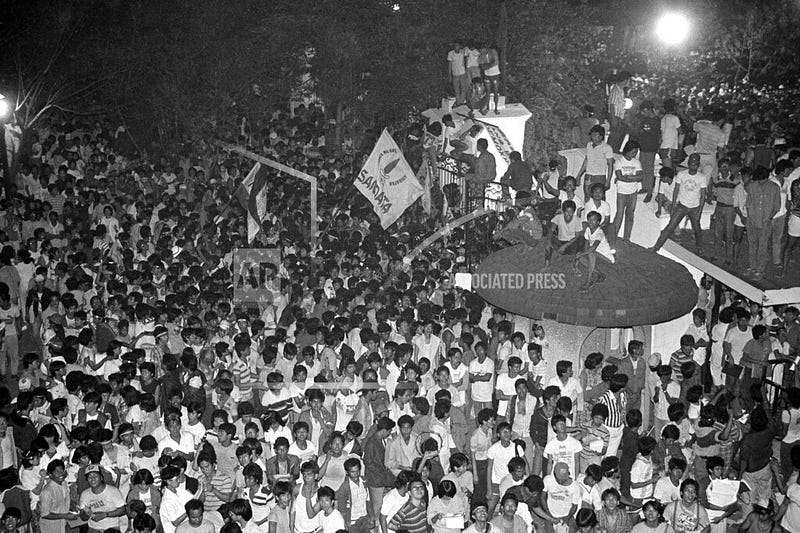
On a regular day, Epifanio Delos Santos Avenue (EDSA) is just another street commuters curse for its god-awful traffic but from the 22nd of February until the 25th, it is a symbol and a reminder of a brilliant and shining moment for Filipinos. It is a physical marker of over two million people who took to the streets and faced armored tanks to topple the dictator Ferdinand Marcos, Sr.’s bloody and tyrannical rule that spanned over two decades. And this year, we mark 36 years since the miracle of the bloodless revolution that was EDSA.
A lot can be said about the state of the Philippines post-EDSA — unrest, numerous uprisings, and the failure to ultimately destroy an inherent oligarchy. Several, if not hundreds, of revisionists, would probably read as far as this paragraph and immediately claim that what we all call the People Power Revolution had been no more than the replacement of the Marcoses with the Aquinos, which is highly irresponsible and if not, a myopic view of our country’s history.
Filipinos are often described as inherently kind and forgiving people. As Singapore’s Founding Father Lee Kuan Yew once wrote in his book From Third World to First,
“The difference lies in the culture of the Filipino people. It is a soft, forgiving culture. Only in the Philippines could a leader like Ferdinand Marcos, who pillaged his country for over 20 years, still be considered for a national burial. Insignificant amounts of the loot have been recovered, yet his wife and children were allowed to return and engage in politics.”
The People Power Revolution was more than a war between two political families, as some critics would shortsightedly put. It was the product of a culmination of two decades of autocratic rule, electoral fraud, and the countless murders and disappearances of people who dared to speak out of turn. It is proof that the power that the people give, they can also take away. More importantly, it is further evidence that what they call our people’s “forgiving natures” and “resilience” will never serve as an excuse for a government’s incompetence.
When one looks at photos from those four fateful days in 1986, one cannot help but feel a spark and a longing to see a country united. We see scenes of soldiers laying down their arms and hugging civilians, children offering uniformed personnel flowers, and strangers linking arms in front of tanks. This is the spirit of EDSA, a portrait of peace and unity.
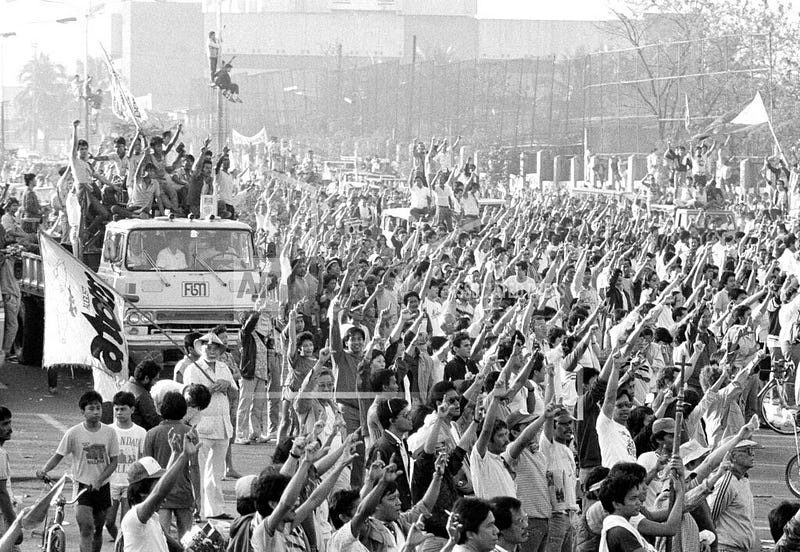
How easy it is, albeit, irresponsible for so many of us to forget these images and that our freedom came with a price willingly paid for by students barely out of school who were brave enough to dissent in the streets, by journalists who dared to speak when no one else did, and by lawyers and judges who fought when others chose to turn a blind eye. These people — many of them unnamed and forgotten — wore no colors but simply dissented for the sake of what was right. It was through their collective efforts that the thousands of people, filled to the brim with the atrocities committed against them and in need of change, flocked to EDSA. Revisionists may again argue that I wasn’t there to face the tanks myself. True enough, however, I do my part by remembering.
Now more than ever, when the dictator’s descendants are now coming out from the shadows in hopes of restoring the power they once wielded, we all must do our part. In attempting to change history, we deny these heroes who marched in EDSA their due after facing tanks and guns with nothing but rosaries in their hands and the air in their lungs as they demanded our freedom. In trivializing the deaths during martial law to an “insignificant number,” we desecrate the memory of those who never even had the opportunity to walk to EDSA themselves.
Ultimately, this is the biggest failure of EDSA — its failure to disassemble a broken system and how just three decades later, many of us have seemingly forgotten. To put things into context, one would have to imagine Germans having forgotten the Holocaust. Unimaginable and to some extent, unforgivable. Today, I think about EDSA and its shortcomings, what it stood for, and more importantly, the nameless and faceless heroes who never had the chance to see the sunshine on the Philippines once more as a free country after 20 years. How easily have several of our countrymen forgotten the gift of EDSA and how it’d been a gift we shared with the world for it paved the way for the dismantling of the Berlin Wall and eventually, the return of democracy in countries like South Korea and Romania. It was the peaceful revolution heard around the world.
Today, I choose to remember. I hope you do too. And together, may we never forget.