
Thirteen Insights on Neurodiversity from Richard Powers’ Bewilderment
That can help you understand yourself and neurodiversity.
Finding a neurodiverse character in a movie or tv show is like looking for Waldo.
They are hard to find.
Atypical is an excellent series on Neflix that shows the family dynamics of having a teenage son on the autism spectrum, but other than this example my mind has to think hard to find a tv show or a movie with a neurodiverse character.
I’ve heard the “The Good Doctor” on ABC centers around a surgeon who has autism and savant syndrome, and “Parenthood” on NBC features a character Max Braverman, an eight-year-old with Asperger’s. There’s also a comedy “Everything’s Gonna Be Okay” on Freeform with a female character with autism, played by an actress, Kayla Cromer, who is on the spectrum.
So, maybe, I need to watch more tv. I’m not counting Rain Man since it’s the only movie people mention with an autistic character and Dustin Hoffman’s character Raymond doesn’t represent the diversity of the spectrum.
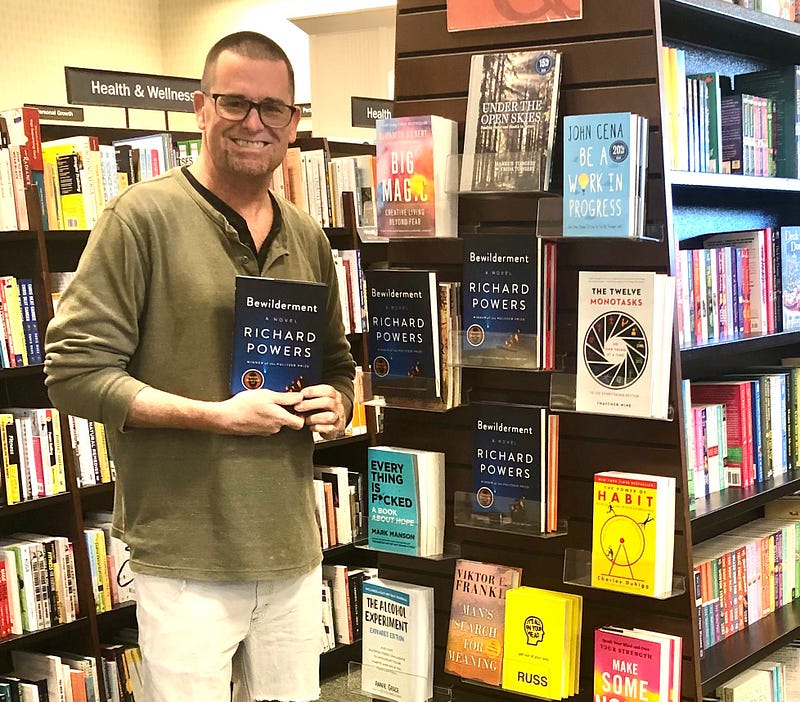
Bewilderment
Neurodiverse characters are hard to find in novels too. Thus I was excited while reading Richard Powers’ latest novel, Bewilderment, last week.
The book has two neurodiverse characters. The boy is definitely neurodiverse and, as they say, the apple doesn’t fall far from tree — and the author by the way won a Pulitzer Prize for his last novel Overstory, so I was interested to see how he would portray neurodiverse characters.
The story revolves around a nine-year-old, Robin, and his dad, Theo, who are dealing with the loss of their wife and mom. There’s also Robin’s attempt to save the dying environment, and Theo’s effort to find life on other planets.
But the main storyline is the father and son relationship, and the father trying to support his son after his mom’s death and troubles with a non-inclusive school and an incident where Robin throws a thermos at another student.
It’s Science Fiction, at least for now at least
It’s Science Fiction because of its focus on a technology (that doesn’t seem too far off in the future) called decoded neurofeedback that enables people people to feel what another person feels based on recorded brain waves.
As a self-diagnosed person on the spectrum, I found the book full of awesome insights on neurodiversity that related not only to my life, but also to my sons.
Here are thirteen insights to chew on from Bewilderment:
- It’s hard to trust the accuracy of a diagnosis.
“I never believed the diagnoses the doctors settled on my son. When a condition gets three name over as many decades, when it requires two subcategories to account for completely contradictory symptoms, when it goes from nonexistent to the country’s most commonly diagnosed disorder in the course of one generation, when two different physicians want to prescribe three different medications, there’s something wrong.”
I get why a diagnosis is beneficial. It can help you to better understand yourself if you’re neurodiverse or and it’s helpful for a parent to know how support their child. But there’s a lot of people who don’t fit neatly into a cluster of behavioral traits and a label can never fully describe an individual.
The danger of diagnostic labels is they often lead to stereotyping and thinking that a person with some kind of DSM-label can’t accomplish certain things.
2. Oddly, there’s no name for the compulsion to diagnose people.
There should be one in the DSM. I took a few marriage and family therapy classes for a counseling degree in another lifetime. I remember reading a disorder in the DSM called intermitted explosive disorder.
I told me wife she had this. We laughed. It just means she gets upset easy without warning.
3. Everyone alive on this fluky planet is somewhere on a spectrum
This is what Theo tells a physician who wants to diagnose his son on the spectrum, and there is another passage that comments on our society’s compulsive tendency to want to diagnosis every behavior that’s different:
“Has be been diagnosed with something?”
“So far the votes are two Asperger’s, one probable OCD, and one possible ADHD.”
He smiled, bitter and sympathetic. “This is why I dropped out of clinical psych.”
“Half the third-graders in the country could be squeezed into one of those categories.”
4. Neurodiversity isn’t always “the problem” as it’s believed to be. Taking a systems approach, the culture at a school could be part of the problem.
In Bewilderment the protagonist gets bullied for not understanding gossip. His mom and his dog have died in a matter of months. These are the reasons for his “disturbed behavior” at school more so than his being a neurodiverse kid.
The principal’s solution to all this is to insist Theo put his son on medication. Is it just me? Or isn’t it obvious the boy is grieving the loss of his mom and the non-inclusive attitude of his classmates is an equal part of Robin’s problem?
5. ND kids and adults have a wicked sense of humor
Dad: “Hey, I am a biologist, aren’t I?
Son: “Ass…trobiologist.”
I hear this same kind of humor and word play by my son on the spectrum. Dav Pilkey, the author of Captain Underpants and Dog Man series, credits his ADHD and dyslexia as helping him write the kind of books he does, calling ADHD and dyslexia his super powers.
So creativity with language seems like a hallmark of a neurodiverse brain. And the ass…trobiologist quote reminds me of when my dad sat on a cactus needle during a soccer team and said, “What the hell is sticking up my ass?”
6. ND kids and adults have high emotional intelligence.
There are examples of this all through Bewilderment, and that’s why I like the book so much. This is an overlooked characteristic of neurodiverse people.
Here’s one example:
While the Robin and Theo are hurtling down water rapids on a camping trip, Robin says to his dad, “Wait. Were you here with Mom? Your honeymoon.”
It was intuitive conjecture, but he was right.
Emotional intelligence is like a sixth sense or super power for many neurodiverse people, and this is another trait I see regularly in my son.
7. You know this…ND people have heightened senses
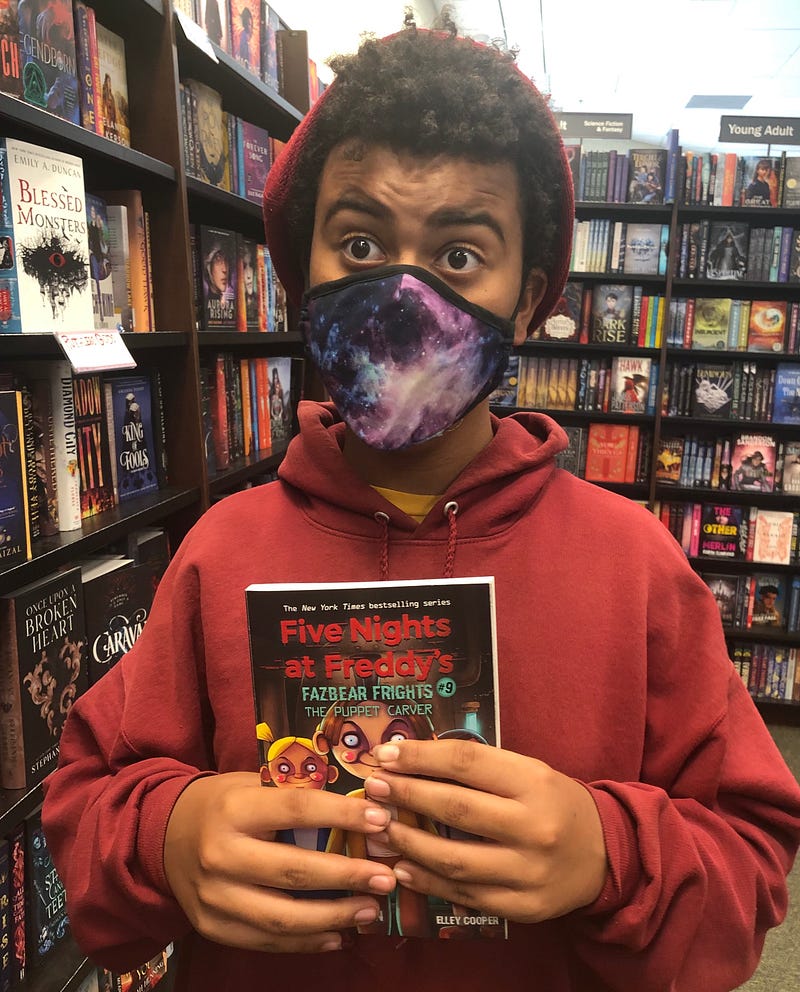
“He could smell a fart across a crowded movie theatre.”
Okay, I just wanted to squeeze that sentence in, but it does illustrate how neurodiverse people have heightened sensitivity to smells, tastes, textures, sounds and fluorescent lighting at glow-in-the-dark miniature golf courses.
You can take word on the latter. Trust me, it wasn’t a pretty sight.
8. A ND parent raising a a ND child isn’t easy.
Do we have some neurodiverse parents in the house? I’m one. I highlighted a few sentences in Powers’ novel where the father makes statements about parenting that I (and maybe you) can relate to as a ND parent:
“I didn’t know how to be a parent.”
“Everything about parenting terrified me.”
“I could no more raise a child than I could speak Swahili.”
Ironically, as I’ve found to be true, the father relates well to his son because he shares many of the quirky traits and outside-the-box thinking as his son.
9. ND kids are smarter than they may show in school grades.
“Why don’t you get ready for bed, and we’ll burn the midnight oil.” Our code for reading together for twenty minutes past his bedtime.”
“Can I have a juice, first?”
“”Juice might not be the best thing, right before bed.” I didn’t need a two a.m. disaster. I’d removed the plastic fitted sheet. It was too humiliating for him.
“How do you know? Maybe it is. Maybe juice is the perfect thing before bed. We should run a double-bind experiment.”
See my point? This is a bright nine-year-old, but for many neurodiverse kids their intelligence may not always reflect in their grades at school. That’s why we should see grades as not the only measure of a child’s intelligence.
10. A ND person speaking their mind at the dinner table can be seen as rude by a NT (a grandmother saying a Thanksgiving prayer):
“Nobody is listening to that prayer, you know. We’re on a rock, in space, and there are hundreds of billions of other rocks just like our.”
Of course, the grandmother did not see this as Robin expressing his world view that was forming in his nine-year-old brain. Nor do many NT or ND parents listen to their child’s thoughts in moments like this in the home.
This issue to isn’t what they’re saying as it is how they may be saying it.
11. ND people’s ability to hyper-focus should be seen as a super power.
“When Robin settled into a groove, few things could deflect him.”
I heard Dav Pilkey say this same thing about himself. And I see this trait in myself. I can have tunnel vision focus on something I want to get done.
12. ND people have a sensitivity to injustice from being treated different.
Robin tackles many societal issues from our disintegrating biosphere and endangered species with a Greta Thunberg mindset. Pretty amazing, when you consider he is nine, but maybe it relates to the decoded neurofeedback
13. ND kids and adults tend to be self learners.
“He’d learned more in one summer, one his own, than he’d learned in a year of classroom.”
Ultimately, what I liked the best about Richard Powers’ Bewilderment and why I’m recommending the book is what it was criticized for in a few reviews, being too narrowly focused as a story on a father and son relationship.
Despite the other thematic elements, what I enjoyed the most is the simple father and son story at the core of the book, the camping trips and trip to Washington, D.C., that show the intimacy of a father and son relationship.
Here’s an example of what I’m talking about sprinkled throughout the book:
He was better with takeoff the second time. As we broke down through the clouds in our final approach, he shouted over the engines, Holy Crap! Washington Monument! Just like in the book!
The rows near us laughed. I pointed over his shoulder. “There’s the White House.”
He answered in hushed tones. Wow. So beautiful!
“Three branches of government,” I quizzed.
He held out his finger, fencing with me. Executive, legislative, and … the one with the judges.
We saw the Capitol from the cab on our way to the hotel. He was awed.
Hi, I’m Scot, thank you reading my story to the end : )
Check out my YouTube video on my first three weeks on Medium. It got a little crazy in the beginning, but I’ve since calmed down to not get in a frantic state.
I love reading and writing on Medium. Especially on neurodiversity.
If you are not a Medium member yet and would like to receive unlimited access to all Medium content, you can sign up here. It’s just $5 a month. I will receive a small referral bonus, at no additional cost to you, when you sign up using my link.