
Skiing During the Pandemic
What’s changed, what’s working, and what needs improvement
As the holidays approach and the coronavirus pandemic enters a dangerous new phase, many skiers wonder whether it’s safe to return to the slopes.
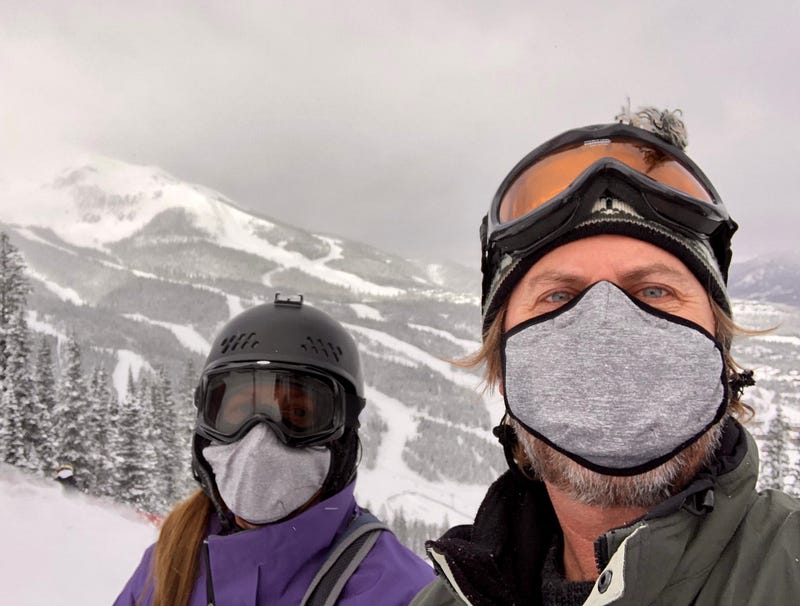
Last week, my wife and I got a first hand look. If our experience is any indication, the industry could be in for a challenging season.
Thanksgiving Day marked the beginning of ski season at many resorts across the U.S. We spent the day skiing at Big Sky, Montana’s largest and best known ski resort.
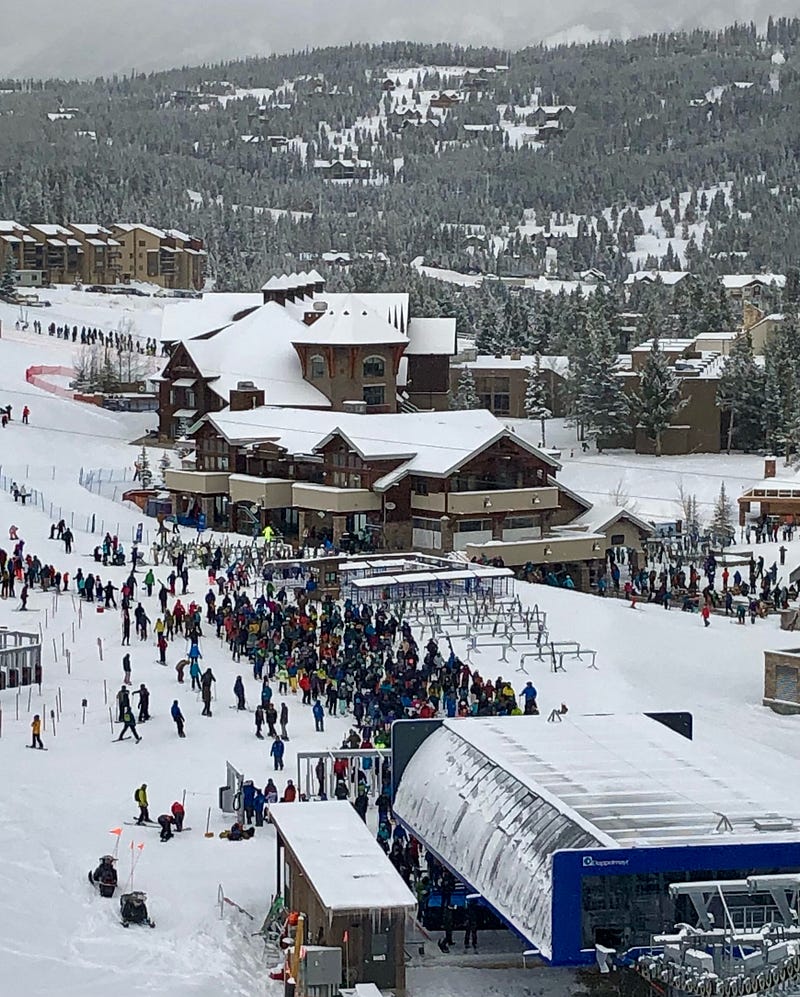
Since September, we’ve lived at Big Sky Mountain Village, located at the base of the ski area. During our time here, we’ve been impressed by the absence of crowds. All of that changed on Thanksgiving morning, when thousands of people showed up to ring in the new season. Lifts opened at 9 am, but even before then, skiers gathered at the base area. Lines quickly formed at the lifts, and skiers packed the few runs with sufficient snow to open.
From a COVID-19 perspective, skiing has the reputation of being a relatively safe activity. Skiing is an outdoor sport. Skiers are spread out over vast areas and breathe unlimited quantities of fresh mountain air.
But it’s not the skiing that poses the greatest risk; it’s the congregation at the base, in lift lines, at mountain dining facilities, and in bars and restaurants at night. As in many places, enforcement of mitigation measures is key. The best laid plans can be derailed by lack of compliance.
Destination resorts like Big Sky attract guests from across the country and around the world. Those guests bring with them illnesses present in their home regions and then commingle in resort facilities and in surrounding communities. The resulting stew has the potential to feed disease outbreaks.
The risks posed by ski areas are well documented. Last winter, a coronavirus outbreak at the Austrian ski resort of Ischgl was linked to more than 6,000 infections in nearly 50 countries, an event that contributed to Europe’s initial coronavirus surge.
Europe is now wrestling with how to avoid a repeat of last year. Austria and Switzerland recently decided to open for the season, while other countries, such as Italy, Germany and France, vow to remain shut or operate under significant restrictions.
Safety first
Last spring, surging COVID cases caused the U.S. ski season to grind to a halt. Ski areas abruptly closed in March, shortening the season by as much as two months and closing many business dependent on winter tourism. Big Sky was no exception.
In an effort to get ahead of potential coronavirus-related setbacks, the National Ski Areas Association this fall published their “Ski Well, Be Well” guide to best practices for skiers and resorts alike. The association represents more than 300 alpine resorts that account for more than 90 percent of the skier/snowboarder visits nationwide.
“Ski industry leaders from across the country established these foundational best practices according to scientific guidelines put forth by infectious disease experts, including the CDC and WHO,” the organization says on its website. “Ski areas will comply with additional federal, state and local regulations as they are implemented.”
Both Boyne Mountain Resorts and Vail Resorts advised the creation of the safety document and endorsed its contents. Boyne owns Big Sky, as well as Washington’s Snoqualmie, Maine’s Sugarloaf and several others. Vail Resorts, the nation’s largest ski corporation, owns and operates 37 mountain resorts in three countries, including Vail, Beaver Creek, Breckenridge, Park City, and Whistler Blackcomb.
In attempt to assert some control over resort capacity, Vail Resorts in August announced plans for its first reservation system, requiring skiers to make reservations to ski ahead of time. Other resorts are slowly adopting reservation systems, especially for skiers using partner passes. Skiers using the Ikon Pass will need to make reservations at many resorts, including Big Sky.
Big Sky is now actively rolling out its slate of best management practices intended to curtail risky behaviors known to facilitate transmission of the virus.
“Each of our teams have worked tirelessly to develop new operational practices with the goal of providing the safest experience possible for our guests and our teams,” Big Sky Public Relations Manager Stacie Mesuda told me in an email exchange. “Many things will be different this season — directional traffic in our F&B (food and beverage) locations, new lift-line configurations, social distancing guidelines, and most important, the requirement for all team members and guests to mask up while at the resort as it is mandatory in all public space.”
The resort’s publicized face covering requirements include wearing masks while at the base area, in lift lines, while riding and unloading chairlifts, and while indoors.
“Our efforts to wear masks and facial coverings consistently are a crucial factor in staying open all season,” Mesuda said.
In addition, Mesuda said, the resort has invested in weekly surveillance testing for both symptomatic and asymptomatic employees, beginning in early December. Separately, Big Sky is participating in a community-wide testing partnership.
Good intentions
Our experience on Thanksgiving suggests that despite good intentions, operating the resort safely remains a challenge. Throughout the day, we observed behaviors that were inconsistent with Big Sky’s published regulations and raised questions about whether the resort and the industry have the ability to operate in accordance with their own safety requirements.
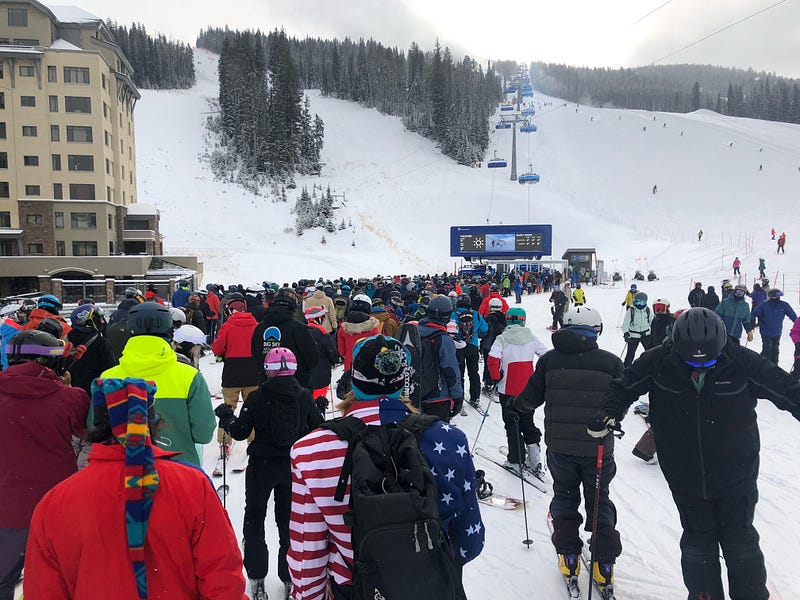
In many ways, skiers and the resort behaved as if this season is no different from previous ones. Lift and ticket lines were long and social distancing was scant. Signage encouraging safe practices was present but not always visible in crowded areas, leaving skiers unsure where and how to queue safely at lifts. Absent were any resort employees roaming the lines to assist with directions or enforce social distancing and face covering requirements.
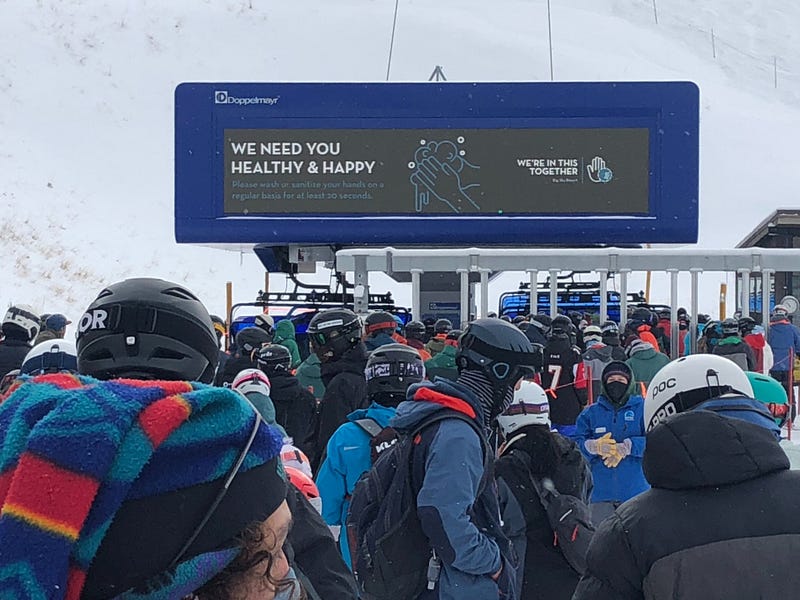
Mask usage was far from universal. The face coverings we observed among guests were likely to be worn below the nose, where they provided no protection, either for the individual or those around them. Even when worn properly, the masks we observed often consisted of coarse-woven gators or bandanas. Few masks we saw were constructed of materials thought to provide maximum protection.
Mesuda told me in a follow-up exchange that “we believe our guests can do much better and have empowered all our teammates to remind guests of our resort policies, while also educating them on proper wearing, acceptable forms of coverings, and ensuring everyone does their part. Most of our guests want to do the right thing — and this is all new to them. We are finding that once we provide some education to our guests about our expectations, they are happy to comply. However, several non-compliant guests were asked to leave the resort and we will maintain that approach in every similar instance.”
Uncomfortable moments
While actively skiing, my wife and I felt as safe as we would have during any other ski season. But throughout the course of the day, we found ourselves in situations—ticket lines, lift lines, riding on lifts—that caused us to accept risks that we have scrupulously avoided throughout the pandemic. This made us uncomfortable.
In the line to obtain our passes, a printer malfunction delayed processing of orders. We stood in line for more than 30 minutes. Most patrons around us wore masks, but social distancing was spotty. We saw no resort employees in the area enforcing compliance. There were no mazes to guide patrons, no marks on walkways suggesting safe distancing. The group behind us continually encroached on our personal space. At one point, a man in the group stood only inches behind my wife.
“Can you please scoot back?” she asked.
The man puffed up and glared at her as he took a step back. “Is this far enough?”
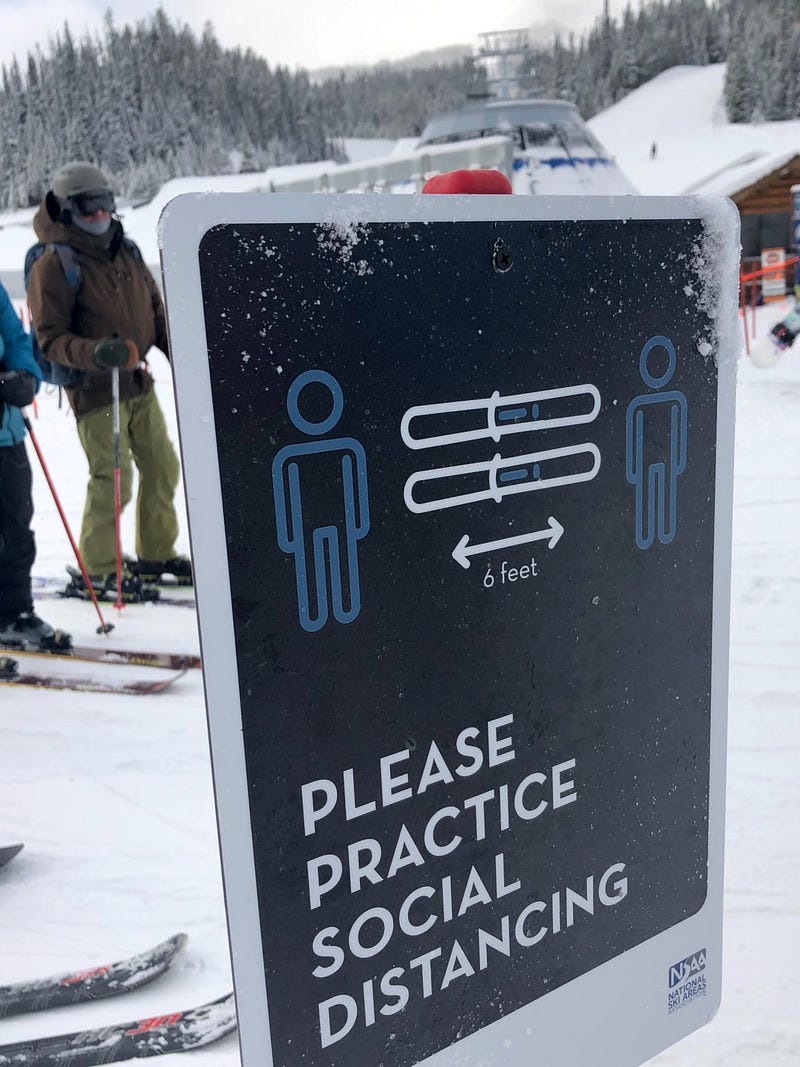
“Six feet,” my wife said, pointing to a resort sign posted next to her.
In the lift line, because of crowd density, we saw few posted signs encouraging compliance with the resort’s safety rules until we made it all the way to the front and were about to board the lift. By then, we had spent 20 minutes jammed together with other skiers awaiting a trip up the mountain.
“Are you having trouble enforcing social distancing and mask requirements?” I asked a lift operator as we approached the front of the line.
“It’s not that I’m having trouble,” she said. “They pull their masks up when I tell them to. But until then, they just do what they want.”
She asked whether we had seen many people without masks. We’d observed around seventy percent compliance, I told her, but that even those in compliance wore face coverings that offered little protection, or they wore them below the nose. She agreed.
“Did you receive much training on COVID?” my wife asked.
“It was very brief,” she said. “Very brief.”
Mesuda later told me that “every new and returning employee went through a mandatory orientation session which featured COVID-19 education, review of resort policies and expectations (for guests and employees), and complemented with department-specific training from department managers.”
I asked the lift operator whether the resort had people patrolling lift lines to ensure compliance with Big Sky’s face covering and social distancing requirements.
“We’re supposed to,” she said, looking futilely out at the line snaking into the distance.
Looking in the same direction, we saw hundreds of people packed together on a windless day, sharing space and air, breathing hard from runs just completed. Compliance tended to fall among groups: if one member of a group wore a mask, everyone wore a mask. In other groups, no one wore face coverings.
Skiers who went through the line unmasked weren’t asked by lift operators to mask up until just before loading onto the lift — at which point, a mask was arguably less helpful.
“Thanks for caring about this,” the lift operator said as we boarded. “Because nobody else seems to.”
Who’s in charge?
At least initially, Big Sky appears to have chosen to rely on guests to independently monitor their behavior and adhere to the resort’s safety requirements. Mesuda as much as confirmed this.
“While we do our part, we are also asking our community to do their part and use good judgement to be socially distant whenever possible,” Mesuda said.
And that’s part of the problem. Perhaps due to coronavirus fatigue or politicization of COVID mitigation measures, a segment of the population continues to abstain from mask wearing and social distancing requirements. Without enforcement, the resort and its guests are at the mercy of those who elect not to comply. And those who exhibit reckless behavior on the slopes are likely to conduct themselves recklessly in other aspects of the their lives, making them more likely to contract the virus and put everyone around them at risk.
Regardless of guest behavior, the resort appeared to have some trouble doing their own part. For instance, we were told to expect separate lines for those wanting to ride only with members of their parties and those willing to share lift rides with others.
“Our lift riding plan is a hybrid intended to maximize uphill capacity while respecting personal choice and space,” Mesuda said. “Guests can choose one of two lines — a “Friends & Family” line if they want to ride with the group they are traveling with (drive together, ride together) or a “normal” line, which would load lifts with unrelated parties as we have typically done in the past.”
On opening day, we saw no such options and no signage directing us. At the front of the line, we were loaded onto the lift with another party, and no one asked us whether that was okay.
Mesuda later explained that the option to ride only with members of one’s own party is limited.
“On select lifts, we are offering guests the option to ride with their party only; and if guests are comfortable, the ability to ride with other parties as well,” Mesuda said. “On lower volume days, we will accommodate our guest’s desire to ride alone or only with members of their party across all lifts that are running.”
On Big Sky’s website, the resort states it will not enforce maximum capacity on chairlifts but will allow groups traveling together to ride on their own chair when “operationally feasible.” In contrast, lifts will be loaded only with people in the same group in nearby Colorado.
Table for two
Perhaps the greatest danger on the mountain lies within the resort’s indoor dining facilities. States around the country are once again issuing stay-at-home orders and forbidding or limiting public gatherings indoors, including indoor dining at restaurants. Despite ranking in the top 10 per capita for test positivity rates, conservative-leaning Montana has resisted implementing aggressive restrictions.
“We are operating restaurants at 50 percent occupancy in compliance with state and county guidelines,” Mesuda wrote. “In addition to managing to a reduced capacity, we have implemented additional measures to minimize the risk of COVID-19 exposure which includes: requiring facial coverings in all indoor facilities unless seated and eating, directional specific entry/exits, increased frequency of sanitizing common area surfaces, as well as online ordering, dedicated pickup areas and even the introduction of a delivery service to lodging units by way of Swifty Delivery.”
Operating dining facilities at 50 percent capacity falls short of restrictions imposed by many cities and states with lower per capita infection rates, and in places where diners are more likely to come from nearby neighborhoods. At Big Sky and other resorts, dining facilities could be veritable melting pots — and 50 percent capacity is little different from an average day in mid-winter.
The CDC rates on-site dining with indoor seating as “Highest Risk” if seating capacity is not reduced and tables not spaced at least 6 feet apart.
Former FDA chief Scott Gottlieb said Monday on CNBC that he avoids indoor dining altogether.
“I will not eat indoors in a restaurant,” Gottlieb said on “Squawk Box.” “I’ve been eating outdoors since the summertime and wouldn’t eat indoors in a restaurant. I think the risk is too high to be in a confined space without a mask on with other people eating in that same location right now.”
While admittedly cautious, my wife and I haven’t set foot in an indoor restaurant in eight months. The prospect of sitting down with strangers from distant locales, regardless of how much surface cleaning is done, is unimaginable. For skiers with concerns about airborne transmission of COVID-19, that leaves few choices but to eat outside. Al fresco dining is fine when the weather is pleasant, but it’s a chilly prospect during a January blizzard.
Looking forward
Opening day at Big Sky reminded me of an episode of truTV’s educational comedy series Adam Ruins Everything. In an episode entitled “Adam Ruins Security,” Adam explains the concept of “security theater.” Security theater is the practice of enacting security measures that are intended to provide the feeling of improved security while doing little or nothing to achieve it. Examples include tightened airport security after a terrorist attack.
On opening day, I felt that Big Sky was to a degree practicing “safety theater.” Through their published guidelines, the resort talked a good game, and this made me feel safe. But on opening day, the resort failed to take some of the actions that would have actually kept me safe.
Since opening day, I’ve noticed some improvements. Mesuda acknowledged as much:
“The lift lane configuration has been extended for Ramcharger 8 and the same since the opening of Swift Current, with a recurring placement of messaging noting facial coverings are required and to socially distance at least 6 feet apart. While lift lanes may have seemed crowded, with most guests maintaining a “tip to tail” distance between skiers and riders, they are generally spaced 6 feet apart and adhering to the recommended spacing between parties. It’s also important to note, by providing our guests the opportunity to only ride with their party on select lifts, and encouraging additional spacing between groups — lift lines will appear longer this season. However, with reduced guest volume and our high-speed chairlift network, we believe guest wait times will be less impacted.”
Readers of this story can view the photos included and ascertain for themselves whether Mesuda’s “tip to tail” comment is accurate.
In the resort’s defense, Thursday was the first day of the season. The resort will no doubt iron out kinks and address shortcomings in their safety policies. The situation on opening day was made more difficult by virtue of the fact that snowfall has been light, meaning that only a couple of lifts and runs were open. With few choices, visitors are confined to a smaller footprint of skiable terrain. As the season progresses, guests will spread out. This may reduce congestion at the base and in lift lines.
But the resort only has a few weeks to get it right before the holiday crush, when many times the number of visitors — heralding from broad geographic areas — will descend on the mountain. By then, the pandemic’s grip on the nation is expected to tighten.
Big stakes
There’s a lot at stake, not just for Big Sky, but for the country’s nearly 500 ski resorts and the communities that depend on them. Snow sports tourism contributes around $20 billion to the U.S. economy each year, according to researchers at the University of New Hampshire and Colorado State University.
There’s a lot at stake for skiers, too. Between travel, accommodations, lift tickets and gear, skiing is an expensive sport. Having a ski vacation cut short by a COVID-19 infection is a difficult pill to swallow, even without considering the risk of ending up in the hospital. And if guests become infected, they may be forced to quarantine onsite.
“Ski areas have also been asked to message to their guests that they will be required to extend their stay and quarantine should they test positive for COVID-19 during their stay,” a spokeswoman from the Colorado Department of Public Health and Environment recently said.
If that were to come about, guests themselves may be on the hook financially.
“If you have to isolate, you are going to have to pay,” Aspen Chamber president Debbie Braun said. “People need to be very aware when they come to town, and we need to make sure they understand our public health orders.”
Mesuda said that in the event that guests become infected during their stay at Big Sky, the resort will “assist them on a case by case basis to ensure they are isolating safely and in compliance with the local health department’s best practices.” She declined to say who would pay for an extended stay.
Bottom line
In the weeks leading up to opening day, we were comforted by Big Sky’s aggressive messaging that suggested the organization is respectful of the coronavirus and is taking steps to mitigate the threat it poses. Big Sky’s website contains pages of information detailing the steps they have taken to ensure guest safety.
Our actual experience underscores the fact that regulations without enforcement are of little use. There will always be a subset of the population that ignores or even ridicules restrictions as onerous, overbearing, or an infringement on personal liberty.
Mesuda says that with the policies it has in place, the resort is confident it can make it through the season safely. If things go poorly, however, they are not afraid to adjust.
“We intend to use common sense and good practices to open safely and efficiently for the full duration of our ski season. Like last winter, we are not afraid to pivot or make hard choices once the season is underway; but remain confident that our current plan will allow us to have a full season of skiing.”
With little snow in the forecast, skiable terrain across the West will likely remain limited into the holiday season. Congestion at the base, in lift lines, and in restaurants will persist. Guests will continue to flock in from all points. With that in mind, it is incumbent on Big Sky and other resorts to do more to enforce their regulations and weed out noncompliant visitors who would put others at risk.
My wife and I intend to ski throughout the season, but like all things this year, we will modify our behavior. We will restrict our skiing to days when crowds are thinner. We’ll bring our own meals and eat them outside. We’ll avoid situations where crowds form and social distancing is inadequate. We’ll request to ride lifts without other parties. We may ski shorter days, since we won’t use the resort’s lodges and restaurants for meals or rest breaks.
By limiting our exposure to others, we believe we’ll feel safe enough to ski. And as long as we are skiing—actually gliding over snow in fresh mountain air—there is probably not a safer place to recreate.


