
‘Thinking About Thinking’ (Uncovering Hidden Strengths in Your Mind)
The art of using Learning Journals to engage metacognition
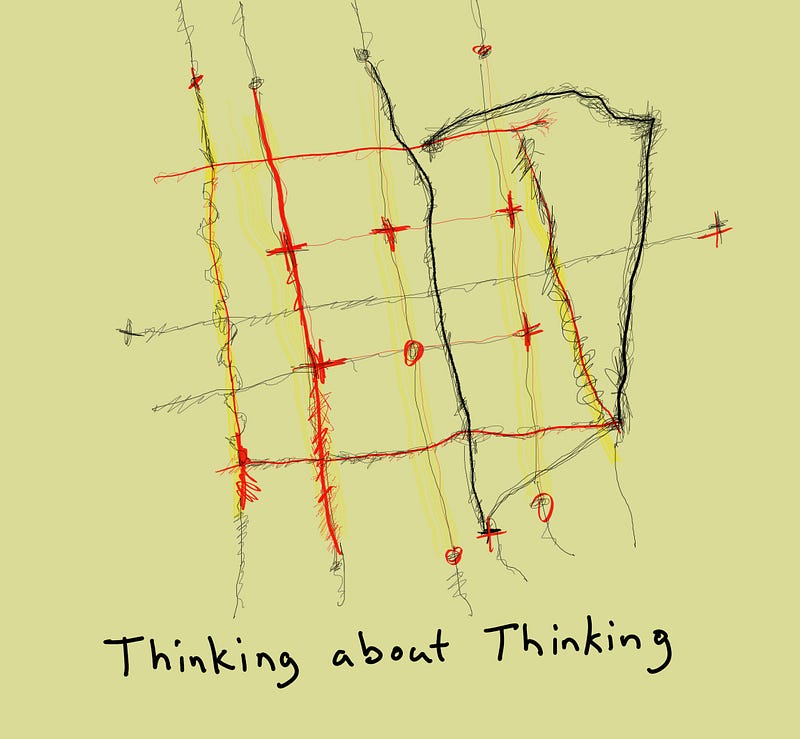
Just as water transforms into steam with heat or solidifies into ice with cold, we too can often need a catalyst to transform our careers, relationships, and lives.
This catalyst may very well be the art of ‘thinking about thinking’ — a process that can reshape our lives into something new and transformative.
What is ‘thinking about thinking’ and why is it so important?
‘Thinking about thinking’ (also known as metacognition) is the practice of consciously watching, analyzing, evaluating, and reflecting upon one’s thought processes.
It often involves stepping back from our habitual patterns of thought and taking a bird’s-eye view of our mental landscapes. Or maybe a butterfly’s-eye view of our Self.
This practice is crucial for so many reasons, for example, it allows us to:
- understand how we make decisions (often habitually or reflexively)
- solve problems (often based more on the past), and
- learn new things (especially in pushing beyond our old ‘things’).
When we engage deeper, we can become much more aware of our cognitive biases, mental shortcuts, and assumptions. This is the difference between ‘transformative’ and ‘informative’ experiences and processes.
See, the thing with experience, is that it’s always based on the past (never the future).
Same thing with data. Last time I checked, 100% of all data is based on the past.
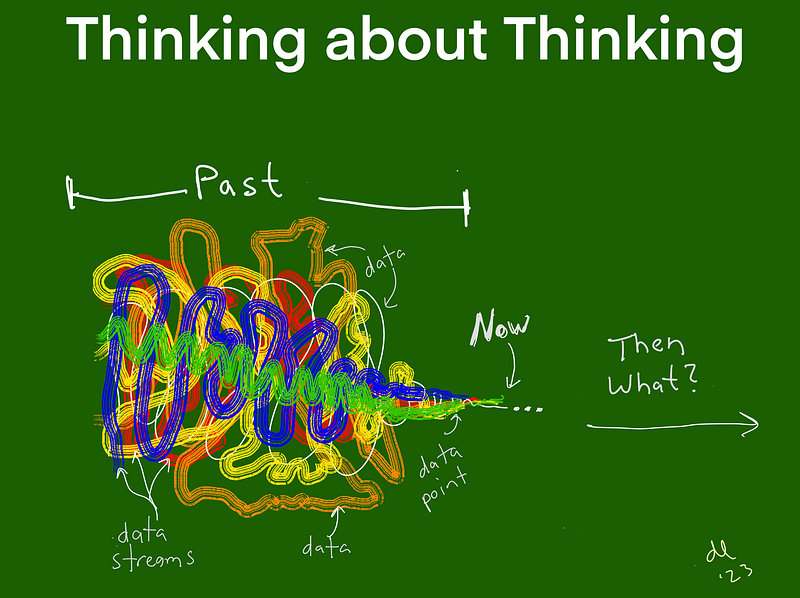
The future is pondered through assumptions, suppositions, visions, dreams, and more. When we engage ‘thinking about thinking’ we can refine how we do things, how we think about them, and how to take action in new ways.
We can make far more informed decisions and launch innovative ideas. And, we equip ourselves with the ability to question our preconceived notions, encouraging intellectual growth and self-improvement.
In essence, ‘thinking about thinking’, is the transformative fire (or heat) that opens new possibilities through mixing the raw materials of our experiences and knowledge (reflection on the past) with openness and curiosity (introspection in the Now) to ponder and decide about what could be (prospection into the future).
There are three powerful unlocks that can come as a result of more engaged ‘thinking about thinking’.
Three Critical Unlocks from ‘Thinking About Thinking’
Thinking about Thinking is a powerful process with so many benefits. There are also multiple ways of engaging in it. Or using it to feed other kinds of ‘thinking’ (e.g., strategic, empathetic, design, systems, focussed, and more). Here are three:
1. Enhanced Problem-Solving Skills (Especially for Wicked Problems)
Reflecting on our thought processes helps us identify and improve our approach to problem-solving. This doesn’t only mean solving problems in the conventional sense. It means learning to live with and through complex, ‘wicked’ problems like climate change and social issues.
This increased self-awareness will lead to more effective learning strategies and better decision-making, both personally and professionally.
This doesn’t just mean “solving” problems because wicked problems — like, climate change, implications of Artificial Intelligence (AI) and Machine Learning (ML), poverty, and homelessness — are often not solvable.
A critical problem-solving skill — engaged by thinking about thinking — is learning to live with — and through — wicked ‘problems’ and challenges.
This past summer in western Canada, I thought about this a lot, as we were shrouded in smoke from wildfires for much of the summer. It was the worst year on record with an astronomical size of forest burnt.

Wicked problems like rapid climate change, wildfires, and floods — are combining to create a ‘new normal’. We simply can’t address some of these challenges in the same ways we have in the past. And, we can’t get at the emotional impacts either — without changing our thinking.
Thinking about thinking can get at our emotional responses to challenges and problems — and assist in designing systems and strategies to navigate those. This leads to increased emotional literacy, better learning, and stronger self-awareness — individually and collectively.
When natural emergencies and otherwise descend upon us — there’s very little that we can control beyond our Self.
2. Boosted Emotional Literacy
‘Thinking about thinking’ will assist you (and me) in understanding emotional responses and thought patterns. This, in turn, builds greater emotional self-awareness — and thinking about responses and reactions.
Engaging in regular processes of thinking about thinking can improve interpersonal relationships and communication, as well as increase empathy and understanding toward others. But, most importantly, empathy towards your Self.
The diagram below is one I share frequently. It’s a play on an old Stephen Covey set of wisdom from his classic book 7 Habits of Highly Effective People.
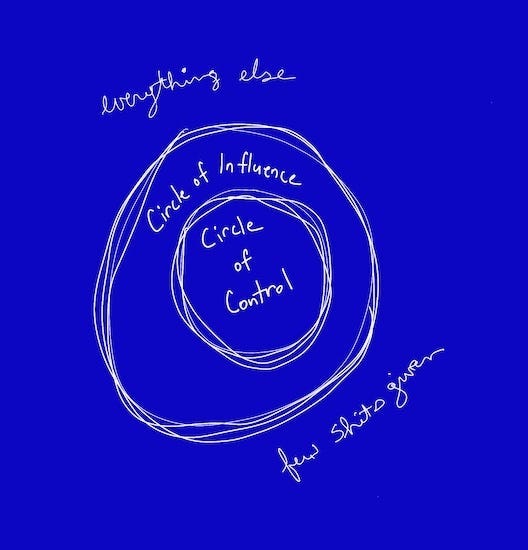
It outlines that there are some core things we have control over — namely our Self.
There are things that we can influence. Those around us, our communities, a bit of institutions, and a little bit of bigger things, such as the right to vote (for those that have it).
And, then there is the vast endless universe of things we cannot control nor influence. It is here, where we must be very cautious about what we choose to ‘give a shit’ about.
Spend the most time giving a shit to the stuff in the centre (circle of control). Spend some time in the next circle (influence), and not a lot on ‘everything else’. Doing this can then support personal growth and self-improvement
3. Encourages Personal Growth and Self-Improvement
When we engage in metacognition (thinking about thinking), we gain insights into our strengths and weaknesses, our many biases (there are hundreds), and our various comfort (and discomfort) zones.
Doing this can facilitate targeted personal development and change. It can also assist deeply in developing resilience, coping, and adjustment processes.
Keep in mind: “Weaknesses” are not necessarily a minus — not necessarily negative. For example, I’m well aware there are many things I suck at. Being fluid, flexible and adaptable with those in mind, can be a critical life skill. As can be asking for assistance, seeking a mentor, and being open to guidance from other places, things, people, etc.
The self-reflection that gets engaged by exploring strengths and weaknesses enables us to set realistic goals, monitor progress, and adapt strategies and systems for growth, learning, and (sometimes most importantly) unlearning throughout life.
Unfortunately, for many, “thinking” has some negative memories and stigma attached to them. Schooling and education systems can often leave etched scars on many — because they didn’t “think” in the way the school system insisted they ‘should’.
There’s a pretty simple tool that can assist in working through this.
The Role of Learning Journals
One of the best and most effective tools to support and engage thinking about thinking is a Learning Journal.
Learning Journals are a tool as simple as they are powerful. They don’t require any special equipment or training, just a willingness to pause and think about what you’re taking in.
There is no right or wrong way to keep a Learning Journal. And, they can be kept in so many ways, so many formats, and so many mediums.
These are personal records for documenting experiences AND reflecting on them to identify strengths, weaknesses, and learning connections. They help in developing critical thinking skills, deepening self-awareness, and promoting continuous learning.
The key aspect — and unlock — with Learning Journals is going back over them from time to time. This is where you can leverage the superpowers of the trifecta: reflection (looking back), introspection (right now), and prospection (looking into the future).
Benefits of Learning Journals
Here are a few benefits that surface through the use of Learning Journals:
- Encourage cognitive flexibility: Engaging in reflective writing (or drawing, sketching, mapping, doodling, etc.) nurtures abilities to adapt thinking strategies, embrace and be open to diverse perspectives, and approach problems from multiple angles.
- Deepen learning and retention: The act of thinking about thinking in Learning Journals solidifies knowledge acquisition, enhances memory, and promotes a deeper more meaningful understanding of any subject matter (especially of one’s own life and Self).
- Enhance problem-solving skills: Regular reflection on thought processes can supercharge effective problem-solving techniques, identify logical fallacies, and overcome mental roadblocks (especially habits — conscious and unconscious).
- Catalyze personal growth: Thinking about Thinking in Learning Journals deepens personal growth through self-reflection, mindfulness, and the continuous refinement of one’s cognitive abilities and habits (e.g., forming new ones).
Engaging a Learning Journal doesn’t need to become some onerous task, or some long list of rules to follow. Or, record for 30 days straight. Even just a few bullet points semi-regularly can open up completely different ways of seeing things.
Putting it into Practice
To engage and harness the power of ‘thinking about thinking’, let’s integrate this concept into a practical exercise using a Learning Journal.
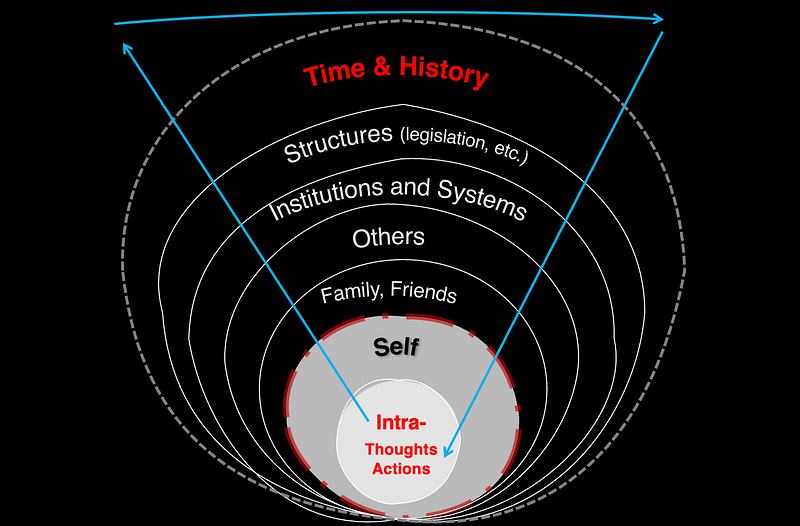
Consider this in the context of the ‘shit I can control’ diagram above — and the diagram below. This reflective practice will help you discern between what you can control, what you can influence, and what is beyond your control and influence.
Step 1: Acknowledge the Self — and the Self within the Self
At the center of the diagram above is the ‘Self’ — the starting point of your ‘thinking about thinking’ journey. There is the deeper internal Self that we engage with through Intra-communication (our thoughts, self-talk, and actions).
All of this occurs within the larger “Self” in general.
To begin: reflect on some recent thoughts and actions. Ask yourself:
- What decisions did I make recently (e.g., today) that I had full control over?
- How did my choices align with my personal values and goals?
- In what areas did I notice my habits influencing my actions?
Write these reflections down, noting the patterns that serve you well and those that you might want to change. (Make sure to note a date, as you will come back to these down the road.)
Step 2: Explore Your Influence
Moving outward to the next layer, consider the people (family and friends), communities, and systems (institutions) you have some influence over. Reflect and note down some thoughts on questions such as:
- What conversations have I had that could lead to change?
- How can I positively affect my relationships and community through my actions?
- In what ways have I contributed to the systems I’m a part of?
- Where might I be expending too much energy (e.g., giving too many shits) on things I don’t have much influence over?
Note some of these experiences, paying attention to where your influence has been effective and where you might wish to expand it. And, importantly, make a few notes about how you’re feeling about these (at the moment).
Step 3: Understand the External
The outermost layer represents the vast expanse of what we cannot control. Here, the exercise is one of acceptance and perspective:
- What events have caused me stress recently that I have no control over?
- How can I redirect my energy from these concerns to what I can act upon?
- Can I find peace in acknowledging the limits of my control and influence?
Document these insights — and note how you feel about the — especially if you recognize how liberating it can be to let go of the weight of the uncontrollable.
And, if you really want to open up the can of worms… then take this reflection process back down the circles — ending back with your intra-personal communication.
Step 4: Envisioning Change
With the self-awareness gained from these first few steps of using a Learning Journal, think about how you can apply this newfound clarity to enact change.
Set a few intentions for growth — maybe self-improvement or change — and consider how you can use a Learning Journal to continue this process of learning and potentially unlearning. Then the real power starts to kick in with the next step.
Step 5: Regular Review
Make it a habit to regularly review your Learning Journals. Maybe weeks, maybe months, maybe years. This retrospective look will help you see how your thoughts, influence, and acceptance change and evolve. It’s a vital part of the learning process that promotes ongoing personal improvement.
This ‘shit I can control’ diagram — plus the systems perspective of interlocking circles — is just one framework to support reflective, introspective, and prospective processes in Learning Journals.
These can be hard copy, in an app, in a software program — or even a series of blog posts, articles, or social media posts. A ‘Learning Journal’ can be so many things.
For example, I recently published an article on how 52 straight free weekly issues of my newsletter were an immensely valuable Learning Journal — especially as I learned, and documented, my journey of establishing digital writing businesses from scratch.
By creating a little bit of a structured approach to ‘thinking about thinking’ — we can uncover some remarkable things. It can be a powerful means to reshape your life, refine your decisions, change habitual ways of operating and maybe even steer your future in a direction aligned with your deepest values and aspirations.
If you’re interested in learning more. We recently started The Learning Journal Initiative here on Medium, as part of Humanity Academy. Stop by and read our Learning Journal-focussed articles and maybe even Follow us to stay updated.
We also offer a Free 5-day Educational Email Course: The Learning Journal Crash Course. (No catch, no spam — just great content).