
Thinking
Not The Way Out
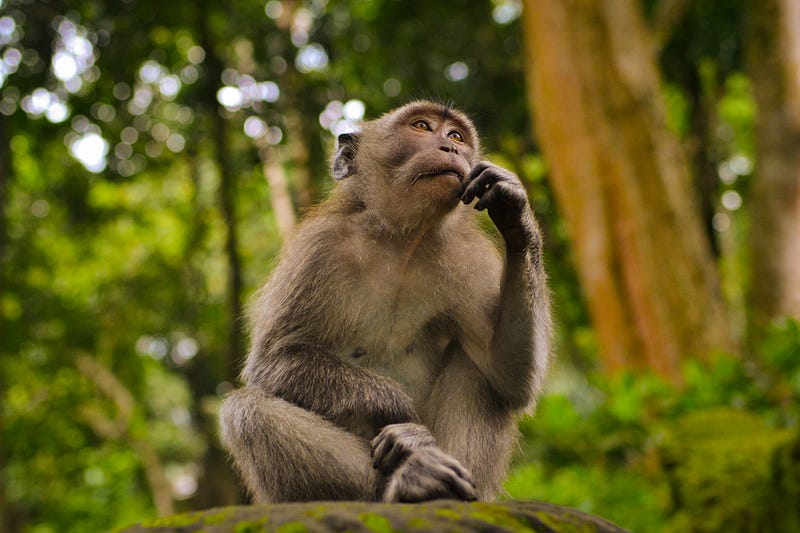
We cannot think our way out of thinking — this is axiomatic
The absolute truth (some would say Absolute Truth — initial caps) cannot be reached by the intellect. It is a non-duality that brooks no external (versus internal) view. It lies beyond the conceptual, beyond thinking.
This is the view of Advaita Vedanta, the Upanishad-based wisdom taught by Shankara among sage others. The thinking mind, however (some call it Ego), begs to differ, does not believe this, does not take “no thinking” for an answer, and keeps thinking. And thinking.
And thinking.
In vain.
But that leaves only non-thinking as a way to understand this, that, and everything and I’m no good at non-thinking, says the mind.
Well, can’t you think no-think, wonders Dogen.
Easy for you to say, says the mind, you’ve been dead these last several centuries. Not around to discuss this. And, adds the mind, if there’s no thinking involved, no concepts, no words, no images, how would I know, I mean really know the Truth if I see it when there’s no language or anything to nail things down?
Well, that’s just the thing, answers Dogen (as if still alive), there is a knowing beyond language; it is something you experience rather than know or grasp.
So experience is different than knowing or grasping?
It is a better way of knowing, says Dogen.
I find that hard to believe, answers the mind.
Dogen shrugs his best been-dead-a-while shrug. Believe what you wish sort of a shrug.
The mind thinks of something else to say. Draws a blank. That’s more like it, says Dogen.
The mind that’s writing this is enchanted by language. I know two of them (English and Swedish) and I love words. And I am perpetually amazed at how precisely words from either language can convey a particular fact, or thing, or feeling, or mood, or hope, or relative truth.
And this mind is also amazed at how well, how closely some have come to describing Absolute Truth using words. It’s like they erect this words-and-concepts ladder higher and higher and closer and closer to that vast (though un-vast) emptiness just up ahead that is the Absolute Truth, but there is no such thing as poking the top end of the ladder into that emptiness and place a final word rung to let us climb all the way in.
No, the ladder, by definition (or, I sometimes suspect, by agreement) stops short. The final leap, the final letting go, the final purely on intuitive-trust ascent into truth needs must be wordless, language-less, thought-free, transcending thought and concepts and images.
But what if the King doesn’t wear any clothes, says the little child. But the little child (whose name is Doubt) is using words, and therefore he too is lost far, far below as you let go of the ladder and wing your way up into Truth.
© Wolfstuff
P.S. If you like what you’ve read here and would like to contribute to the creative motion, as it were, you can do so via PayPal: here.


