
Thinking a state funeral
The problems of the Abe administration need to be demonstrated

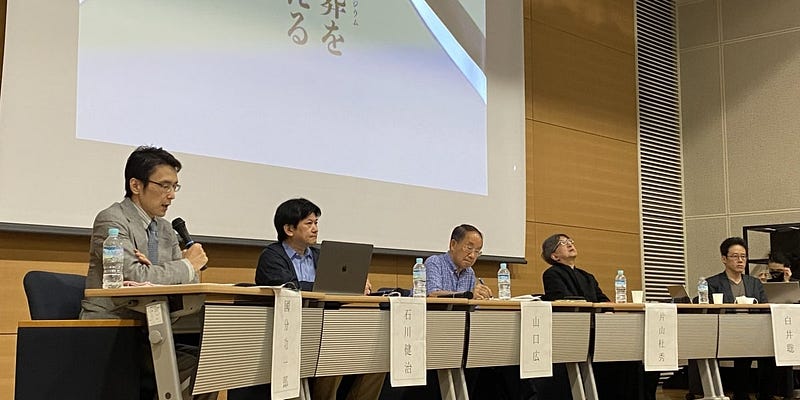
On 19 September, in order to consider the state funeral of former Prime Minister Shinzo Abe, the laboratory of Professor Koichiro Kokubu (Philosophy) of the University of Tokyo broadcast on YouTube a discussion by six intellectuals, including political and philosophical experts and lawyers, on the theme ‘Thinking about the state funeral’. Approximately 3,200 people (according to the organisers) watched the simultaneous broadcast.
The Abe Government and the Constitution
Attempts to change Article 96 of the Constitution, which sets out the procedure for amending the Constitution, under the pretext of ‘putting the Constitution back into the hands of the people’, fail. (In 2013)
Ignore precedents and practices of the Cabinet Legislative Bureau and appoint someone favourable to the Abe Government as heads of the Legislative Bureau. (In 2013)
The previous interpretation of the Constitution by the Japanese Government was changed by a mere Cabinet decision, claiming that the right of collective self-defence could be partially exercised. (In 2014)
The security-related bills, which many constitutional scholars, previous heads of the Legislative Bureau and experienced Supreme Court judges have called unconstitutional, will be passed into law. (In 2015)
Characteristics of the Abe Government
Thorough lack of respect for the legacy that politics has built up over the years.
Misuse of democracy, where elected officials have the right to decide everything. Or disregard for constitutionalism.
If constitutionalism is the principle that any power is limited, then the two features above are ultimately the same.
Part of the scandals of the Abe administration
⭐Moritomo Gakuen issue (In 2017) The issue of state-owned land in Toyonaka City, Osaka Prefecture, purchased in June 2016 by Moritomo Gakuen, a school corporation that operated a kindergarten and other facilities in Osaka City, as a site for a primary school. The land was sold for ¥134 million, after deducting about ¥800 million for the removal of underground deposits by Moritomo Gakuen from the ¥956 million price of the cleared land. The sale of the school, which was to be opened in the amount of 4,400,000 yen, was subject to an enormous amount of media coverage concerning the process of determining the sale price and the involvement of the Prime Minister Abe and his wife in the process.
⭐Kakei Gakuen issue (In 2017) The issue surrounding the Kakei Gakuen Group’s plan to establish a new veterinary school at Okayama University of Science in Imabari City, Ehime Prefecture, Japan, was debated in the Diet on 13 March 2017, when Mizuho Fukushima of the Social Democratic Party questioned the House of Councilors Budget Committee on the allegations. The Ministry of Education, Culture, Sports, Science and Technology (MEXT) did not approve the establishment of a new veterinary school for many years, but in 2017 (2017), a new veterinary school was to be established by Okayama University of Science in Imabari City, which was designated as a special national strategic zone by the Abe Cabinet. At this time, there were suspicions that the new veterinary school may have been established with Imabari City in mind, and investigations were conducted with the relevant parties.
⭐Falsification of official documents problem (In 2018) Since the sale of cheap state-owned land to Moritomo Gakuen was revealed in February 2017, there has been ongoing debate in the Diet over the circumstances surrounding the sale. Prime Minister Abe stated that he would quit as prime minister and parliamentarian if it came to light that I or my wife had anything to do with the sale. Mr Sagawa, then head of the Rissozai Bureau, has repeatedly stated that the records of negotiations with the academy over the sale had been “destroyed” and stressed that no politicians were involved and that the transaction was fair.
However, earlier this month, when the Asahi Shimbun newspaper scooped up allegations that the Ministry of Finance had rewritten settlement documents prepared for the state-owned land deal, the ministry revealed that it had rewritten 14 documents. It admitted that it had altered the documents to fit Sagawa’s answers, including deleting all passages in which the names of Mrs Akie and several politicians appeared.
Democracy is founded on the separation of powers between the legislative, executive and judicial branches, and the falsification of official documents is a major problem that could shake this. Official documents are indispensable for checking later whether administrative policy decisions were correct. However, for the past year, parliamentary deliberations have been based on false documents. This makes it impossible for the Diet to monitor the government. Parliament represents the people. It is a serious problem that the people have been deceived.
Kenji Ishikawa, Professor of Constitutional Law at the University of Tokyo, says: “The Legislative Bureau’s position is that it is possible to have this state funeral without having to create a ‘State Funeral Law’ in addition to the Organisational Law. Leading administrative law scholars also believe that if it is a non-powerful administration that does not impose mourning obligations, it can be carried out using the Organisational Law alone. However, if state funerals as a state action are considered to be an essentially important matter, then a law is necessary even without imposing the obligation of mourning”, he pointed out. Professor Kokubu said, “The Abe administration destroyed official documents and thoroughly criticised those who were out of power. If a state funeral is held, these things will be tacitly approved and help complete the Abe regime”, he criticised. Satoshi Shirai, associate professor at Kyoto Seika University, pointed out that “Japan, which gave birth to the 2012 regime (of the second Abe administration), was rife with xenophobes and right-wing groups such as the Nippon Kaigi and the former Unification Church were activated”. He said: ‘There is criticism that making a fuss about the relationship with the former Unification Church is at the mercy of the suspect Tetsuya Yamagami (who shot Mr Abe), but we have created a situation that can only be changed through violence. Our Japanese society was corrupt and defeated before the attack happened. The state funeral is a vain and repudiation of our defeated society. We must not allow this to happen,” he stressed. Seiko Mimaki, Associate Professor at the Graduate School of Doshisha University, said: ‘During then US President Trump’s first visit to Japan in 2017, Japan responded to his request for huge weapons purchases. After returning to Japan, Trump tweeted, ‘There will be massive orders in military and energy’, and diplomacy was conducted over the heads of the people”, and added: “What happened under the Abe administration’s Japan-US honeymoon? We need to reconsider the legacy of Abe’s diplomacy”. Hiroshi Yamaguchi, a lawyer involved in helping former believers of the former Unification Church and second-generation cult members, said: ‘If we hold a state funeral, for the believers it means that the state has recognised Abe’s deepening relationship with the former Unification Church, and the cult leaders will be pleased. The families of the believers will suffer and the second generation of the cult will suffer.
Thank you for reading.
To learn more about the issue of state funerals in Japan, read this article.


