
Think Affirmations Are Nonsense? You’re Doing Them All Day Long
You just don’t know it yet.
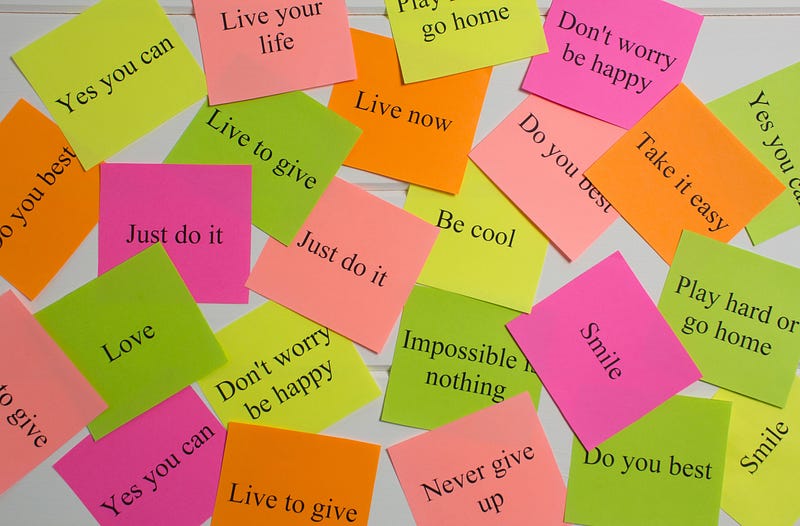
Logical thinkers and cynics love to bash affirmations like the all-time classic from 1920, “Every day, in every way, I’m getting better and better.”
The mere thought that silently repeating positive affirmations in your mind is helpful infuriates some people like this writer at Vice.
Positive Affirmations Are Basically Bullshit. Why doesn’t repeating nice things to yourself — a ritual touted by woo-woo healers globally — make you feel good? — Tracey Anne Duncan, VICE
Well, that was a bit harsh.
But further down in the article, Tracy Anne Duncan hedges a bit by noting, “If an affirmation is perceived as exaggerated, then not only could it not be helpful, but the results could be negative.” That makes sense.
She then goes on to say. “Ilene Ruhoy, neurologist and founder of the Center for Healing Neurology, says, ‘Affirmations can be helpful and powerful. They can help you achieve things.’”
So VICE started at Bullshit and ended with “Affirmations can be helpful and powerful.”
But we cannot deny one thing.
We Talk to Ourselves All Day Long — That’s Doing Affirmations
And 80 percent of our self-talk is negative! Oops!
If 80 percent of my self-talk were negative, I’d say that’s a problem. I don’t need a scientific study to tell me that bashing myself all day long is harmful to my psyche. But here’s some science anyway.
According to the National Science Foundation, the average person has about 12,000 to 60,00 thoughts per day. Of those, 80% are negative and 95% are exactly the same repetitive thoughts as the day before and about 80% negative. — Psychology Today
Ninety-five percent of my thoughts are the same as the day before? Holy cow? I sure hope most of mine are positive.
What to do?
Positive Self-Talk
If you want to increase your positivity, self-talk is the place to start
“There are only two kinds of thoughts,’ explains [Performance Psychologist] Michael Gervais, ‘those that constrict us and those that expand us. — Quoted by Steven Kotler in, The Art Of Impossible
Negative self-talk can drag you down unconsciously. “This sucks. Why is my life so unfair?” I can’t handle this.” Can you imaging talking to a good friend like this.
Positive self-talk moves in the other direction. Positive self-talk provides a little more space to expand and grow. “I choose to be here. I’ve got this. I can rise to the occasion.”
But for this to work, you need a lot more positive self-talk than negative. University of North Carolina professor Barbara Fredrickson came up with the positivity ratio.
“It takes three positive thoughts to counter a single negative thought, she wrote. “This is the tipping point beyond which the full impact of positive emotions becomes unleashed.” Barbara Fredrickson, PhD
The best way to lift yourself up is to remind yourself what you know is true about yourself. Think about times in the past when you’ve succeeded. That’s where you should start. Create some affirmations that are tailor-made for you.
Use these affirmations during the first few minutes of your meditation, before going to sleep, and before getting out of bed in the morning. Talk to yourself like a kind and loving friend.
Meditation
The point of meditation is to disarm your thoughts, not by battling them but by noticing them and letting them go.
As you sit and watch your thoughts, don’t engage. Don’t take them seriously. They’ll go away. This technique is not about what you do but what you don’t do. You don’t feed your thoughts. Notice them, but don’t invite them in for tea.
In meditation, you’re not just ignoring negative thoughts. You’re ignoring ALL thoughts. So a long-term meditation practice will gradually show you that your thoughts are not reality. You don’t have to believe them. Eventually, that “let it be” attitude will begin to seep into your everyday life.
Meditation fosters kindness in general and kindness to yourself in particular.
Become Your Best Friend
Negative self-talk is brutal. “You idiot, why did you say that.” We often say things to ourselves that we would never say aloud to a friend.
A gratitude practice can alter your negativity bias. Here are a few ways to practice gratitude.
Write down ten things you’re grateful for, and as you write them, take the time to feel the gratitude. Let yourself get a bit emotional and notice where you feel it in your body; your gut, head, or heart.
Do this one as you lie in bed at night before you go to sleep. Call up a visual image and name of a person you’re grateful for and say:
“Thank you for everything you’ve done for me. I’m grateful you’re in my life. Or. May you be joyous and happy. May you be safe and free from harm. I’m so grateful you’re in my life.
Call up the image of everyone you’re grateful for — family, friends — and repeat these phrases or ones you make up. Plus, remind yourself how grateful you are to be alive. And how grateful you are for your good health, your job, your home. You’ll find there is much to be thankful for.
I often fall asleep while I’m doing this one. It’s a nice way to fall asleep, I think.
Final Thoughts
I hope I have been able to remind you that you are talking to yourself all day long. That voice in your head is you. Affirmations work both ways, positively and negatively. Over the next few days, take the time to notice your self-talk. Especially notice when it’s negative. Ask yourself, “Is this a nice way to talk to me?
Use all three methods: positive self-talk, meditation, and gratitude practice for the best results.
The Buddha gets the last word on positive thoughts.
Preceded by mind are phenomena, led by mind formed by mind. If with mind polluted one speaks or acts, then pain follows, as a wheel follows the draft ox’s foot.
Preceded by mind are phenomena, led by mind formed by mind. If with mind pure one speaks or acts, then ease follows, as an ever-present shadow — The Buddha, The Dhammapada
If you enjoy reading stories like these and want to support me as a writer, consider signing up to become a Medium member. It’s $5 a month, giving you unlimited access to stories on Medium. If you sign up using my link, I’ll earn a small commission.


