
Things I Wish I Knew Before I Moved Across the Ocean
Holland can seem like you haven’t gone far away from home.
Don’t let it fool you.
When I traveled to Senegal to visit my daughter 20 years ago, I knew I was somewhere else as soon as the plane started to come in for a landing. The soil was different. The architecture was different. English was not their first language or even the second or third.
With our light skin and blonde hair, my daughter and I both stood out from the crowd. This was quite literally true since we are both tall for American women and were often half a head above most people we met. There was no mistaking Dakar for New York, or us for locals.
It was an enriching experience. Sometimes delightful, sometimes less so, my time there helped me grow and gave me opportunities to learn about a culture that was vastly different from my own. I was there for about two weeks, and every day was a new adventure. When I returned home, I had many stories about having been to a foreign country on a continent across the ocean.
Last September, I packed some bags and left the United States. I don’t have plans to come back any time soon. You can read about it here:
Arriving in Holland was familiar. I’d been here before, and although I don’t yet speak Dutch, virtually everyone around me speaks English. You don’t realize how different the soil is until you get your hands in it, and while the architecture is different from New York City, it’s not so different from where I lived in the Hudson Valley, which was, after all, colonized by the Dutch.
My blonde hair means I look so Dutch that people often begin speaking to me in their own language. My daughter, at 175cm, is barely average height here.
It’s easy to think that because I’m in Western Europe instead of West Africa, the culture here is very similar to what I’ve experienced my whole life.
It is not.
There are many things to get used to when living in a new country. Most of the biggest differences I’ve observed have been positive; in many cases, they are why I came in the first place. People don’t carry guns. The police don’t brutalize people. The medical system is remarkably sane. The first two examples are no problem at all, but the medical system, while very pleasant, is still quite a change. Furthermore, all the seemingly small things that still take getting used to, have made immigrating to a new country challenging for me.
Here are a few things I wish I knew.
Holidays are a big deal here.
The holidays are not the same in The Netherlands as they are in the US. You might think some of them are, but no… there’s a whole Dutch culture that celebrates the seasons in their own unique ways, and they are quite serious about it. So, for example, while people here do celebrate Christmas with things like family dinners, they don’t celebrate with bunches of toys and an old guy with a beard.
They do that on Sinterklaas evening, also known as Pakjesavond, which literally means “packages evening” in English. Many of the Dutch people I’ve met are very passionate about this holiday, as well as their beloved Sinterklaas and his traveling band of helpers. It would have helped me to know more about him before I found myself watching his arrival this year online with my grandkids, mouth open in shock as I watched his helpers who were wearing black makeup. My takeaway from listening to the Dutch people I know is that it is best to stay out of the conversation about Zwarte Piet. They will sort it out amongst themselves and are working on it.
New Year’s was also quite a surprise. The Dutch are not, in general, rowdy and wild. That all changes on New Year’s Eve, when people take to the streets, setting off massive amounts of fireworks and burning Christmas trees, making the streets of Amsterdam appear like an apocalyptic dreamscape.
I had been warned about New Year’s and had my noise-canceling headphones handy and avoided being on the street after dark. However, no one had warned me about King’s Day and how crazy busy the streets would be in the middle of the afternoon. As a result, I got stuck near the city center for around an hour, unable to get on public transportation. That’s the kind of thing that shakes me up, so in the future, I’ll avoid going anywhere on King’s Day without a guide.
The color orange is also a big deal, although not as big as bicycles.
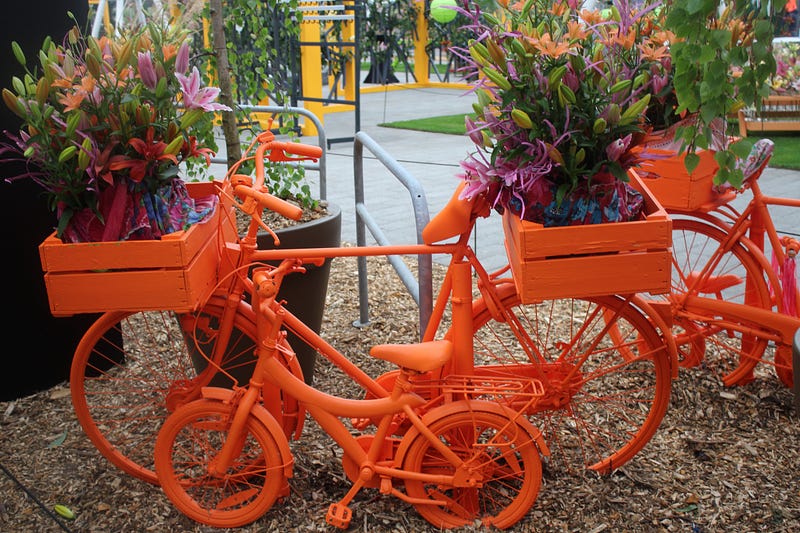
The sculpture of the orange bicycles in the photo at the beginning of this article is very Dutch. Not just because of the bicycles (we will get to that in a minute) but also because the color Orange is the national color and worn as a show of Dutch pride during holidays such as King’s Day and any time there is a sports event with Dutch participants on the field. I wish I had known this earlier because I would have prioritized more of my orange clothing when I packed.
Biking is the best way to get around here, by far, and having a car is not required. There are four times as many bikes in Amsterdam as there are cars and excellent public transportation. However, depending on where you live, many places are easily accessible by bike that are not so easy by tram or bus. If you don’t have a bike, you may find yourself very limited. I can’t ride a two-wheeler, but fortunately, I could buy a used electric tricycle that allows me to get around for those trips that are too far to walk but not on a public transport route. I wish I had known to buy an even better trike because this one has a minimal range. Alternatively, living closer to a tram stop would also make travel easier for me. I plan to upgrade my ride soon, and the one I bought used has been an affordable alternative for now.
…when I was scheduled to get some blood work done, my doctor told me to make sure I showed up “sober” to the test.
You do actually need to learn to speak Dutch if you plan to stay.
It is absolutely possible to visit here and speak only English. Shopkeepers, tour guides, and generally anyone you meet in the larger cities will speak enough English to help you with whatever you need. However, not everyone speaks English here. For one thing, as a senior citizen, I have discovered that many women my age don’t speak English at all. To my dismay, I learned this by going on Tinder to try to find other women and ended up in long and fairly pointless conversations in Dutch that amounted to saying “good morning,” “good evening,” and “have a nice day.” I have also found that if you want to have a social life with people from the Netherlands, it is unreasonable to expect others only to speak your language when you’re in their home.
Furthermore, those who do speak English don’t necessarily speak it as well as they think they do. While most of the people I’ve met can have a basic conversation in English and the professionals can generally communicate what is needed, I realized that some things don’t translate across cultures as easily as others. For example, when I was scheduled to get some blood work done, my doctor told me to make sure I showed up “sober” to the test. As it turns out, that word doesn’t mean the same thing in Dutch as in English, so, fortunately, I double-checked what he was telling me to do.
The Dutch are known for being direct; they are also kind of nosy.
I have found that part of the famous Dutch directness includes directly asking questions about all sorts of things that sometimes have shocked me. My relocation consultant asked me about my relationship ending and whether or not I was upset to have broken up. A random guy who walks past my apartment apparently had many questions, because one day when he saw me out walking my dog, he stopped and asked them all, ranging from whether my dog had come from the states, was I here because of my daughter, and how long I planned to stay. Many people, ranging from neighbors to Uber drivers, have asked for details about my immigration status.
I have to add here that the Dutch reputation for being direct is absolutely earned. My fysiotherapist told me recently that my knee makes cracking sounds because I’m old. A neighbor stopped by one day to tell me I was parking my electric tricycle in the wrong place and referred to it as “this little thing.” (Although, to be fair, that conversation may be more related to the language issue.) And I’ve had more than one person comment on my weight in a way that was very matter-of-fact and nonjudgmental. Those comments were more like, “You’re fat; so was my aunt Emma,” rather than, “You’re fat and need to lose weight.”
Dutch food is basically very basic and a little weird.
There’s a reason why the expression “Dutch cuisine” has never made it into the popular vernacular. For example, someone needs to tell them you can’t just bake some bread in a flattened round shape, throw a few seeds on it, and call it a bagel. The bagels have no taste at all unless you count the vague taste of cardboard.
As it turns out, it seems the Dutch are ALL about convenience foods. They have potatoes already peeled and sliced every which way in the supermarket.
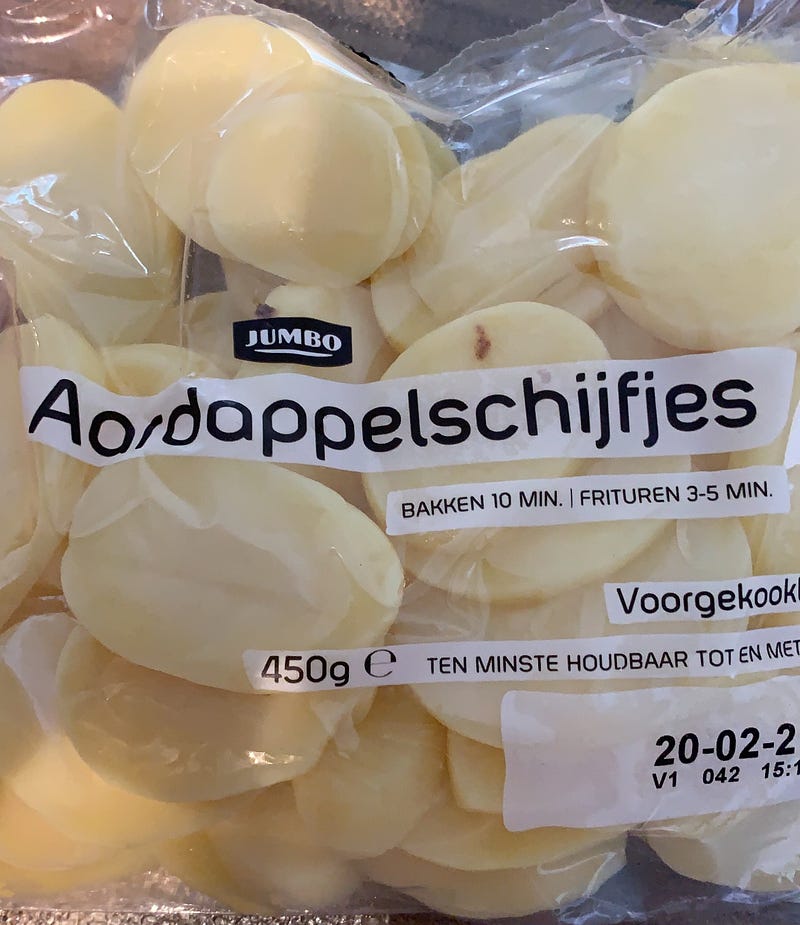
You can buy boxes of ingredients that will turn into dinner and freshly made dinners that have been prepared to go right into the microwave. Also, while I am talking about it, the entire kitchen is weird. The refrigerator is tiny. The oven operates on microwaves. The dishwasher is big enough for doll dishes.
Perhaps most importantly, people here are very kind.
I’m very independent and have learned to do most things for myself. I’m not used to or good at asking for help. However, being in a new country has meant that I often need assistance and sometimes don’t realize I’m going to need it until I’m out wandering around and have become hopelessly lost, or occasionally until I am experiencing a wave of emotions. This has been true when I’ve gotten lost, and people stop to offer me directions, and when I am shopping and feel overwhelmed by the walls of products that I can’t identify.
A particularly touching example happened when I first arrived in the Netherlands on the train from London. I hadn’t seen my grandchildren in nine months and sat watching a family with two small children who were the only other people in the car I was in. I enjoyed watching the dad be what I think of as a typically Dutch father — loving and joyfully involved with his children. They were about the same number of years apart as my grandkids, and suddenly I started to cry. The father immediately came over and asked how he could help. He got me some water and assured me we were almost at our stop and that I would be seeing my family soon. When we arrived at the stop, they were also getting out. My family was on the other end of the track, and the Dutch family checked with me to see if all was well. Then they stood there and waited until my grandson found me and threw himself into my arms. Over his shoulder, I saw the mother and father nod to each other with big smiles as they then gathered their own children and left.
Last but not least, google translate will be your best friend and, just like your friends, will sometimes let you down.
I wander around the stores with my phone in my hand and my google translate app open. I used it to have all those conversations on Tinder. I also use it to try to comprehend the many pieces of mail I get from the government. Trust me when I say that it doesn’t always help.
I have received pieces of mail that informed me about policies regarding donating my organs when I die and ones that seem to want me to send samples of my poop. I may or may not have any of that right. Recently I was trying to figure out what was in some sausages, and the app said they were “dirty.” When I gave up and asked one of the people who worked there what type of sausage it was, she told me it was just “regular sausage.” I have no idea what she or the app meant by that.
I bought them anyway. I’m just as weird as the Dutch are.