
Things I learned about myself from a month-long, 5,000-mile road trip (Part 1)
Screaming in the car and pooping in the desert.
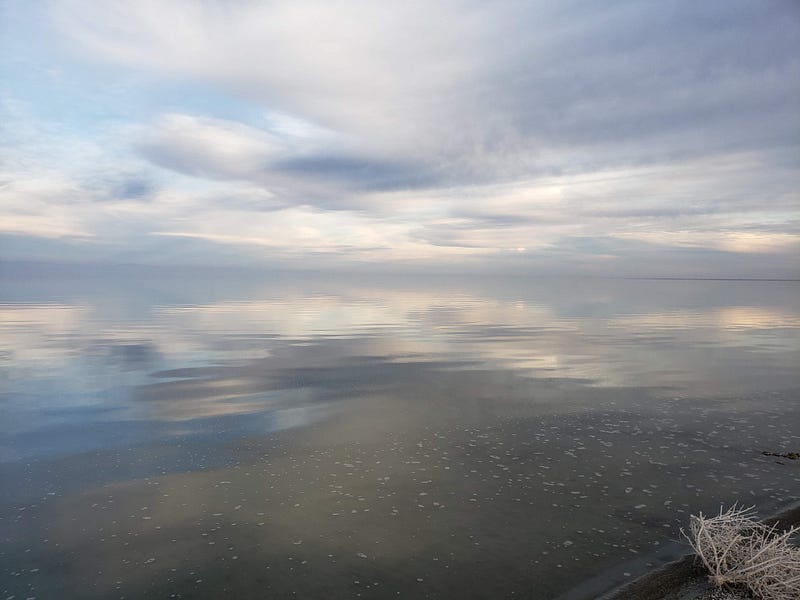
I recently returned from a 5,000-mile, month-long road trip. It was part of my year-long sabbatical that I’m calling my midlife process to avoid a midlife crisis. It was hugely impactful, a deeply emotional and spiritual journey. It felt like a Readers’ Digest version of “40 days in the desert”.
The trip took me south and west from Ohio, down into and across Texas-New Mexico-Arizona, out to San Diego, CA, up to Denver, CO, and back south to Roswell, NM before heading home.
A couple of months prior I had completed a two-week, 2,000-mile road trip that took me south and east; Tennesse, and North and South Carolina. Both trips provided me with opportunities to reconnect, or in one instance connect for the first time, with family and friends.
In an effort to process and integrate my experiences, I’m pushing myself to capture things that became clear to me during my “time in the desert”. The hope is that through sharing them, I deepen my own understanding.
I decided to cut this list into two parts. The order is random, as is the line I drew between the two parts.
Here we go.
Simple living was happy living.
I lived out of my 2004 Toyota Highlander. Periodically, I would stay in a hotel to get a shower, do laundry. I was incredibly content and happy. The only thing missing was my wife. If she had been with me I’m not sure when I would have gotten tired of living like that.
Every material thing I “needed” (that word is up for debate in this context, but I won’t go down that hole now) easily fit in my car. With room for me to sleep. That even included my guitar.
I have been on the minimalism/essentialism/enoughism path for a number of years now. While I am far from a fanatic with or for any of those “isms”, I have purged quite a bit of stuff from my life. I am sure this preexisting mindset helped prepare me for my “Highlander life”.
Being completely alone, taking my pants off, and pooping in the middle of nowhere was surprisingly empowering.
If you’ve done this you probably know what I’m talking about, even if the experience frightened you or you don’t want to admit it. If you have not had this experience there’s no use trying to explain.
I think nighttime is the right time.
Scream therapy works.
I was driving from Tonopah, AZ to Joshua Tree National Park, CA, on I-10. A song started playing from my playlist that I associate with a time in my life when I felt very close to my daughter (read more about my relationship with my daughter here). Listening to that song, I struggled with a mix of feelings of gratitude, loss, and grief for that relationship.
I could feel all of that deep in my gut as I drove. As much work as I have done on these feelings over the last six months, I still felt this kernel, this seed of negativity. I hadn’t been able to release it. For some reason, that day, on that highway, the thought occurred to me that there would never be a better time to try screaming to see if that might help me work loose these feelings of grief, frustration, and anger.
I’ve never been much of a screamer. As I’ve written elsewhere, I was once told by a therapist that I have the sensibilities of a southern lady stereotype (reserved, putting the needs of others before my own, etc). I am not good at expressing negative emotions. But, I was over a week into the trip and drawing deeper into internal connection. I was becoming better at trusting these urges that came up from somewhere inside.
It was a beautiful morning, I had the cruise control on and traffic was light. I focused on my pent-up, unexpressed anger, frustration, and feelings of loss. And I screamed.
As I am writing this, tears are in my eyes (which can be somewhat embarrassing in a coffee shop) because I remember the feeling of things leaving me through those screams. The first one or two served to build a bridge to those feelings, to give them a means for escaping. I don’t remember exactly how many times I did scream, but it was enough. It ended naturally, and I felt cleaned out, a comforting hollowness.
Safa Roberts, a wise and wonderful healer and mentor, said not to be so quick to fill in that space once you create it. Take comfort in that emptiness.
That’s what I did. I sat with it as I drove, cherishing that emptiness. I think I still feel lighter after that.
The ability of words or pictures to represent an experience is in negative correlation to the intensity of that experience.
It was a moonless night at Big Bend National Park in Texas. I had climbed out of the car to use the bathroom. I looked up at the sky and stopped.
My brain shortcircuited. Even now as I write this, I can still experience that feeling. I was standing there talking to myself out loud, just repeating over and over “I don’t know what to do with this.” I was literally overwhelmed by the beauty of the sky.
I’m not going to attempt to describe the night sky to you. I didn’t try to take a picture of it. The words I write will not convey the feelings I had during these experiences (pretty frustrating for a writer).
The better the writer, the closer they can take us. But only so far.
Once I had this realization, it actually quieted the part of my mind that needed to try to narrate these incredible experiences. That narration is a (nasty) habit for my mind, the need to create a description and story around things in real-time. With that moved to the background I was better able to just absorb these individual moments.
Camping on land set aside by the Bureau of Land Management for recreational use started an unexpected love affair.
Living all of my adult life in the midwestern US, I was not familiar with the federal Bureau of Land Management (BLM). To the best of my knowledge, there is no BLM land in Ohio, where I live. The type of land I’m describing is not part of the national parks system, although the two types of land can be located next to each other. The vast majority of land managed by BLM is west of the Mississippi River. I started learning more about it over the last few years but still wasn’t sure how “it worked”.
Fast forward to me sitting in a cheap motel in Phoenix, AZ. I was looking for a way to cut up my trip to Joshua Tree without staying in another motel or commercial campsite, like KOA. I was messing with Google maps, reviewing my route, and happened to zoom in at the right place. I spotted “Saddle Mountain BLM” outside Tonopah, AZ.
I fell in love with BLM land at Saddle Mountain. Rough roads, no facilities, no real sites. There may be a fire ring that was built by a previous camper. Just find a spot that takes any potential neighbors’ privacy into account (if they are on BLM land, it’s safe to bet they like their privacy), and set up camp. No fee to pay, just a stated limitation of 14 days. I really have no idea how or if they enforce the two-week limit.
It was like an open-world video game; if you saw someplace you wanted to go you had to head in that direction and figure it out as you went. My little fantasy of being the first human to put my foot somewhere flared up pretty hard.
I stayed at Saddle Mountain one night on the way west and two nights as I was headed back home. I stayed on BLM land outside Joshua Tree National Park. I stayed on BLM land outside Roswell, NM.
I’m not sure I have ever felt freer in my life than when I was on BLM land. Especially outside Roswell. I didn’t see another human being until the following day when a truck went by headed toward a wind turbine farm miles off in the distance.
You can guess where the pooping took place. Nighttime is the right time.
Stay tuned for Part 2.