They/Them Pronouns Deserve Just as Much Respect as Ours
This trans woman asks that you listen not only to HER, but also to THEM
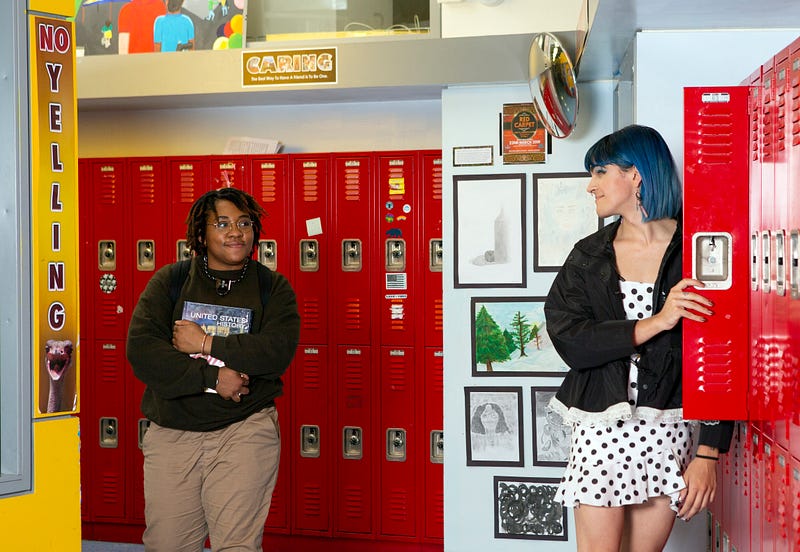
Let’s imagine the English language was like Finnish. If it were, all of our pronouns would be gender-neutral. We would call everybody “they/them,” regardless of their sex or how they identify.
Example: Josephine loves birds. They are often rescuing injured pigeons. Raul, on the other hand, fosters puppies. At the moment they have a poodle named Flower.
Suppose one day Raul—who is particularly manly—says, “You know what? Don’t call me they/them anymore. Call me he/him. Being a guy is a core part of me. I’d like for that to be conveyed in my pronouns.”
But people think Raul is being a special snowflake. Why do they feel the need to have a different pronoun from everybody else? Er, I’m sorry, why does HE feel the need… See, Raul, why must you make things so difficult?
Perhaps this gives you an idea what it’s like for gender non-binary people. Their “they/them” gets perceived as a burden. But the real burden is our system of gender. It leaves non-binary people out. It forces them to make special requests and to seem so different from the crowd.
If the system had been inclusive all along, then we’d already be used to gender-neutral pronouns. And non-binary people would already feel comfortable and accepted by mainstream society.
Just as puppy-loving Raul likes his masculine identity, bird-adopting Josephine enjoys being gender-neutral. Sorry, I don’t know what birds and puppies have to do with this; I just threw them in for added cuteness. But my point is that it’s nice to have your identity validated and understood by people—instead of contradicted every time someone refers to you in a conversation.
If “they/them” is new to you, I hope this analogy helps you put yourself in a non-binary person’s shoes. Compared to their struggles to be recognized by society, a little effort to be inclusive is no sweat.
I notice my binary privilege a lot when people accept me as a trans woman
I know it’s a privilege that I fit in a binary. Acceptance of trans women has not been an easy fight. But folks at least find it comforting a girl like me doesn’t disrupt conventional gender too much.
One time I was accepted by an older cis woman, who spoke of a gender-nonconforming person she knew. She suggested that the person—a family member of hers—needed to “pick a side.”
I was a passable-looking “she/her.” My gender seemed more acceptable to her than someone whose gender is in flux or defies labels. She was worried for her family member. She only wanted them to fit in and live a good life. But for a person who naturally expresses themself otherwise, being forced to conform to arbitrary standards of gender is not an ideal existence.
Luckily, the world is changing fast. Your non-binary loved ones are not doomed to a life of either social oddity or suppression. Instead, they are destined for increasing welcomeness and integration.
The same could be said of other types of people who struggle for acceptance because of gender. It is not on the individual to stop expressing themself so freely or authentically. It’s on all of us to move into a society that fully supports freedom of gender.
I wish I had illustrated to my older female friend why non-binary expression deserves equal respect. I’ve seldom had the aplomb to stand up for my own gender to those who weren’t “convinced.” At least in writing, I hope the right words of allyship can roll off my tongue.
“Non-binary” and “they/them” are 2 different things I’ll try to clarify
I do not presently identify as non-binary. It’s possible I’d get something wrong here. Besides, non-binary people are diverse in how they describe gender. So I hope folks feel welcome to add their own distinctions in the comments!
But here is my current grasp of 5 important points. I thought these could be useful to clarify for anyone still trying to get non-binary identity.
1. Pronouns are a little different for everybody
Not every non-binary person is bothered by being called “she” or “he.” Some people go by any pronouns, because all feel equally fine. Others feel good being called either “they” OR “she”—or “they” OR “he”—just not all three.
2. Don’t be intimidated by new vocabulary
The main synonym for non-binary (also spelled nonbinary or “enby” for short) is genderqueer. There are also more specific terms:
- Agender means no gender.
- Bigender or genderfluid suggest multiple genders they combine or change between.
- Indigenous societies may have their own culturally specific third gender roles with distinct names.
- Gender-nonconforming usually refers to a person’s behavior or expression more than their sense of self. That’s why earlier, I described the family member of my friend with this word, as I had no idea how they would identify.
- Trans or transgender is also a broad word. It can describe anyone whose gender is different from what they were assigned at birth. So trans, as an umbrella term, can include non-binary. But it is most common for trans to be refer to someone like me or Laverne Cox who is male-to-female (a trans woman), or to someone female-to-male (a trans man, like Laith Ashley). We are binary since our identities fit with the male/female duality.
- Cis or cisgender means not transgender, and not non-binary. This is the majority.
If some of these terms are new, don’t be intimidated.
It’s similar to how we have the words girl, woman, chick, lady, female, all with slightly different flavors. I didn’t learn all the nuances of these words overnight when I was a child, so I don’t expect anyone to learn all the trans vocab overnight either.
3. Non-binary is not about how you look, but how you feel
Do non-binary people look androgynous, or not as classifiably male or female as the average person? Often, but not always.
As Treavian Simmons points out in ColorBloq, it’s important not to equate non-binary identity with an androgynous form. No one should feel pressured to look gender-variant just to prove who they are; they can sculpt their looks however they’d like, or not change at all.
Plus, what’s considered “androgynous” is often associated with Eurocentric standards of fashion, such as what’s worn by the mostly thin, white models. Any body can be non-binary.
4. You can identify as “non-binary” to a greater or lesser degree
How do you know you’re non-binary? It seems there’s no exact distinction who is or isn’t an enby. You can strongly resonate with just being a person (nixing the “man” or “woman” label) while also having a binary identity you feel okay with to a degree.
Example: Some posters on Reddit, assigned female at birth, described themselves with words like non-binary woman and genderqueer female. This acknowledges both biological experiences, and psychological gender. It also encapsulates their lived experiences as “women” in society + the fact they’re uncomfortable with it.
Another term I encountered the other day was non-binary trans woman. This would almost be me, if I chose to identify more with my in-the-middleness. Normally I just think of myself the same as a woman in terms of mental gender, only that I was born in a male body. Who knows? I’ll always be super feminine, but I could always change my mind in the future about how I conceptualize my gender.
Despite the above, some non-binary people don’t want to be put in a woman/man box at all. I once enjoyed a YouTube video by someone who looked as androgynous as could be. They had no interest in disclosing what sex it said on their birth certificate.
5. Gender pronouns and identity are related, but knowing one does not necessarily tell you the other
While identity can be complex, pronouns are simple! More people these days are putting they/them, he/him, or she/her in their email signatures, even if they are cisgender. This normalizes the pronoun subject, making transgender and cisgender people more equal. We also get invited to share our pronouns during group circle introductions. These are easy cultural shifts to show respect without putting each other on the spot!
Listen to cues about pronouns. Whenever I learn somebody’s, I like to repeat them in my head several times so I remember. Phoenix, she, Phoenix, she. She is Phoenix; Phoenix is she.
When in doubt, you can rarely go wrong with they/them pronouns. Knowing whether a person identifies themself as non-binary or not is not as essential, as anyone can be respectfully referred to as just that: a person.
Thank you for listening to my spiel about “they/them” and non-binary inclusion. I just learned that the world’s 2nd “out” non-binary mayor was elected in Bangor, Wales! Their name is Owen Hurcum.
On a different subject, this month I’m dedicating my writing to the nonprofit Vegan Outreach. They host an online 10 Weeks to Vegan for about 30 countries. They also contribute food aid for those in need. It would mean the world to me (and fellow creatures) if you decide to donate to my fundraiser. Thank you!