
They Strangled and Hit Her With a Hammer 40 Times
Using the dark web they planned a terrible crime.

“They are devils who have no human heart, so I only want a death sentence. That’s why I’ll do whatever I can.”
-Fumiko, Mother of Rie Isogai
Rie Isogai was walking home from work like every other day. Usually, she called her boyfriend as she walked to the station so she could feel safe. Japan is a generally safe country and crime is low compared to most countries so it’s just an extra precaution she took just in case.
But on August 24, 2007, on the way home from work Rie wasn’t able to contact her boyfriend. As she left her work and was on her way home, she was grabbed by three men who kidnapped and planned to rob her. In the end, they ended up suffocating, strangling and hitting Rie over the head repeatedly with a hammer before dumping her body in the mountains.
Who were these men? How did they meet using the dark web? Why did they choose Rie and why did they decide to kill her? How were they caught and what happened to them? This is the story of the kidnapping, theft, and murder of Rie Isogai who fought until the end and left her murderers with a surprise that they would never forget.

“The more time goes by, the deeper my sorrow of not having my daughter here,”
Mother of Rie, Fumiko Isogai
Who was Rie Isogai?
Rie Isogai was born in Aichi Japan on July 21, 1976. A report from Kyodo News explained Rie was an only child and her father died of leukemia when Rie was just short of 2 years old. So it was Fumiko Isogai who was the sole parent of Rie. A single mother who had raised a smart, honest, hard-working, and caring woman.
Rie worked at an office as a contract employee but was adamant about saving around 100,000 yen or about $1000 dollars a month to buy a house. Her mother often talked about how when Rie’s father was still alive they dreamed of buying a house together. Rie wanted to surprise her mom and buy a house as a gift to her mother and had raised 8 million yen which is about $80,000.
Rie was also interested in a Japanese game called GO, which is originally a Chinese strategy board game that resembles Othello or chess. Rie started attending a GO cafe where people could meet other enthusiasts and play the game. At this cafe, she met an undergraduate student in mathematics named Taki and they hit it off.
They started dating and would often play a number game in which numbers represent words. Similar to English 143 meaning I love you. In Japanese for example the number 39 (in Japanese san and kyu) means Thank You because of the way the numbers sound(San-kyu).
The couple was so close that Rie would call Taki on his home phone (he didn’t own a cell phone) every evening while commuting back home. Unfortunately, on the evening of August 24th, Rie called Taki but no one was at home. This would be her last call to anyone.

The Dark Web
In 2007, according to Yahoo News, there was a private underground site on the dark web called (rough translation), “Dark Employment Security Office” which was an underground bulletin board site that many people used to discuss, recruit and plan for crimes.
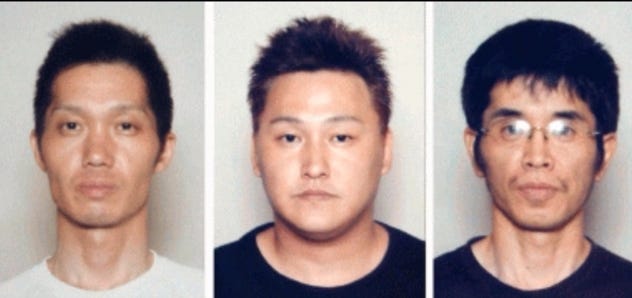
A report that detailed the crime on Abema TV, explained how three strangers ended up meeting on this site to carry out their plan which ended in the death of Rie Isogai. In the television report, they explain that a 40-year-old unemployed man living out of his van, Kenji, Kawagishi, a 36-year-old newspaper clerk, Tsukasa Kanda, and unemployed and heavily in debt 32-year-old Yoshitomo Hori, all found each other on the criminal job site.
On August 17th, Kawagishi wrote, “I’m out of prison and living in my van. Anyone in Aichi wants to join me?” Horii and Kanda replied and were interested to meet up and try to rob people. Murderpedia gave a rundown on the men’s actions before finally setting their minds on robbing a young, office worker.
Another man Yuichiro Hondo also replied and was interested in joining the men. The four of them exchanged ideas such as robbing an owner of a pachinko parlor (Japanese slot machine center) and met that same day but failed to follow through. Once again on August 23rd, Hondo and Kawagishi broke into a plumber’s office but something went wrong and Kawagishi ran away leaving Hondo alone. Hondo surrendered to police and was arrested for trespassing and attempted robbery.
The remaining three men then met in a parking lot in Nagoya to think of a new way to get money. That’s when Kanda recommended abducting a woman and forcing her to give them her money. Hori and Kawagishi liked the plan as it would be easy for three men to overpower a woman and abducting her in their van would allow them the time and privacy they needed to rob her and avoid detection.
The Crime
On the evening of August 24, 2007, the three men drove around the Nagoya area looking for women who were walking alone. They started their search around 7 pm and were hoping to grab someone who was walking in the dark streets away from the city center. That’s when at around 10 pm they spotted Rie, who was walking down the street in Jiyugaoka on her way home. She was just 100 meters or about 300 feet from her home when they approached.
Usually, she was home much earlier but on that day she was attending a work party so was arriving home much later. As she was walking, Hori got out of the van and approached her asking for directions. When she stopped to help, the three men forced her into the van.
Once inside the van, they handcuffed her and threatened her with knives demanding she gives them her money and ATM card. Kawagisihi drove his van to a parking lot in the outer areas of Nagoya where it was much quieter and no one was around to hear her scream.
At first, Rie refused to give up her ATM pin number but after continuous threats and beatings, Rie told the three men her pin was 2960. Once they had her pin, Kawagishi tried to sexually assault Rie but the other two intervened. During the confrontation, Rie tried to escape the van but was caught.
According to Wikipedia, Kanda placed a bag over her head and wrapped packing tape around her head to smother her. Finding it was taking too long, he took a hammer and started hitting her over the head while the other two Hori and Kawagishi started choking her with a rope.

Rie’s Revenge
After Rie had died, they drove to a forested area in Gifu Prefecture and dumped her body around 4 am on the 25th of August. They found 62,000 yen about $600 in her wallet which they split. They then drove to a convenience store and used Rie’s ATM card to try and withdraw the 8 million yen she had in her account.
Unfortunately, the pin she gave them 2960 didn’t work. The number she had given them was not her real pin number and the numbers 2960 in Japanese are read Ni-ku-mu-wa which means, I hate you. Until her dying moment, she had refused to give anything to the men and foiled their robbery attempt.
The three decided to meet up again the next evening and try robbing another woman in Nagoya. But in the afternoon of the 25th, Kawagishi called and confessed the crime to the police. He described the crime and told police where to find Rie’s body. He explained to the police he surrendered to avoid the death penalty which is waived if a criminal surrenders to police before being identified as a suspect.
Using the information from Kawagishi, the police found Rie’s body and contacted her mother who was in Nagano at a golf course at the time. Rie’s mother drove back to Nagoya and identified Rie. She said of the experience,
“I just wanted to hug her tightly, but I remember I couldn’t because it was too painful. Finally, I remember she was colder than I had imagined when I put my cheeks on her cheeks.”
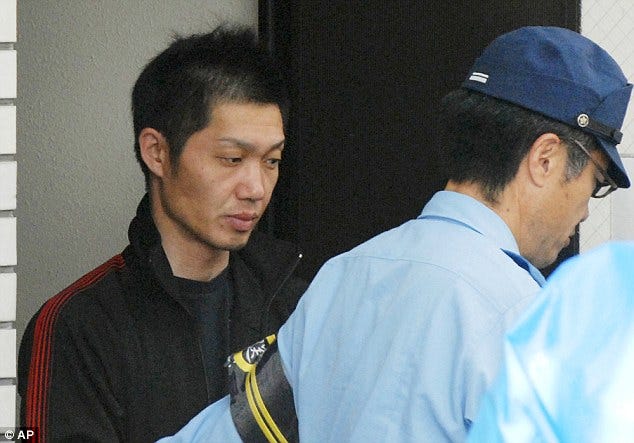
The police were able to find the remaining two men and arrested all three men charging them with robbery, murder, kidnapping, confinement, and abandonment of a corpse. Kawagishi was also charged with attempted rape.
“I don’t think there is room for rehabilitation for the criminals of these crimes. The death penalty should be retained in Japan.”
Tsunehira Furuya, crime writer
Trial
Before the trial even began for the three men, Rie’s mother Fumiko started a petition in 2007 asking for the death penalty for all three men. Victims Families For The Death Penalty thanked Fumiko and applauded her for getting over 300,000 signatures by December 2008.
She presented her petition to the District Public Prosecutors’ Office of Nagoya. Usually, in single murder cases, the death penalty is not sought but because of the petition, growing support by Japanese people for capital punishment, and the case’s connection with the dark web, prosecutors asked for the death penalty. Even the fathers of Kanda and Kawagishi asked the court to sentence their sons to death.
The trial at the District Court of Nagoya began in September 2008. All three plead guilty to robbing and murdering Rie Isogai but during the trial, each defendant blamed the other for being the mastermind and coming up with the idea to murder Rie.
The defense used this to try to persuade the court that none of them should receive the death penalty as the crime though premediated escalated to murder as each man tried to outdo the other. Kawagishi told the court that Kanda was the leader and had originally planned to kill Rie. Hori also claimed Kanda was the leader and until Kanda started suffocating Rie, he had not intended to kill the victim. Kanda claimed all three had agreed to search for a woman, rob her and then kill her for the get-go.
In the closing arguments, the prosecutors demanded the death penalty for all three including Kawagishi despite his confession. Claiming he showed little remorse for the murder and only confessed to lessen his sentence, he deserved the same punishment as the others.
But the defense claimed that without Kawagishi telling police where Rie’s body was and who the other two culprits were, the case might have never been solved. They felt Kawagishi aided in the investigation and should get a more lenient sentence.
Sentencing
Finally, on March 18, 2009, all three were found guilty of the murder of Rie Isogai. Kanda and Hori were sentenced to death. However, Kawagishi was sentenced to life in prison. Presiding Judge Hiroko Kondo felt,
“Kanda had played a leading role in the murder. Their motives for the crime left no room for leniency and that capital punishment was the only option, even after considering that there was only one victim, because their criminal acts were extremely merciless and heinous and deemed to be a serious threat to society.”
Kanda’s lawyer appealed the decision but Kanda withdrew the appeal and was executed in June of 2015.
Hori also appealed to the High Court of Nagoya and in April of 2011, his sentence was reduced to life in prison as the court found that both Kawagishi and Hori were being led by Kanda.
However, in a surprising turn of events, it was found that Hori had actually robbed and killed a couple in 1998 and was once again sentenced to death. According to the report from the Tokyo Reporter,
“Judge Taro Kageyama sentenced Hori to death for the robbery and murder of 45-year-old Ichio Magoori, the manager of a pachinko parlor, and his wife, Satomi, 36, in Hekinan City, Aichi Prefecture in June of 1998.”
The Daily Shincho reported that Hori appealed to the Supreme Court but his death sentence was finalized in July of 2019.

A mother who never forgets
Fumiko Isogai continues to fight for the rights of victims and their families even long after her daughter’s death. She was interviewed by The Japan Times and felt that Japan needs to reform its policies and find ways to ensure families of victims can get justice.
“Isogai, who gives lectures nationwide as a family member of a crime victim, urged the government to strengthen support for families of those who fell victim to crimes, saying they bear heavy psychological and financial burdens following the death of their loved ones.”
When asked how things can be changed she explained the problem that many victim’s families have after the trial is over.
“Currently, even if families of murder victims win compensation in a civil trial, there is no way for them to obtain money from offenders if the offenders fail to pay. And the right to be compensated based on a civil suit ruling expires in 10 years, meaning the families have to file a lawsuit again if they are not paid by then.
The current system is nothing but a burden to victims. There should be a system through which the government compensates victims’ families when offenders don’t make the payments and claims the expenses to the offenders.”
At the time of Rie’s murder, Fumiko fought for the death penalty, and now she continues to fight for the rights of the families of the victims. And despite losing her daughter in such a cruel and terrible way, she wants the death of her daughter to mean something and bring about good and change to the world. She wrote in a book about the case, “I think that the meaning of my daughter’s life is not to let her death be forgotten so that these incidents will not be repeated.”
If you liked this article, please check out these stories of true crime: