
They Should Never Make a Film Adaptation of ‘The Shadow of the Wind’
Some books should be left alone
From almost the moment motion pictures were invented, filmmakers have been turning books into movies. From the Iliad and the Odyssey to the plays of Shakespeare to the latest bestseller, Hollywood has always been ready to bring a successful (or even unsuccessful) book or play to the big screen. They do this in part because people are more likely to see a film based on something they’re already familiar with.
While most hardcore readers naturally think a book is always better than a film adapted from it, this isn’t always the case. It is true the majority of the time, but there are notable exceptions. And though it may sound heretical, there are actually a few instances where the movie far surpassed its source material; The Godfather and High Fidelity were two such rare instances.
Tragically, there are countless examples of superb books that were adapted into horrible films. In my opinion, the worst of these was the adaptation of the Bret Easton Ellis novel Less Than Zero; I was so incensed that I wrote an entire article about it here. Adaptations typically aren’t this bad, but even a mediocre adaptation can have a detrimental effect on a magnificent novel.
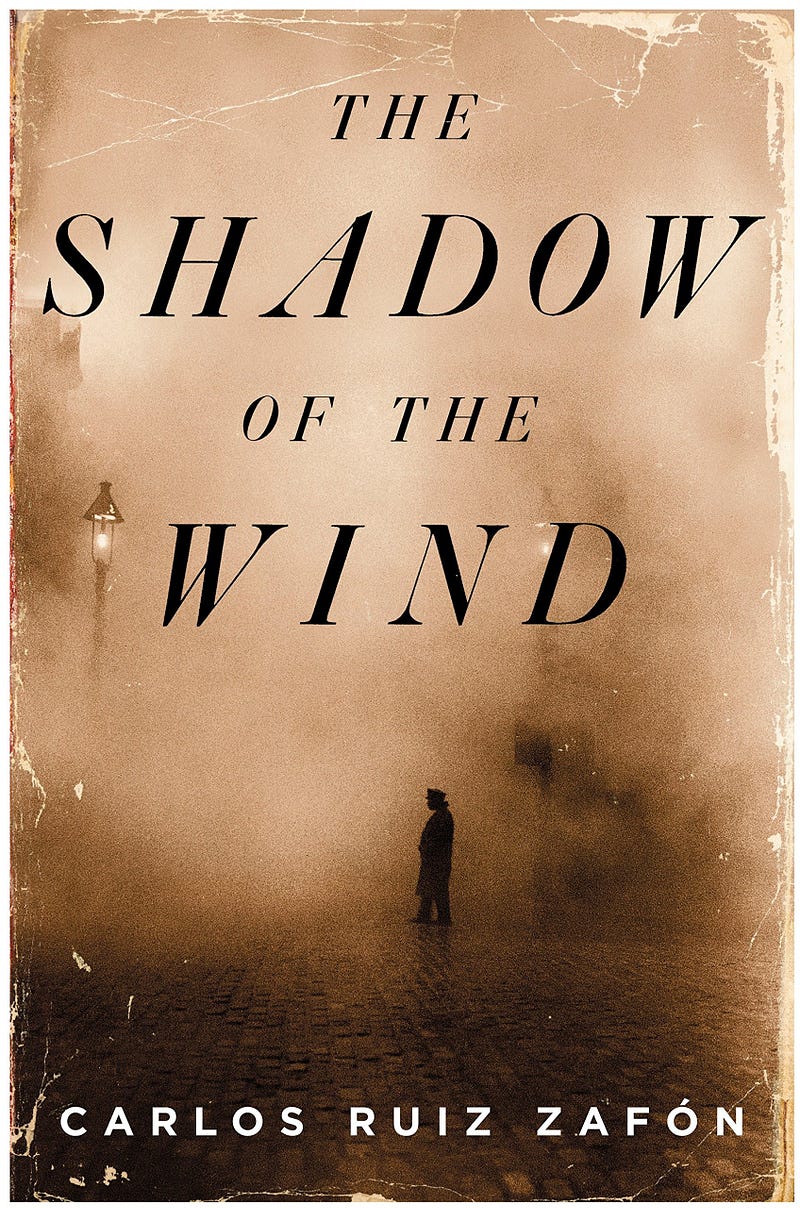
This is why I firmly believe that there should never be a film adaptation of the Carlos Ruiz Zafon novel, The Shadow of the Wind. My good friend and film guru Simon Dillon disagrees, convinced that Guillermo del Toro could do the novel justice. And while I admit that the thought of Benicio del Toro taking on the role of Fermin Romero de Torres has crossed my mind more than once, even that is not enough to sway me, for the following reasons.
My first objection to any adaptation should be obvious: Zafon himself opposed it. This surprised me when I first learned about it, because in addition to being a novelist he was also a screenwriter. Yet in a 2010 interview in the Wall Street Journal, he said this:
“I just feel like my books are well as they are. They belong in the book world. The best film version is the one you see in your brain and that’s enough for me. I want them to subsist on the word of mouth of people who love books.”
The author should have the final word on this, and since that word never changed before Zafon’s untimely death from cancer in 2020 at age 55, it should remain forever final.
My next objection is what I call the Less Than Zero principle (from the example above). Ellis’s novel would have been virtually impossible to film exactly as written, not least of which because it would have received an X rating from the MPPA. While there is nothing in The Shadow of the Wind that would be considered X-rated, Hollywood would inevitably do some of the same things to it that they did to Less Than Zero.
First, despite the fact that the novel has sold more than 15 million copies worldwide, is the second-best selling novel of all time in Spain (after Don Quixote), and clearly has a built-in audience, some idiot executive would want a “star” attached. They would throw around names like Tom Cruise, Leonardo DiCaprio, and Bradley Cooper, ignoring the fact that for much of the book the lead character is in his teens and is Spanish. This last point is crucial.
It was perfectly fine for John Cusack to change the London setting of the novel High Fidelity to Chicago in the film; the city was not crucial to the plot as long as it was a major metropolis. The Shadow of the Wind cannot be moved from Barcelona (the city is as much a character as any of the people are) and any actors in an adaptation would have to be Spanish. You can get away with having Robert Shaw (an Englishman) play a German major in The Battle of the Bulge, but it simply will not work here.
You might argue that it could be set in a fictional, unnamed city with the same Gothic feel (like the unnamed Eastern European city in Kate Beckinsale’s Underworld), but then it would cease to be The Shadow of the Wind. Barcelona matters because the novel is, in addition to every other magnificent thing about it, Zafon’s reflection on the most pivotal and divisive period of Spain’s recent history, a period every Spaniard still wrestles with: the Spanish Civil War from 1936 to 1939 and its continuing influence on Spanish society. This aspect cannot be removed, and it is questionable whether a non-Spanish director (even one as good as Guillermo del Toro) could pull it off.
I’ll give a final reason the novel should never be made into a film (I have more, but this piece is already reaching a length many will avoid), using something once said by the late, great Tom Petty. When MTV first burst on the scene in the early 1980s, Tom Petty and the Heartbreakers only released videos that featured the band playing the song. There was no concept or story because Petty felt that if he did that, he would be replacing the listener’s experience with his own vision. Put more simply, if “The Waiting” was playing on the radio the first time you had sex, he didn’t want to replace that image and memory with a story some intern created for the song’s video.
This idea fits perfectly with Zafon’s quote above: “The best film version is the one you see in your brain.” After multiple readings over nearly two decades, the way The Cemetery of Forgotten Books looks and feels is firmly planted in my mind and any attempt to recreate it on film would surely differ to such a degree that it would be jarring to watch. Everyone who has read the novel sees that magical sanctuary of books a little differently, and it should remain that way.
For these and many other reasons, I pray that they never adapt The Shadow of the Wind into a film. For me, it would be as bad as someone turning Born to Run into a stage musical (like Green Day’s American Idiot). I have lived with Mary, Wendy, the Magic Rat, Scooter, and the Big Man in my head for nearly 50 years; I know how they look, sound, even what they’d eat for breakfast. The same is true for Daniel, Bea, Carax, Senior Sempere, and most of all Fermin. Zafon said they belong in the book world, and who would know better than him?
If you’ve read the novel, let me know what you think in the comments. If you haven’t, stop reading my ramblings and go buy it today. You’ll be glad you did.