
They Never Talked about The War
Until I Met Viet Nam Vets of the 101st Airborne
Chapter 2 from Finding My Hero: An Adoption Memoir from World War 2 (forthcoming, 2021)
A Sailor Kissed a Nurse
On Aug. 14, 1945, a U.S. Navy sailor kissed a nurse in Times Square to celebrate the end of World War 2. When Alfred Eisenstaedt, a photographer saw the couple, he grabbed his camera for a shot that would end up on the cover of LIFE magazine. 75 years later, Etsy, Zazzle, Amazon, and poster companies sell posters of the sailor and the nurse: large, small, framed, unframed, even colorized.
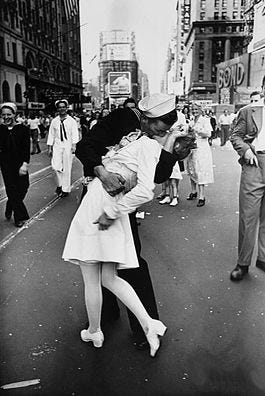
Although I’ve never taken a poll, I’m guessing that many people who recognize the photo don’t know it was taken on V-J day, the day Japan surrendered to the Allies and the War was over.
Nobody Talked about The War
My birth-father, 101st Airborne, 506 PIR, died on D-Day, June 6, 1944, during the Allied invasion of western Europe. If I were to write a book about him, I would need to know about The War.
Despite a Ph.D. in American History, I knew little about The War! I knew about Rosie the Riveter, the name for the women who went to work in war-industry factories during the war. After all, my academic specialty had been women’s history. I knew two uncles served in The War but never left the States.
6 million European Jews died; 407,000 American servicemen died; 12,000 American civilians died; 183,00 American kids lost their dads; $350 billion American dollars went into winning this war. The figures are staggering. And yet they never talked about The War.
A week from my second birthday, on May 8, 1945, Germany surrendered to the Allied forces. Japan surrendered in August. I’m sure great celebrations took place in Denver, parades with grand marching bands, flags flying on front porches. I don’t remember. Growing up, I would only hear oblique references to The War.
Bits and Pieces
When I was a little girl, I had a stamp collection which Gertrude, a retired math teacher who lived next door, helped me with. One afternoon we ran across some German stamps with a picture of Hitler. She said “MaryJo, you don’t want these in your collection.” “OK,” I replied, as we continued sorting stamps and putting them in my stamp book.
I didn’t ask why I didn’t want pictures of Hitler in my collection. I didn’t recognize his picture nor would I have recognized his name.
My Uncle Jack had been in the service. I’d seen a photograph of him in his uniform. When he came back home to civilian life, his back hurt. Nana, my grandmother, would say “Oh, Jack’s back hurts because some lieutenant in the Army made Jack pick up a jeep.”
Helping my partially-blind grandmother find something in the bottom desk drawer, I ran across my ration card. “What is this?” I asked. “Oh that just shows how much sugar or flour you could have during The War,” Nana answered. “But what are these stamps?” She explained that she had to give a stamp to the grocer when she bought something, even something for a baby.
I lived at Nana’s immediately after my adoption as did my maternal cousins. Their Dad was an Army medic in California; their Mom had gone to California to be with him. When I was brought to Nana’s from the orphanage, my Uncle happened to be home on leave. Some in the family have said that Nana “pulled strings” to get him home because the baby girl whose adoption she had arranged was quite sick. After all, he was a doctor.
It seems unlikely that Nana would have had the connections to get a leave for her son on a specific date because of a sick, baby whom her daughter and son-in-law had adopted. Others assured me that Dr. Brown, a pediatrician, was called immediately. A letter written to me by my Mother when my son was born indicated that my Uncle was coming home before they knew the day I would be taken from the orphanage. Whatever the truth, the story isn’t about The War.
The parents of one of my best friends, Marion, had escaped from Germany and certain death in a concentration camp. Her grandparents and all but one aunt did not. I was at Marion’s house often and sometimes intimidated by her Father, Hans, because I couldn’t understand his pronounced German accent. I did sense he was a kind man.
Marion’s parents never talked about The War or the Holocaust. Many years later, Hans and his wife Ellen moved to Los Angeles to escape the winter snow in Denver. This kind and gentle man, no longer silent about the horrors of the Holocaust, began speaking at schools about The War.
I was ten when we all walked down to the corner of 8th Ave. and Cook St. in Denver to watch President Eisenhower’s motorcade. (His wife Mamie Dowd Eisenhower was born in Denver.) I knew him as the President of my country, not the General of World War 2.
My college music history professor and mentor for many years, Albert Seay, had been in France during The War. I surmised this from his explanation of how he met his wife, Janine, and brought her to the U.S. Some said she was the first war bride out of Paris.
While on leave, Albert went to the music library at the Sorbonne. There he met Janine, a music librarian, fell in love, and proposed. Eventually he would teach musicology at Colorado College; she would become head of the College music library.
I always loved hearing the story that took place in Paris soon after The War ended, but it wasn’t about The War. Had he been in combat? Thanks to their wedding picture, I knew he he’d been in the Army. What did he do? Was he part of the US 4th Infantry Division when it entered Paris on August 25, 1944 while the Germans surrendered? All I know is a love story that began in a music library in Paris.
Several years after Albert died, I was having coffee with Janine. I had driven down from Denver to Colorado Springs and mentioned how I loved listening to KCME, the classical music station from the Springs. It would come in clearly on my car radio as I got further from Denver.
She got quite agitated, telling me she hated the station. Albert had a weekly radio show on KCME when I was in college so I thought maybe her dislike of the station had something to do with that. Did he feel they had treated him badly? Maybe he got into an argument with one of the station managers?
Turned out, she hated KCME because the station played too much Sibelius. Sibelius? I couldn’t remember when I’d heard Sibelius on KCME, much less too much Sibelius. Janine’s comment seemed odd.
Later I looked up Sibelius. Sure enough, Sibelius is thought by some scholars to have been an outspoken Nazi sympathizer. Janine’s dislike of the radio station was just one more of those oblique references to The War.
A Professor Speaks Up
In 2014, I finally heard someone talk in detail about The War. Some of us in the audience wept. Bill Hochman, a favorite Colorado College history professor with a specialty in 20th Century American history, had been in the Navy during The War.
When his ship was torpedoed by a German U-Boat, he was rescued by sailors on a British ship. Bill watched his buddies drown. The young soldier was filled with guilt that he had lived while so many had died. So tormented by nightmares of the ship’s fire, the bodies in the water, the screams, the guns, the drowning that he couldn’t talk about The War. Much less teach it.
Bill would come home, go to Columbia for his PhD, and on to teaching American history to undergraduates. He taught about the Depression, about Roosevelt and the WPA, while avoiding any mention of The War. Twenty years after he’d retired, Bill agreed to an interview and the filming of a short documentary about his experiences.
During the screening of the film, he talked to his past students attending their 50th college reunion, some of us retired history professors ourselves. He explained why he couldn’t talk about The War in the classes we’d taken from him all those years ago. It was too hard, too painful. It made him weep. He teared up telling us his story 69 years after The War had ended.
Now I knew why some never talked about The War: it was simply too painful.
Discovering The War
However, in order to “Find My Hero” and write about him, I had to learn about The War: soldiers, families and their families, life during combat, basic training, life in the U.S. during The War, the 101st Airborne, D-Day, the American Cemetery at Normandy, and on and on.
I started with movies. After watching an actor play my father in Band of Brothers, I went on to watch Saving Private Ryan, Ken Burns documentary The War, Dunkirk, Schindler’s List, Patton, The Dirty Dozen. Having not mastered taping TV shows to view later, I watched The Longest Day on Turner Classic Movies at 4 am on the 75th anniversary of D-Day. I still have many more movies to watch.
Journalists, scholars, biographers, historians, novelists, poets, not to mention soldiers lucky enough to come home wrote books about The War. Despite being an avid book reader, until I became obsessed with knowing more about my Father, I had not read a book about The War. I’d read Willa Cather’s One of Ours but that’s about The Great War, World War One. And I’d read books about Los Alamos — again not about The War in Europe.
Obviously I’d need to narrow in on my Father’s experience, reading: Stephen Ambrose, Band Of Brothers, Dick Winters, Beyond Band of Brothers, George Koskimaki, D-Day with the Screaming Eagles, and Donald Burdgett, Currahee! A Screaming Eagle at Normandy. It’s a drop in the bucket!
But movies and books don’t take the place of talking to men who have served: listening to their stories, acknowledging their feelings, seeing them in wheelchairs, walking with canes, wearing artificial limbs, looking at some who seem to be in perfect health but realizing after a brief conversation that something isn’t quite right.
Meeting Viet Nam Vets
In 2019 I attended a reunion of the 101st Airborne in Colorado Springs. Most who attended had served in Viet Nam; many brought their wives. Only a couple of World War 2 vets could make it. My purpose, or so I thought, was to publicize this yet-to-be-finished book at a vendor table.
In the end, I spent more time talking to Vets and listening to their stories. One fellow explained, after telling me his unusually long Viet Nam story, that his therapist of many years had told him that telling his story was healing.
On the first morning, a severely crippled vet came up to the table next to mine, the table with the 3-ring binders of names and contact information of those who came to the Reunion. He wanted to sign in to let his buddies know he was there and to go through the book to see who else had come. It was clear that trying to hold on to the table while looking for the book and then writing in it was difficult.
I suggested he come over to the end of my table. I’d bring the correct book over and find a chair for him. After he’d signed his name, looked for the names of his buddies, and wandered away, I left the chair at the end of the table. It became an invitation for storytelling.
The reunion was like family: men and women who came together year after year, hugging, laughing, joking, missing those who had died since the last reunion. They brought me, a newcomer with no connection to the Viet Nam War, into the family. Some brought their dogs.
They’d stop by my table, look at the poster of my book cover, the picture of my Dad, and the few words I’d printed on a card. Then they’d thank ME for my Father’s service. I was stunned and humbled as Viet Nam vets told me again and again that they were proud of my Dad’s heroism — in World War Two.
One mentioned that he’d watched Band of Brothers at least a dozen times. His wife rolled her eyes and nodded.
“So your Dad? He was the one they called ‘Cowboy?”
“Yes,” I replied.
“Ya know they didn’t get that one right. Your Dad was from Colorado and had an ‘S’ at the end of his name. They said he was from New York and no ‘S.’ Right?”
“Yes,” I replied again. “His name was Halls, not Hall. And he was from Mancos, Colorado, a long way from New York.“
“Well, shouldn’t have happened. They should have been more careful. Your Dad was a hero. Least they could have done was get his name right.”
I told him my Dad is buried at Normandy, that his gravestone is one of the few marked, and his name is spelled correctly.
Another vet ,who’d come to the reunion from California on his motorcycle, began his story with descriptions of a horrific childhood, dropping out of school, followed by getting into trouble, drugs, alcohol, and in and out of jail until he was drafted.
Somewhere along the way during his days in Viet Nam, he told me he’d “found God.” That he began praying. Then started praying for those he saw who were wounded, praying for those who died and were being buried, over bodies that hadn’t been buried. So moved by this experience, he trained through his church as a chaplain when he got back home. Gave me his business card. He calls himself the “Motorcycle Chaplain.”
One told me about still suffering from Agent Orange. A couple vets, in the middle of their stories, would mention that they continued to have PTSD. A large, white truck in the parking lot had been turned into a clinic where vets could see a counselor during the reunion if talking about Viet Nam triggered their PTSD.
Another told me his story of being spit on when he returned. That some would taunt him by screaming “how many babies did you kill today.” He had tears in his eyes.
Yet another walked up to the table and asked if I wanted to hear about his experience in Viet Nam. I said “of course, I’d be happy to listen.” He said 3–4 words, teared up, gave me a hug, and walked away. He couldn’t talk about it, and I didn’t see him again.
There was little discussion of contemporary politics, rarely a mention of opinions of the Viet Nam War. Just a bunch of guys hungering to tell their personal story of unimaginable loss and tragedy. I learned more about war listening to the stories, even if wasn’t my Dad’s war, than I would gain from the movies and the books. I developed a compassion I didn’t realize I had.
Although far from an expert in World War ll, I felt I knew and felt enough that I could move forward with telling John Derrick Halls story and how I found my hero.
Read the story of my birth-father whom an actor played in Steven Spielberg’s Band of Brothers:


