
They Danced Themselves To Death
The Dancing Plague of 1518.
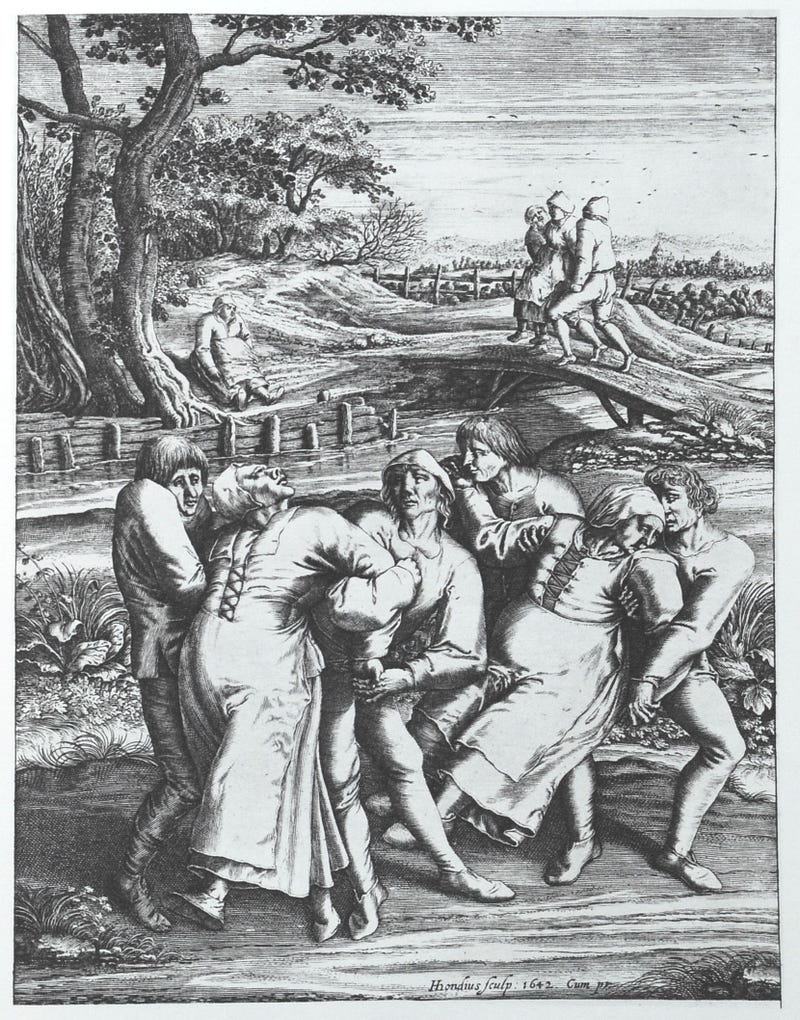
Dancing: the act of moving the body and feet to music. Or in the case of residents in the city of Strasbourg, without music. Who needs music to dance anyway?
Let’s travel back to July of 1518. It’s summer, and in one of France’s cities lives a woman named Frau (Mrs.) Troffea. One day, she steps out into the street and starts twirling, spinning, and flailing her arms about. I believe this is dancing, although I understand if some confuse it for hysteria.
She keeps spinning around the street and seemingly unable to stop. It is a sight to see. But then, suddenly, she collapses. You watch from a distance and notice the poor woman is exhausted. But once the exhaustion passes, she’s back on her feet and dancing again, like nothing else in the world matters.
After a couple of days a few more people join in as though a spell has been cast upon them, and they must dance! By the end of the week, over 30 people have been possessed by the strange urge to move their bodies. Nothing can stop them. Their feet begin to blister and grow sore but they do not stop. More injuries occur as more people become afflicted but they do not stop. What on Earth is going on?
By August, the dancing epidemic had claimed as many as 400 victims. Yes, 400!
Authorities were alarmed at the ever growing number, I mean, who wouldn’t be? Well, the religious leaders, that’s who. They believed that to cure the dancing… more dancing was needed. Hmm, not sure that’s how it works, Vicar. And so, they arranged guildhalls for the dancers to gather in while also providing bands to play music. At least they were no longer dancing to silence — looks less strange now.
A great number of the dancers perished — from strokes and heart attacks — and many collapsed. It wasn’t until early September when the mania that had swept over the city began to subside.
Physicians blamed it on overheated blood, while others believed demonic possession. I would have to agree with the latter, there could be no better explanation for this.
One theory, brought to life by Historian John Waller, was that there was a Catholic saint who 16th-century Europeans believed had the power to curse people with a dancing plague. Yeah, sure he did. Whether you choose to believe this or not, all of the superstition at the time may have triggered a stress-induced hysteria which led to the event.
Some investigators in the 20th-century suggested that residents may have consumed bread made from rye flour that was contaminated with the fungal disease ergot. Ergot is known to produce convulsions and hallucinations. Which, I guess, could be mistaken for very bad dancing.
There were other theories such as the dancers being part of a religious cult but, to this day, no-one is quite certain how the dance plague began. What caused it? And why, of all things, dancing?
I guess the Dancing Plague of 1518 will remain a mystery. For now.