
These Essays Will Change The Way You Think
Amongst all the academic gibberish, you will find some words of wisdom
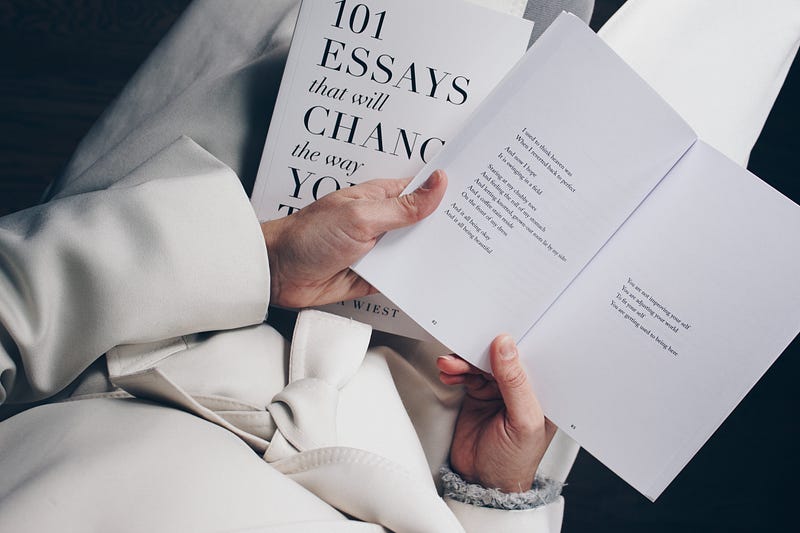
The mark of a great essay is that its conclusion is life-altering. A slight exaggeration, but very true. A good essay utilizes its conclusion as its last chance to reassure its reader, a great essay concludes with its reader convinced.
In academia, reading terrible essays and writing even worse ones is part of your daily routine. I wish I could say that you become used to the monotonous droning writing, to the pretentious use of every convoluted word in the dictionary, to the ridiculously lengthy and rambling sentence structure. You don’t.
But you strike gold now and then.
In the midst of all this terrible academic gibberish, you discover articulated wisdom. Great essays are the works of literary masterminds. They spin simple language into threads of golden wisdom.
These essays are like no other. They are captivating and emotive, witty, and clear. You not only devour their writing style but are mesmerized by the arguments being made. These essays have you thinking in ways you never thought. You are transfixed from the beginning and transformed by the end.
Amidst the crime novels and your guilty pleasure YA contemporary reads, it is important that you pick up some essays.
Here are some brilliant essays that will truly change the way you think.
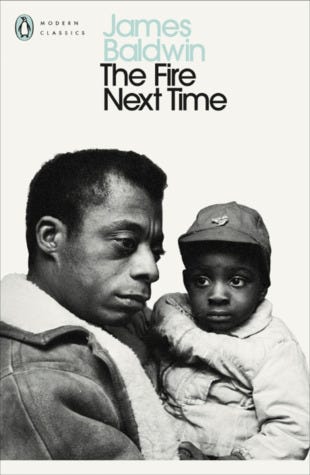
James Baldwin — The Fire Next Time (1962)
No best essay list should be complete without Baldwin. A deeply emotive literary genius. Spectacularly raw, intensely poignant.
My first encounter with Baldwin was when I took a class on the Civil Right Movement. I had never heard of Baldwin and had picked the class to understand America’s complex history and relationship with race.
I had definitely come to the right author. Baldwin without a doubt is one of the best black essayists of the twentieth century.
While Baldwin’s novels were good, I think he truly shined in his essays. The Fire Next Time is comprised of two essays: ‘My Dungeon Shook: Letter to my Nephew on the One-Hundredth Anniversary of the Emancipation’ and ‘Down at the Cross: Letter from a Region of My Mind.’
The reason I found this essay so impactful was its exploration of love. Despite the centuries of brutality and inhumanity. Despite all the anger, rage and fury. Baldwin saw love as the only solution.
Love is so desperately sought and so cunningly avoided. Love takes off the masks that we fear we cannot live without and know we cannot live within. I use the word ‘love’ here not merely in the personal sense but as a state of being, or a state of grace- not in the infantile American sense of being made happy but in the tough and universal sense of quest and daring and growth.
Baldwin was no naive idealist thinker when he wrote about love. He powerfully presents love as a two-fold process in the elimination of racial subjugation. For Baldwin, the black man must learn to love himself for who he is. He must accept himself first and reject the definitions society puts on him. The black man must also love and accept the white man as it is the latter who is the one suffering from the sickness of racism.
If the word integration means anything, this is what is means: that we, with love, shall force our brothers to see themselves as they are, to cease fleeing from reality to begin to change it.
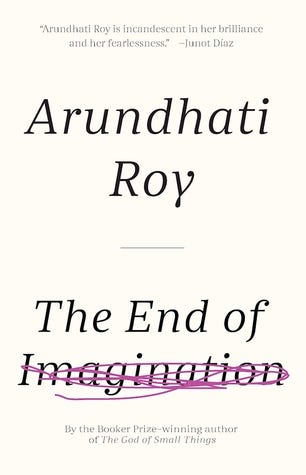
Arundhati Roy — The End of Imagination (2016)
Roy is truly a magician with words. I find her writing remarkably simple yet deeply captivating.
I stumbled across her work on my father's bookshelf and immediately was drawn to the title. As a lover of all things fictions, I was alarmed. Why was imagination ending!
The End of Imagination is a collection of Roy’s essays that explore contemporary issues such as the American invasion of Afghanistan, Nuclear testing and the mass displacement of people by the Indian dam projects. It is about how these issues silence us; silence our imagination to envision a better world.
We have to use our skills and imagination and our art to re-create the rhythms of the endless crisis of normality and in doing so expose the policies and process that makes ordinary things- food, water, shelter, and dignity_ such a distance dream for ordinary people.
The reason I find Roy so impactful is how she is able to disentangle complex world issues and is able to foreground those who get caught in the snare of politics and truly suffer. She reminds us of our humanity.
It is also Roy’s unique ability to weave words in a way that are deeply moving. Her essays remind me of the great and revolutionary power of literature to bring about real change in the hearts and minds of people.
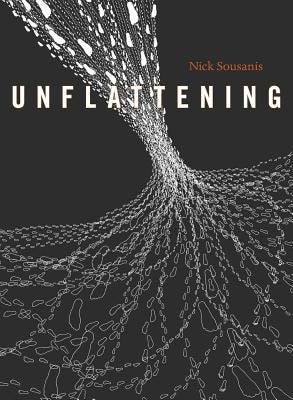
Nick Sousanis_ Unflattening
Unflattening is a radically unconventional essay as it is written as a graphic novel. I read unflattering when I was studying graphic novels and I was blown away by how it made it think me think.
Utilising the power of visuals, Unflattening makes its readers think of concepts in new and clever ways.
A picture seeks a thousand words and a visual symbol speaks a thousand more. Visual symbols are so simple yet are able to convey such complex and deep meaning. They also do not need translation and can be understood by all people in multiple ways.
Unflattening changes the way you think by making you look at simple things in a new light.
Reading a great essay is really invigorating for the mind and transforms the way you think. Essays are more than just for the academic field. They have a lot to teach us both about great writing and the world around us.