
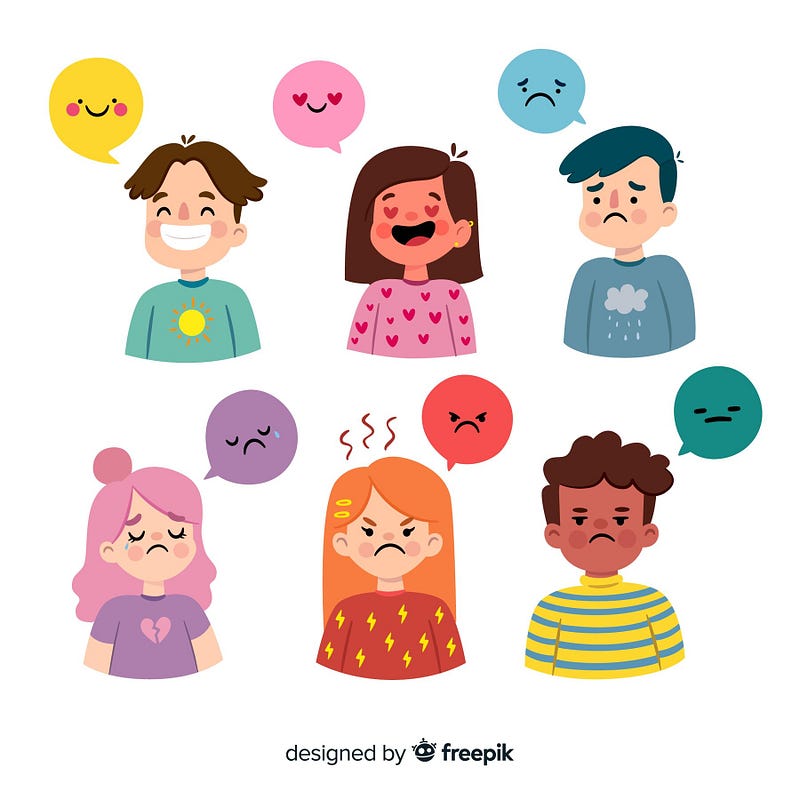
The Way You Should Deal With Emotions & Liars Forever
These are useful tricks
Tip #1: Are there techniques to improve emotional well-being?
Yes. Meditation or NSDR can slow down the link between the trigger and refractory period so that you can break the link before it takes hold of you.
Making sure your sleep is good and long enough will also help. Keeping away from moods. Choosing friends, partners, and managers carefully will also help positively. Having a cold shower or ice bath for 1–2 minutes will produce more dopamine for a longer period.
Good if you’re an introverted personality. And you will be more happy in life.
Yes, this is exposure therapy and a huge part of conscientiousness.
Tip #2: What is the link between emotions and mental health?
Aggression, anger, and low affective empathy are linked to Psychopathy in men and women.
Aggression is also indicated as not needed to diagnose women with psychopathic personality or Antisocial personality disorder. High happiness may lead to manic episodes together with Neuroticism or emotions. And the subcategory depression. It may become a bipolar disorder.
The same combination can lead to grandiose narcissism and vulnerable narcissism.
Also being too high in Neuroticism or emotionality you run the risk of becoming borderline. Low affective empathy can be both psychopathy, machiavellian, narcissism, and sadism. This can be something you were born with or it can happen through sexual abuse during childhood. Or a bilateral stroke in the insula and other parts of the brain that regulate your affective empathy.
If you are low in cognitive empathy you might be autistic.
How to deal with overwhelming emotions?
Cognitive therapy is the only thing that we know works.
Cognitive therapy uses exposure therapy. There is a large amount of data that supports it. The reason is that it is grounded in scientific facts that we can validate.
The simplest method to overcome overwhelming emotions is to AMPLIFY the emotion.
Now you might wonder if I completely lost it.
But it works.
Tip #3: If you are suffering from anxiety.
Here is what you do. Do everything in your power to amplify your anxiety. You do that simply by telling yourself that you have anxiety. It can sound like this. In your head scream
“Man, I am having anxiety. Man, I am super anxious. I am having a panic attack. I want to have more panic! Make me more anxious. I am super anxious.”
Just keep on screaming in your head so that you become more anxious.
What you will notice within 10 to 30 seconds is that it goes away.
Tip #4: Do it with stress.
“Man, I am super stressed! Wow, this stress is super high! Come on stress make me more stressed!”
You will notice that the palms of your hands will dry up from sweat if you are stressed. And it goes away.
I have personally tried this before and during an interview.
For me, it works like a charm. The sweat on the palms of my hands dried up instantaneously. During the interview, I started to stress. But when the interviewers started talking to each other for a minute or two I screamed the words in my head. Amazingly it worked.

Tip #5: Another good cognitive therapy trick is to say this sentence.
“Thank you my subconscious for informing me that I have a thought. But you know what? It is only a thought.”
The time it takes for you to speak this sentence in your head. Is enough to break the connection between the trigger and the refractory period. If the thought comes back.
Simply keep speaking the sentence in your head.
Tip #6: The third cognitive trick is a mental picture.
I have a black sausage dog standing in front of my right foot.
The dog has its front legs just underneath my right kneecap. It is looking up at me and smiling. Just the picture of that dog in my head always makes me smile. It produces dopamine that balances out the negative emotion. Therefore the picture in my head gives me confidence.
All negative emotions go away.
What about lies and emotions?
Can you tell if someone is lying?
I am sorry but you can’t! There are NO scientific ways of determining if someone is lying. They have to confess for you to know if they are lying.
Some of you think you are good at telling if someone is lying.
From a scientific point of view, you can’t tell if someone is lying. You need to verify it. We are of course not talking about you seeing someone taking the last cookie and then telling you they did not.
Then you already know the truth.
I am talking about when you have no idea that the other person is lying to you and you not knowing about it.
There are two typical mistakes people make when trying to identify a lie.
Tip #7: The Othello error
Which is disbelieving a truthful person.
You accuse someone of lying and see the person scared or nervous. You then take that as an admission of guilt and that your statement is accurate. When in fact.
It is a display of an emotion and not a confession according to Paul Ekman in his book “Telling Lies”.
Tip #8: Then we have the Brokaw Hazard
It is when someone thinks they are a good lie detector.
By thinking you are good at telling if people are lying. You will miss obvious things. Skilled liars practice their lies. They do it to look super confident. If there are no cues that suggest some kind of deception.
You will not react and ask more questions.
That is why they slip under the radar.
This is shown in recent scientific experiments where Machiavellians and Narcissists are Sincere but not Honest. Sincere is believing your lies and confidently speaking about them. A great example is someone telling you they did not take the last cookie with a straight face. Remember that in the cookie example, the person might be ashamed of his or her body and therefore always act stressed when talking about food.
You might interpret that as the Othello error according to Paul Ekman in his book “Telling Lies”.
In that, the stressful response is an admission of guilt. Which it is not. In some cases, a liar shows contempt right after they told the lie. They think you’re a sucker for believing them. Remember that a sign of contempt is not an admission of guilt. Only that you have determined that they had just that feeling of contempt.
They might have a feeling of contempt towards themselves or you.
I’m grateful for your support!

If you enjoyed this article please leave claps👏👏👏👏👏, so I know what you enjoy reading the best.


