
These 5 Historical Mandela Effects will Blow Your Mind
Five historical Mandela Effects that made me question reality


Mandela Effect or False Memory?
The Mandela Effect describes a phenomenon where a large group shares memories that never happened in the current reality. The term was coined by blogger, Fiona Broome¹, because of a widespread belief that Nelson Mandela died in prison. The scientific community declares that the Mandela Effect is nothing more than shared false memories.
Common Mandela Effects like the spelling of Berenstain Bears¹ (which I always spelled Berenstein Bears ) are disconcerting. Yet, I can still easily dismiss them as false memories. However, as a life-long history buff, the following five historical Mandela Effects made me question reality.

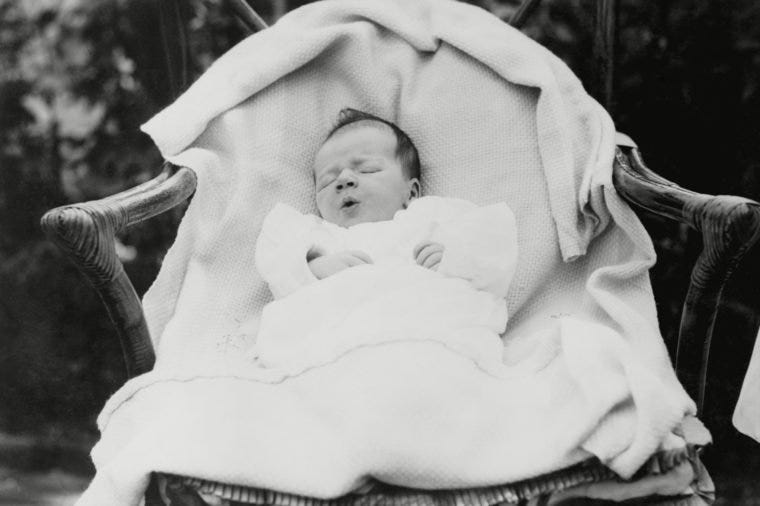
The Lindbergh Baby
Reality:
In 1932, a man kidnapped Charles Lindbergh’s baby. The infant’s body was found two months after the kidnapping. The child had been killed by a blow to the head not long after the kidnapper abducted him.³
Mandela Effect:
The authorities never found Charles Lindbergh’s baby. No one knew what happened to him. Some theories claimed that the baby lived but never knew his true identity.
Personal Experience:
When I was growing up, my mom and I loved mysteries. We watched many documentaries about the mysterious abduction of the Lindbergh Baby. Could all of these documentaries have been wrong? Am I misremembering a subject on which I’ve watched many documentaries?
Dazzle Camouflage on War Ships
Reality:
During WWI, artist Norman Wilkinson created Dazzle Camouflage. By the end of the war, 2,300 British ships used this method to confuse enemy U-boats. ³ In WW2, this method was used on the decks of ships to confuse enemy planes.
Mandela Effect:
Dazzle Camouflage did not exist during WWI.
Personal Experience:
Dazzle Camouflage was not a military secret, and it was exciting and beautiful. I’m a history and art buff, and considering I’ve watched hundreds of documentaries on WWI, it’s difficult for me to imagine that I’ve overlooked the existence of dazzle camouflage until discovering it in 2019. It was a British camouflage, which could explain it- only I am also into all things British. It just seems like I should have seen it before now.
JFK Assassination: Jackie O. Climbs Out of Car
Reality:
The assassination of President John F. Kennedy while traveling in a Dallas motorcade had six passengers in total, including; JFK, Jackie O, Bill Greer, Roy Kellerman, and John and Nellie Connally. After the assassin shot JFK, Jackie climbed over the trunk. There are debates about why she did that. Jackie’s climb is common knowledge and filmed from multiple angles.
Mandela Effect:
The car only had four people in it. Jackie O sat, frozen as someone shot her husband. There were outcries that she was unfeeling, but doctors explained that she was simply in shock. There was absolutely no footage of Jackie O climbing across the trunk of her car.
Personal Experience:
I watched countless JFK related documentaries growing up. Seeing this new” (to me) footage of her climbing over the trunk disturbed me deeply.
Mona Lisa’s Smile
Reality:
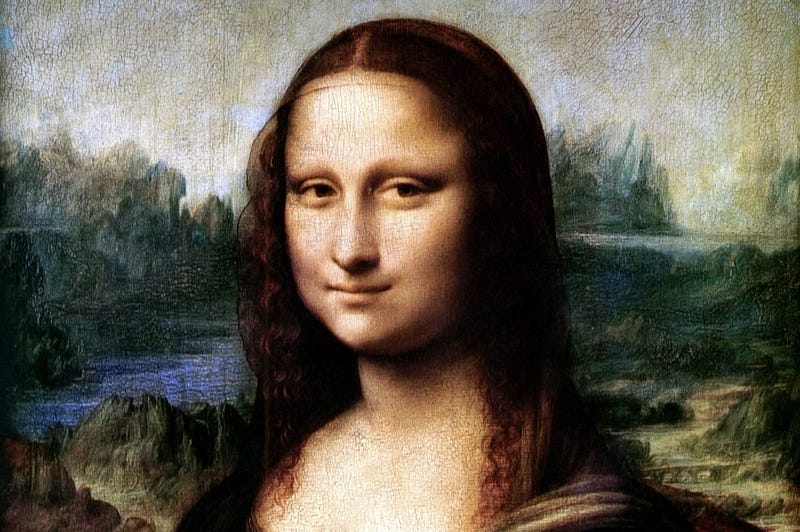
Mona Lisa’s Smile curves on one side, indicating a smirk if not a smile.
Mandela Effect:
The Mona Lisa did not have a discernible curl to her lip, and her cheeks were less fleshy.
Personal Experience:
I’ve drawn the Mona Lisa many times since childhood. Her mouth was severe — no slight curl on one side. It was a fun challenge to try and replicate this look. I studied the portrait with a magnifying glass, especially around the eyes and mouth, trying to discern how she seemed to be smiling without smiling.
Red Hats on Moai
Reality:
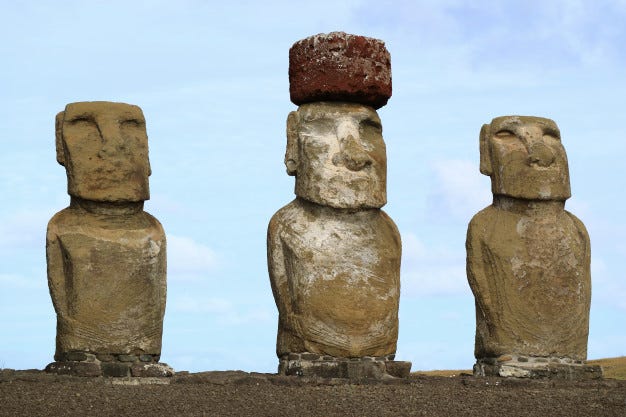
Some Moai (Easter Island statues) wear red caps. Many of the sculptures have pointy noses. The mystery was how prehistoric inhabitants placed red hats (or top-knots) on the monoliths, and a working theory is now in place.
Mandela Effect:
The statues never had red hats, and the shape of the faces was broader with deep-set eyes and broader, flatter noses.
Personal Experience:
I have a hard time dismissing Easter Island changes as false memories. The information was fresh in my mind when I discovered this Mandela Effect because my niece and I had both recently become obsessed with researching Easter Island.
It’s not a mass misremembering. We share the Moai face and red hat changes. However, so far, only my niece and I remember the big mystery that used to shroud the island.
Sharing that info will make me sound crazy, but I’m going to share it in another article anyway because it freaks me out.
Glossary
The “Mandela Effect”: when a large group of unrelated people shares a memory that never happened in this reality. (Mandelaeffect.com) see also; false memory
Shared false memory: Multiple people saying the same false memory — the generally accepted scientific term that explains the so-called Mandela Effect.
False memory: a psychological phenomenon where a person recalls something that did not happen or happened differently from the way it happened. (Wikipedia)
Sources
² http://theconversation.com/the-mandela-effect-and-how-your-mind-is-playing-tricks-on-you-89544
³ https://www.history.com/news/dazzle-camouflage-world-war-1


