
Technology
Thermoacoustic Stirling Generator Built By China
What are they and why might they be important?
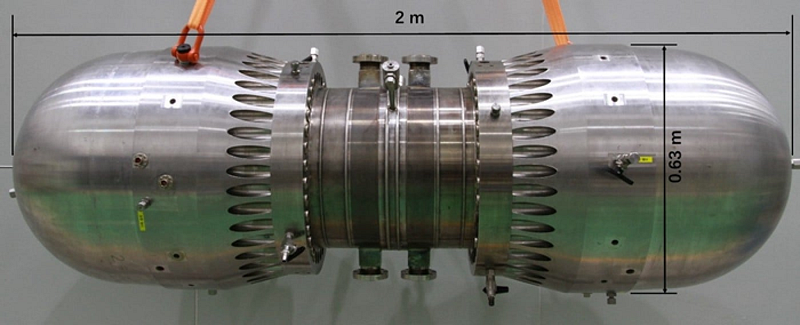
Despite owning several conventional power generators over many years I didn’t know that Stirling engine electricity generators were built, almost commercially, by Philips. They could not be manufactured cheaply enough to compete with internal combustion models as they face manufacturing challenges due to material requirements for containing high-pressure gas.
In case you’re wondering what a Stirling Engine is, it’s an engine which uses an external source of heat to produce mechanical energy, as compared with an internal combustion engine (your car if not electric) which uses heat inside the cylinders to produce mechanical energy.
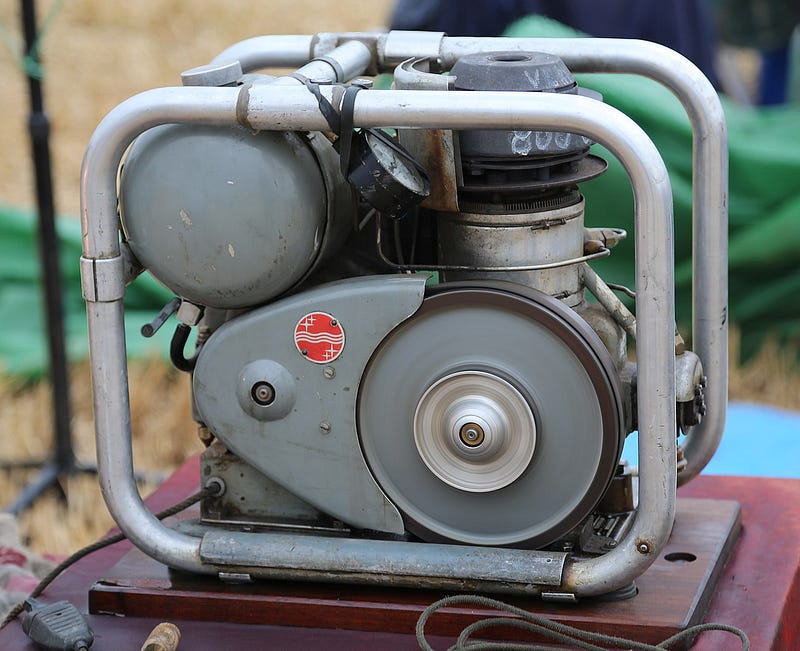
The Philips projects were uncommercial, but Stirling engines did find a use.
In 1996, the Swedish navy commissioned three Gotland-class submarines. On the surface, these boats are propelled by marine diesel engines; however, when submerged they use a Stirling-driven generator developed by Swedish shipbuilder Kockums to recharge batteries and provide electrical power for propulsion. A supply of liquid oxygen is carried to support burning of diesel fuel to power the engine. (Wikipedia)
Now Chinese engineers have combined the Stirling engine principle and the thermoacoustic principle to produce a highly efficient electricity generator.
The thermoacoustic principle is new to me. Things have moved on a bit since I studied the Laws of Thermodynamics, too many years ago.
What is a thermoacoustic generator?
A thermoacoustic generator is a device that converts heat energy into acoustic (sound) waves and then into electrical power. It operates on the principles of thermoacoustics, which is a field that explores the interaction between heat and sound within a fluid medium. Thermoacoustic devices typically consist of a resonator, a stack of porous material, and a heat source.
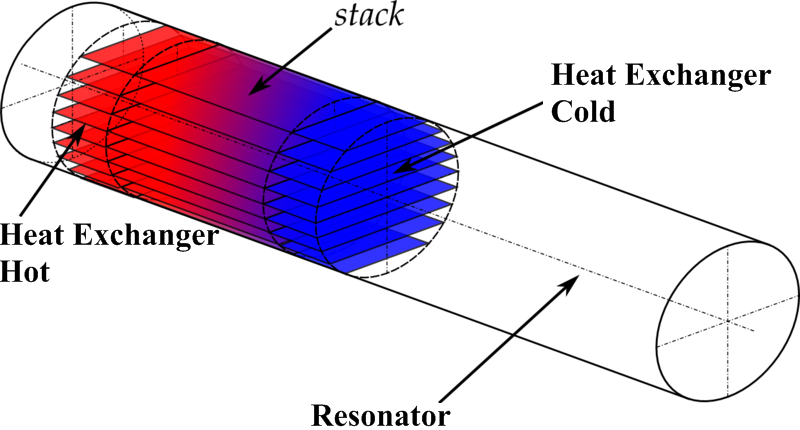
Heat Source: The process begins with a heat source that applies a temperature gradient to a gas or fluid within the device. This temperature difference can be created using an external heat source, such as a flame or an electrical heater. Perhaps even a nuclear pile.
Acoustic Waves: The temperature gradient leads to the creation of standing acoustic waves within the gas or fluid. These waves are generated as the gas oscillates between regions of higher and lower temperatures.
Resonator: The acoustic waves then travel through a resonator, which is a chamber that helps amplify and resonate the sound waves.
Porous Stack: The resonating acoustic waves pass through a stack of porous material. This stack is usually made up of materials with a high thermal conductivity, such as metal or ceramic. The stack is critical for converting the acoustic energy back into heat.
Electrical Generation: As the acoustic waves travel through the porous stack, they cause physical deformations which are then converted back into electrical power using a piezoelectric material or other suitable means.
Thermoacoustic generators have the potential for various applications, including waste heat recovery, solar energy conversion, and remote power generation. They are known for their simplicity, lack of moving parts, and ability to operate in harsh environments.
There is military interest as these thermoacoustic devices are very quiet and would be useful for power generation, particularly in submarines.
NASA holds patents on a thermoacoustic generator design: The Stirling Thermoacoustic Power Converter and Magnetostrictive Alternator (LEW-TOPS-80). This proposes a thermoacoustic engine paired with an alternator to generate electricity in space, but NASA has yet to unveil any prototype or specific performance metrics.
The news
China has apparently developed a working prototype with significant performance figures.
Chinese scientists have taken a step forward in the race for alternative energy with the development of the most potent thermoacoustic Stirling generator to date.
Powered by heat, the highly efficient generator operates very quietly, which is ideal for applications where silence is critical, such as in submarines and the aerospace industry.
In a recent demonstration, the prototype delivered a groundbreaking 102 kilowatts of power from a heat source of 530 degrees Celsius (986 Fahrenheit). It marked the first time that type of generator had crossed the 100kW threshold — a milestone for practical application. — South China Morning Post
According to an interview with one of the developers in the South China Morning Post:
“The current thermoelectric conversion efficiency is about 28 per cent; with a hotter 600 degree thermal fluid, efficiency could reach 34 per cent,” he said.
Such efficiency can rival that of steam turbines.
“It operates quietly and efficiently, and can use different types of heat, including solar energy, waste heat and biomass,” a CAS statement quoted Lou as saying.
It continues:
“High-pressure helium at 15 megapascals [~150 atmospheres] serves as the working medium, and the absence of mechanical parts needing lubrication means the generator could exceed a decade of lifespan,” Hu said. Hu noted that the motor’s design avoided harmful vibrations and maintained an airtight seal within the mechanism.
“The linear motor, consisting of a piston driven by sound waves, permanent magnets and coils, contributes to the high conversion efficiency. Its symmetrical design also eliminates some harmful vibrations,” he said.
“The linear motor keeps a very tiny space, about the thickness of a human hair, between the piston and cylinder. This prevents the parts from touching while maintaining the internal airtight environment.”
“It is a promising new generation technology for solar thermal, biomass power generation, and distributed energy systems,” Hu said.
As well as Chinese submarines. I said.
And NASA?
I couldn’t quite get my head around the acoustic side of things, so I checked the NASA site. Their system is known as ‘the Glenn design’.
The Glenn design allows the transducers to operate at high frequency while presenting a mass rather than stiffness impedance. Glenn’s magnetostrictive alternator uses stacked magnetostrictive materials under a biased magnetic and stress-induced compression. The acoustic energy from the engine travels through an impedance-matching layer (which can be formed from aerogel materials) that is physically connected to the magnetostrictive mass.
Did you get that? There’s more, and it’s a bit easier for me to grasp.
Compression bolts keep the structure under compressive strain, allowing for the micron-scale compression of the magnetostrictive material and eliminating the need for bearings. The alternating compression and expansion of the magnetostrictive material creates an alternating magnetic field that then induces an electric current in a coil wound around the stack. This alternator produces electrical power from the acoustic pressure wave and, when the resonant frequency is tuned to match the engine, can replace the linear alternator to great effect. — NASA (ibid.)
External heat requirement
Solar energy can be used as the heat input for Stirling engines. It doesn’t require combustion (which usually creates bad gases as a by-product). In a Concentrating Solar Thermal System, the working fluid can be heated to as much as 1,000⁰ C.
Stirling engines driven by solar radiation are already in use to generate electricity.
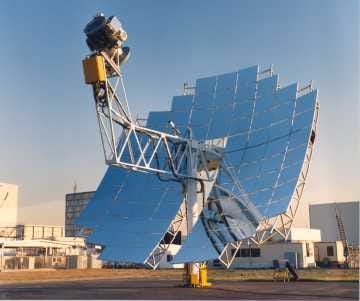
These plants are achieving efficiencies of more than 30%.
Now they just need to replace the alternators with thermoacoustic generators.
Whether a thermoacoustic version would produce cheaper electricity remains to be seen — alternators are cheap and there are no issues about containing high pressure gas.
A thermoacoustic generator for my boat?
I just need one that produces about 6 kw, and that will fit in my boat, burning diesel oil. One day perhaps, but meanwhile I’ll have to continue using a conventional internal combustion generator. Made in China, sadly. And ten years lifespan would definitely be an improvement.
But it seems to me that these will remain a niche devices, OK in submarines and spacecraft.


