
There’s More to Cambodia Than the Khmer Rouge
My life in Cambodia began in the ’90s. We toured the Killing Fields and Tuol Sleng Torture Museum, but there was so much more to the Southeast Asian country. I lived there from 1994 through 2001.
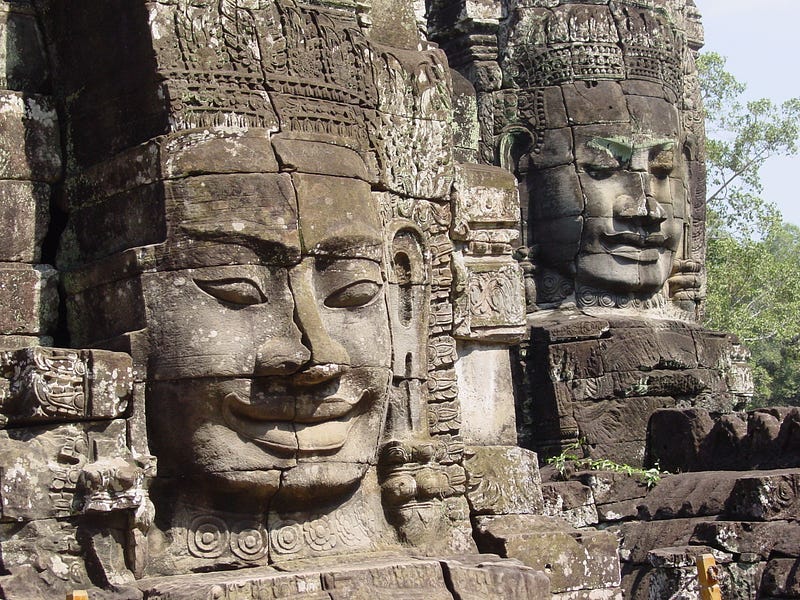
The country’s politics and drama, along with its unique culture, drew us in. My ex and I lived there for years. In time, I left and my ex stayed. I’d discovered he was spending a lot of time and money with a young Vietnamese woman, who he’d met through a friend.
She was married, but that’s a loose term in Cambodia. No ceremony, and no license, but she and her soldier husband had a little boy. She farmed the kid out to grandma when my husband (sigh) came along. He became her cash cow so to speak, and she worked hard to get her hooks into him. Not her fault. His. Entirely. Probably mine too, but more on that later.
In the Kingdom of Cambodia, the Tonle Sap runs the length of the riverfront. The Mekong River, just on the other side of the island beyond the riverfront, joins up with the Tonle Sap. Every year, the river changes direction! There’s a big water festival, and people celebrate.
Memories of the ’90s come in images, sounds, and smells. Frangipani trees drop their fragrant yellow-white blossoms, which rot on the ground. Young children still carry baskets of lotus blossoms, with green seedpods. And the noise of motorcycles and cars floats over everything, along with exhaust fumes. Beauty of nature and lots of honking and motorcycles.
People always asked me why we lived in Cambodia, and it’s a fair question. It’s not a typical place to land, especially for an Oregonian. I don’t have Cambodian family members, nor did Ken. He was from Michigan.
The short answer is that we were traveling and happened across the most fascinating place. Within just a few weeks of being in Phnom Penh, I felt a sense of purpose that was so compelling that I wanted to stay for a while.
Ken felt the same, but his dirty little secret was he intended to land there. In his journal of 1989, he wrote in that year’s journal that he would return to the “third world” as soon as possible. He always told me he loved travel. We both did. I didn’t know he wanted to make a life in one of the edgiest countries in SE Asia.
He liked anything dangerous, edgy, illegal, and forbidden. It was how he was built. I’ve had to learn to shut off that part of my mind that misses the hell out of him, because we had a lot of good adventures, but life was hard in Cambodia. I came close to death — very close — twice. I’ll tell about that later.
It’s been years now, and I’m remarried. My life is good, and I can look back on all the adventures and travel without being furious and sad. I can smile about it all, everything that happened.
Many of the expats used to hang out at the Foreign Correspondent’s Club of Cambodia, The FCCC. I think the name may have been shortened to the FCC after it sold.
Everyone has to go to the FCC when in Phnom Penh. Its location on the riverfront, along with the open-air perimeter of bar seats facing that river, make it perfect for people and traffic watching.
The FCC has colonial yellow walls, with slowly rotating ceiling fans. Journalists and adventurers sip icy cold cocktails, and some go out to dance at the clubs, with blaring music.
Lots of fancy bars and restaurants are in Phnom Penh now, and in the ’90s, you could get delicious food from all over the world. Every culture was represented, and the expat restaurant owners are from France, Germany, Australia, the USA, and many other countries.
Phnom Penh was such a party town in the ’90s. Early dinner out, maybe a French restaurant, and then dancing all night, then to the street stand for noodle soup.
Times were simpler in the neighborhoods, and quiet at night except for the occasional blast of an AK47. The Cambodians thought if you shot at a rain cloud, it would burst it and the rain would stop. Not kidding! My explanation might be a little brief, but that’s what I heard more than once: You shoot, shoot, shoot the gun, then the rain stop!
The Cambodian soup seller walked through the streets, playing a rhythm on the bamboo. The sound was his own unique rhythm, toh toh tee, toh toh tee tee. People came to know the sound, which was advertising for chicken soup.
The stick moved up and down on that bamboo hollow, and the seller could run and bring a hot bowl. Soup carts occupied corners of streets, with their yellow lights and swarms of gnats. Women and men served the steaming Pho, and the broth was fragrant and spicy, with the smell of star anise and little bubble of fat rising up.
I liked the thick, white noodles, but Ken sometimes got the yellow noodles, squiggly and harder. Thin slices of beef were cooked on the spot. Chicken was available, or tofu in white squares, or meatballs. A plate of greens was on the table with a Formica top, along with bottles of sauces red and green. Chiles were placed in small white plastic bowls and floated in vinegar.
At midnight, 1 AM, and through about 3 AM, small children living in the street would be out begging, or selling the small flower medallions that Ken called “flower doughnuts.” The smell was so sickeningly sweet. I loved them and hated them, but always bought them.
Glue-sniffing teenagers began showing up in the late 90’s, which was distressing. They would wander around puffing in and out of plastic bags, walking dizzily around. They scattered like mice if approached by a policeman asking them to move away, but nothing was done about them.
Cambodian kids lifted the glue bags to their faces even if the bag were no longer in their hands. All the time. Sad.
Lots of prostitutes worked in the city, although while I lived there, occasionally places would be shut down.
Girls wearing pastel pink, green or yellow pajamas — not the Vietnamese attire, but what we think of as those pajama suits — were on the street late at night, and some squeezed into tiny miniskirts and tops that plunged down low.
The Vietnamese women shouted aggressively in guttural voices as they played pool or bossed men around, You no good! You devil! Why you no buy me drink? Then they’d bend far over the pool table, giving the men plenty of time to look.
I don’t have anything against sex workers, not at all. I couldn’t stay married to a man who saw them as a lifestyle!