

There’s an Emerging Health Crisis in the Black Community
These are the tragic effects of soul food
“Health nuts are going to feel stupid someday, lying in hospitals dying of nothing.” — Comedian Redd Foxx, who later died of a heart attack at 68 years-old
Type II diabetes runs in my family…or so I’m told.
I have a sneaking suspicion that decades of eating fried chicken, chitlins (pig intestine), and collard greens soaked in bacon grease might have a part to play as well [Insert detective emoji].
I’d hear the excuses growing up: “We’re just big-boned honey,” my grandmother would say or “this is your culture’s food — be proud.”
Sure, soul food is my “culture’s” food, but seldom are we told that it’s what my ancestors had to eat because they were slaves.
Now it’s 2020, and I am no slave.
The Tragic History of Soul Food
The first few generations of African Americans were fed scraps and leftovers from their slave masters. These were the parts of the animal that no one wanted and often lacked nutritional value.
But black people made the best of it and turned scraps into Southern delicacies.
They cleaned and cooked pig intestines and christened them chitlins. Or they turned old, inedible cornmeal into piping hot cornbread. Early slaves concocted unfathomable creations like oxtails (oxen butts), pig's feet, ham hocks (pig ligaments), gizzards (organs found in the digestive tract), and fatback, to name a few.
In 2020 nearly half of the adult black population is obese, according to recent CDC reports.
It’s overwhelmingly evident that slaves ate for survival, not for nutrition.
So when we went ahead and consumed these kinds of foods for centuries on end, health in the black community became a fatal epidemic.
Soul Food’s Impact on The Black Community
In 2020 nearly half of the adult black population is obese, according to recent CDC reports. African American women have the highest rates of obesity compared to any other minority group; about four out of five black women are overweight or obese.
But perhaps most disturbing of all is that blacks and Hispanics lead the way for childhood obesity.
Sure you can blame a greater risk for chronic illnesses like type II diabetes, heart disease, and cancer on genetics, or you can look at the foods these communities are consuming.
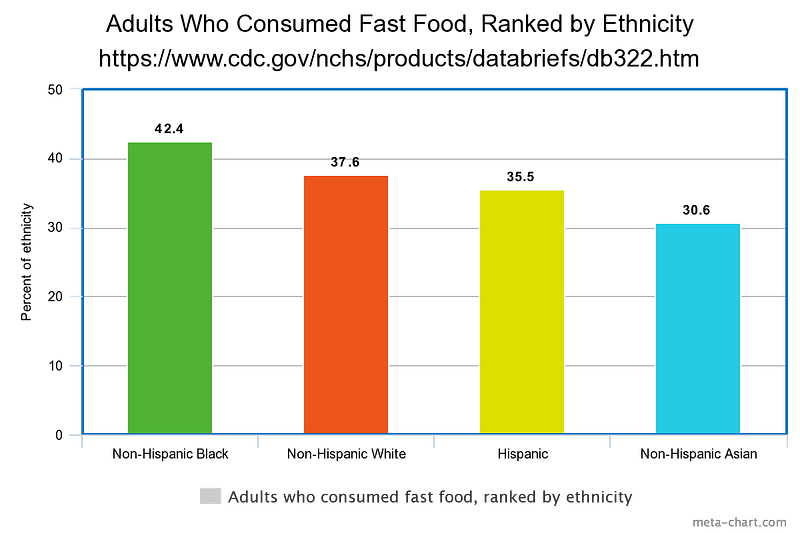
Here’s a graph breaking down fast food consumption from 2013 to 2016. Despite representing 13 percent of the U.S. population, black America is leading the way:
This issue of poor dietary habits has compounded in the present day due to black people’s lack of exercise and our increased consumption of sugar.
In 2018, African Americans were 20 percent less likely to engage in physical activity compared to white people, according to the U.S. Department of Health and Human Services Office of Minority Health.
Athletics plays a significant role in the development of young African Americans. But it would seem as we hit adulthood, there no longer seems to be an encouragement to maintain a healthier lifestyle.
That isn’t to say that some aren’t trying to change these poor health habits.
The Push For Healthier Soul Food
Some restaurants are making a push to create healthier soul food. Places like the Seasoned Vegan in Harlem or The Land of Kush, a vegetarian soul food joint in Baltimore are trying to change the black community’s relationship with food.
“I heard about how bland vegan food was,” said owner of the Seasoned Vegan, Brenda Beener in an interview dnainfo. “I heard that people of color wouldn’t be interested…[Now] some of my best customers are meat-eaters who told me that if they could eat like this every day they would be vegan.”
All this being said, the solution to this health crisis doesn’t have to be switching diets or abandoning traditional soul food entirely.
Let’s face it, nobody wants to eat broccoli over fried chicken; salads instead of macaroni and cheese; brussel sprouts rather than Fred Flinstone-sized turkey legs.
You could become an overnight health nut, but the data tells us you’ll eventually fail.
95 percent of diets fail because people limit themselves too much.
Instead, try incorporating a few healthier foods into your diet — eat for nutrition and sustainability, not to shed weight (although burning fat is a consequence of eating healthier).
Remember! You do not have to abandon your guilty-pleasure foods, but you should gradually limit them.
Maybe go out for vegan soul food instead of fast food every now and then. But make sure to treat yourself to the foods you enjoy as well — in other words, you can have your cake and eat it too.
Final Thoughts
Personally, soul food isn’t a cheat meal for me, but you bet your grits I like to get my hands on some oh-so-cheesy Tex-Mex every now and then.
Traditional soul food can and should be enjoyed in small doses; we don’t have to throw the baby out with the bathwater. 95 percent of diets fail because people limit themselves too much.
But we can’t keep enjoying these kinds of foods on a weekly, or sometimes daily basis and blame our obesity and chronic illnesses on crap genetics. Well, we could keep doing that, but it’s not going to solve anything.
If we don’t hold ourselves accountable, black people will continue to get fatter and sicker.
And with the kind of year we’re having, I say it’s time for a change.