
There’s a Mental Toll to Excessive Thinking, Here’s How to Stop it
It has profound implications on the mind, body, and soul.

A man sits alone on a rock.
He’s leaning forward with his back hunched over. His elbow rests on his right knee and his palm curves inward to support his chin. His mouth is thrust into his knuckles and his eyes cast a downward gaze.
The man is visibly absorbed in thought and contemplation. He is pensive and very still — the world around him seizes to exist.
He seems lost within his existence, frozen from motion, withdrawn from any sense of being, the entirety of him so invested in thought…
But this is not a man I’m describing. This is The Thinker, the iconic sculptor by French Artist Auguste Rodin. It’s a 6-foot statue cast in 1904 that sits in the gardens of the Rodin Museum in Paris. And I only met The Thinker on a weekend trip to Paris a few years ago while visiting a friend who lives in Montmartre.
I paint an image of the sculptor with words that describe a person, because, quite honestly, The Thinker is a masterpiece that is so real in its depictions of the physical and mental toll the burden of our excessive thinking bestows on us.
In my first six months of entrepreneurship, the worry, anxiety, rumination and my inability to get out of my head created an ocean of apprehension in my life. I drowned in it. I created a sea of woe that pulled me deeper into a suffocating recurring tide of self-resentment. And it took me a while to realise this:
Excessive thinking can be destructive.
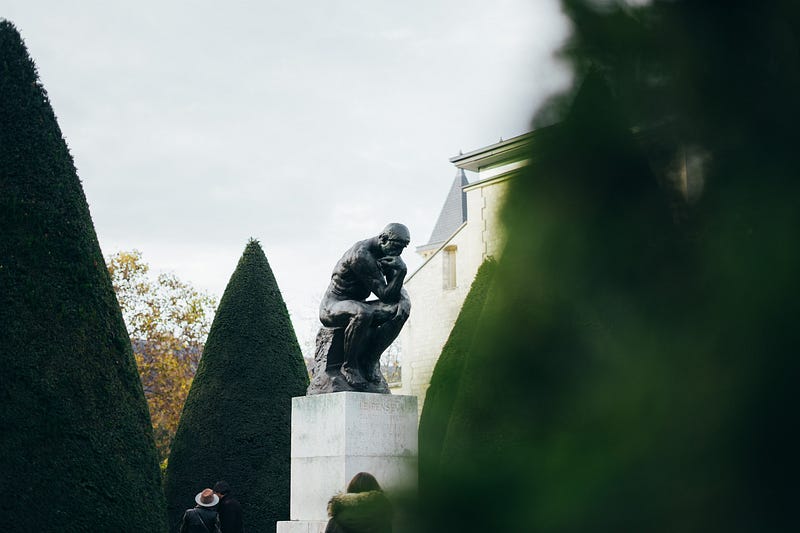
That’s why Auguste Rodin depicts The Thinker as a strong, athletic figure who is clenched by the tenderness of his inner-struggles of thought.
Rodin conveys that the act of thinking is a powerful exercise with profound implications on the mind, body, and soul. Thinking is not merely going about our days. Thinking is a conscious act that involves energy, intention, attention, and consciousness. As he describes below, it engages the entirety of our body:
“What makes my Thinker think is that he thinks not only with his brain, with his knitted brow, his distended nostrils and compressed lips, but with every muscle of his arms, back, and legs, with his clenched fist and gripping toes.”
While I did not fully comprehend the extent of the message at the time of my visit, today — three years later — as I reflect on the day I stood in gardens of the Rodin Museum staring at Le Penseur, I finally see what Rodin wanted us to see, because, at one point in my life, I became The Thinker.
I spent months living through the heaviness and burdens of my thoughts. I was twisted and curled in tension, incapable of escaping the repetitive chatter in my mind. The Thinker is a reminder to us all that overthinking can drain our energy and paralyze us into inaction. But as with everything in life, there are ways to win back our power over our thoughts.
Be Conscious of the Thoughts That Weigh You Down
Excessive thinking and rumination can be dangerous. Studies have shown that overthinking has a lot of negative consequences on our wellbeing — it has a toll on us physically and mentally. It elevates your stress levels, reduces your creativity, clouds your judgment and strips you of your power to make decisions.
I can speak from experience. In my first six months of entrepreneurship, as I was building up my business, the only thoughts that we consuming my mind were those of worry and fear: “How I am going to make money? How am I going to pay the bills this month? What happens if I go bankrupt? Did I make the wrong decisions? How foolish I was to quit my job for this.”
Repeating these ideas in my head every single day and night created so much self-inflicted pressure. I lost confidence in myself. I felt weak and powerless. The very act of creating something of my own was supposed to be a joy, yet it made me miserable. But as I read more about cognitive behaviour and self-development, I realised this: It is my negative thoughts that are creating this misery, not me.
When you learn to consciously de-attach yourself from your thoughts, you learn how to control them.
“Emotional freedom, and inner peace, is knowing what to do when those negative thoughts and feelings arise,” writes Brianna Wiest in an article where she explains that
“The problem is not the problem, it is how you think about the problem.”
This means that the thoughts you’re having have no meaning — you bring meaning to them. We see problems as problems, rather than thoughts that we can choose to refuse to respond to, or as irrational thoughts that created irrational emotions.
Everything we are actively thinking of at this very moment can be reversed by changing the way we think. All the rumination, the worry, the anxiety, the stress, we have the power to consciously stop our minds from feeding into them.
“A person who thinks all the time has nothing to think about except thoughts. So, he loses touch with reality and lives in a world of illusions.” — Alan Watts
Through excessive thinking, we lose touch with reality. When we learn to consciously de-attach ourselves from our thoughts, we learn how to control them so we can get back in touch with reality.
When I saw the mental and physical toll my thoughts were having on me, I decided to stop engaging with them. When they would arise, I would be conscious of them and in the heat of overthinking, I would stop and say: “No. I’m not going to swim deeper into these thoughts right now. I’m not going to give in.”
Be conscious of the thoughts that weigh you down. Excessive engagement with negative thoughts can destroy you. Be an observer of them, but choose not to indulge in them. Instead, deviate from them.
Make Time for Honest Reflection
The idea is not to stop thinking, the idea is to engage in moderate deep thinking. And there is no better form of deep thinking than honest reflection.
There are different forms of self-reflection, but the one that works best for me is writing. I sit down, open up my journal and write down my thoughts. Everything. I just spill it all out on paper. And, somehow, I always feel a little lighter afterwards, like my thoughts are no long illusions in my mind, but concrete words on paper.
Research shows that the habit of writing what we feel helps us with metacognitive thinking, which is “thinking about one’s thinking”, or in simpler terms, it’s our “awareness of our own thoughts.” That’s why you become more aware of your thoughts and what they’re trying to tell you when you write them down.
The idea is not to stop thinking, the idea is to engage in moderate deep thinking.
The goal is to take time to invest in some peace and quiet so you can become more aware and remove yourself from the “being” of your thoughts. You want to observe your thoughts so you can understand what they are and why you’re feeling the way you are.
Take Action to Get More Clarity
When it comes to The Thinker, I like to believe that at any moment, he will burst up with confidence and energy. He will stand up, and start walking because, there, at that very instant, he chose what will become of him: He is not a thinker, he is a doer, who thinks.
Ideas are worthless if we don’t act on them. But while I don’t encourage you to think forever, I also wouldn’t encourage you to act without thinking.
Be not a thinker. Be a doer, who thinks.
The reality of life is this: Action brings more clarity than thought.
Sometimes, the best way of getting out of the repetitive chatter of the thoughts in our mind is simply to take action. We learn by doing. We get clarity by doing. We find the answers by doing. Be not a thinker. Be a doer, who thinks.
As I continued to walk the path of entrepreneurship — as I continued to “do” — I realised that what I want in life is not to build an eCommerce product business, what I want is to use words to inspire growth in people, and I am willing to build a business around it through writing, teaching, and speaking.
Taking action gave me more clarity.
Why it Matters to You
Like any other masterpiece of art, The Thinker is open to interpretation, and our reactions to it can tell us something about ourselves.
For me, The Thinker represents a man so lost in the depths of his thoughts that they weighed him down into a self-created world of struggle.
It reminded me that while there is power in reflection, there is far greater power in action. When we overthink, we burn. When we reflect, we understand. When we take action, we learn.
And to that, I say: Be not a thinker. Be a doer, who thinks.
Mind Cafe in Your Inbox
When you follow us on Medium and tick the box that opts-in to email updates, you’ll receive a weekly roundup of our best-performing articles in your inbox.
To keep up to date with other news, follow this link and click subscribe.