
There Will Always Be Too Much To Do
The trick is to figure out what not to do.
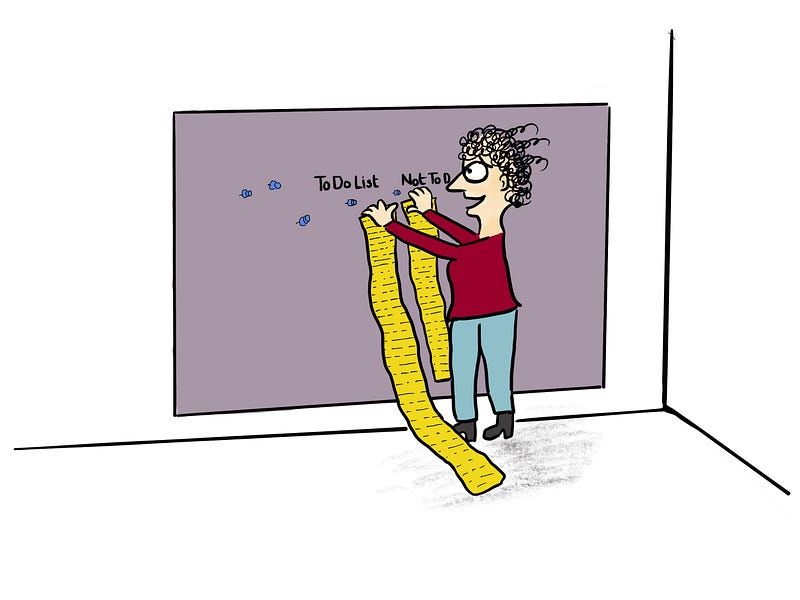
We are reaching the end of yet another year. Each year, around this time, I review the current year and make plans for the next.
This year has been a weird one. Not just for me but everyone in the whole world. On the one hand, it was calamitous, restrictive, and depressing, while on the other hand, it was uninterrupted, quiet, content time perfect for learning and doing things that get put on the back burner.
I enjoyed these undisturbed months a lot and used them to learn and grow. I got a lot done, but the feeling of not accomplishing much wouldn’t go away. It is as if I haven’t even made a dent in what I wanted to do.
I am not the only one who feels like that. Oliver Burkeman wrote in The Guardian:
Today more than ever, there’s just no reason to assume any fit between the demands on your time — all the things you would like to do, or feel you ought to do — and the amount of time available. Thanks to capitalism, technology and human ambition, these demands keep increasing, while your capacities remain largely fixed. It follows that the attempt to “get on top of everything” is doomed. (Indeed, it’s worse than that — the more tasks you get done, the more you’ll generate.)
The upside is that you needn’t berate yourself for failing to do it all, since doing it all is structurally impossible. The only viable solution is to make a shift: from a life spent trying not to neglect anything, to one spent proactively and consciously choosing what to neglect, in favour of what matters most.
I used to be fixated on productivity. When I was able to strike-off all the items from my To-Do list are a good day. The same used to be the measure for the year. It would be a good year if I achieved all the goals I had set up for myself. But the problem was I would keep adding more goals all through the year.
I have finally started to see that I am staking my self-worth on my productivity levels. I don’t need to accomplish more. I need to figure out what are the things I need to stop doing.
The point Oliver Burkeman is trying to make is that we need to continue to align ourselves to our core, which is not easy. We go off tangent all the time. And the way to avoid that is to take a pause and think.
The end of the year is a good time for that. Although notional, this annual cycle of time is a good measure to re-evaluate priorities. To figure out what you want to continue doing and what you should stop doing.
Sing up to my newsletter A Whimsical Writer.
— — — — — — — — — — — — — — — — — — — — — — — —
This story first appeared at www.neeramahajan.com.
If you enjoyed it, you might also like this one.