
Art that Teaches There is Nothing Insignificant in the World — It All Depends on Your Point of View
How two artists encourage us to look at the world differently

The German Romantic writer Goethe wrote these lines: “There is nothing insignificant in the world. It all depends on the point of view.”
The thought keeps coming back to me: that significance is bestowed by how you look at things, not merely by what you’re looking at.
It reminds me of the brilliant French artist Sophie Calle, who in 1979 found herself at a party in Paris. There she met a man known as Henri B. What happened next would initiate one of her most compelling works of art.
Transformative Power of Curiosity
Henri B told her he was about to travel to Venice on holiday. The artist sensed an opportunity. In the strange and unpredictable world of Sophie Calle, even the most mundane coincidences can become major plot twists.
Secretly, Calle followed Henri B to Venice. For two weeks she pursued him around Italy’s floating city, recording his day-to-day actions, taking photographs of him in bars and cafes, down side alleys, and lingering on bridges. She wore make-up to disguise herself: a blonde wig, hats, gloves, sunglasses. To remain surreptitious, she attached a device to her Leica camera known as a “squinter”: a mirror that allowed her to take photos without aiming directly at her subject.
As she watched Henri B from afar, she noted down his actions and speculated on his feelings. In this way, she began to build up a detailed diary of observations and reflections. She also wrote down her own sensations as her surveillance heightened.
Suite Vénitienne is the artwork that resulted from her pursuit of Henri B.
As the enchanting city of Venice unfolded before her eyes, Calle concluded that she felt as if she was falling in love with the man she didn’t know.
The old warren of narrow streets, cafes and bars — captured in her fleeting black and white photographs — became “a repository of her desires”, heightening her feelings for the man she was trailing and for the sense of power her surveillance was giving her.
One of the lessons that Calle’s art can teach us, is that everything we do and every encounter was come across has the potential to be interesting — and therefore a subject for art.
What is extraordinary — and what Calle bravely confronted, many years before the advent of the internet — is how much our desire to look is part of the human condition.
In the years following, Calle made several works of art that explored the act of observation. What at first seems like voyeurism is inverted through the creation of the work of art in which Calle’s own actions become the focus of attention.
In 1981, in a captivating twist of roles, Calle commissioned her own mother to enlist a private detective who would surveil her every move and meticulously document her activities. The outcome of this intriguing experiment, The Shadow, shows photographs of Calle taken by the hired detective, as well as descriptions penned by the artist herself, recounting her profound sense of unease and self-discovery upon realizing the identity of her surreptitious observer.
In another work, Address Book, 1983, the artist seized upon the chance discovery of an address book she had found whilst out walking. She contacted many of the people listed inside and built up a portrait of the book’s owner through their unsuspecting accounts.
What I like about Sophie Calle’s art is how she is able to tap into the world around her and carve out her own meaning. Piece by piece, Calle weaves together a poignant collage of the possible lives she finds around her, forging an intimate bond with individuals she never knew in real life…
Art at Your Own Command
In bygone centuries, art meant objects: tangible paintings and sculptures that you could hold in your hands. Part of Calle’s project was to test what art could be, to explore its furthest limits, to ask “Where does art reside? Is it in the object or in the idea behind it? Who decides?”
The Italian artist Piero Manzoni would have undoubtedly agreed with these probing questions. In the early 1960s, Manzoni playfully toyed with the idea of the artist as a god-like figure who could make art at their own command. Nothing was beyond the creator’s power. In one sense he was poking fun at the art establishment; in another, he was telling us that we all have the freedom to invent at our own free will.
Manzoni’s message was unequivocal: “Assert your creativity without doubting.”
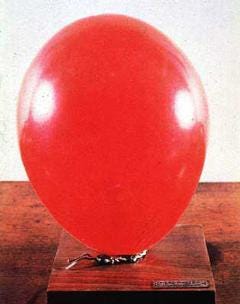
In 1960, Manzoni made one of his more renowned series of artworks. Titled the Artist’s Breaths (Fiato d’Artista), the work consisted of a series of red, white and blue balloons each inflated with the artist’s breath. He pinned each balloon to a wooden base and inscribed the base with “Piero Manzoni — Artist’s Breath”. These became new works of art, inflated by the artist’s own lungs.
Some people might struggle with the unorthodox nature of Manzoni’s approach to art. Others may smile at his guileless audacity. By making a purely transient work like this — objects that would literally deflate before the buyer’s eyes — Manzoni was parodying the traditional emphasis on the artist’s creative force and also testing the sculptural emphasis on stoney permanence and solidity.
He was also saying that works of art can be made by anyone at any time. Sometimes you just need a lung full of gumption.
Manzoni wasn’t finished. In 1961, he conceived of designating real people as works of art by signing them with his name. The idea was to allow living people to become works of art by “lending” them his signature — which would last until the ink faded.
_-_panoramio.jpg)
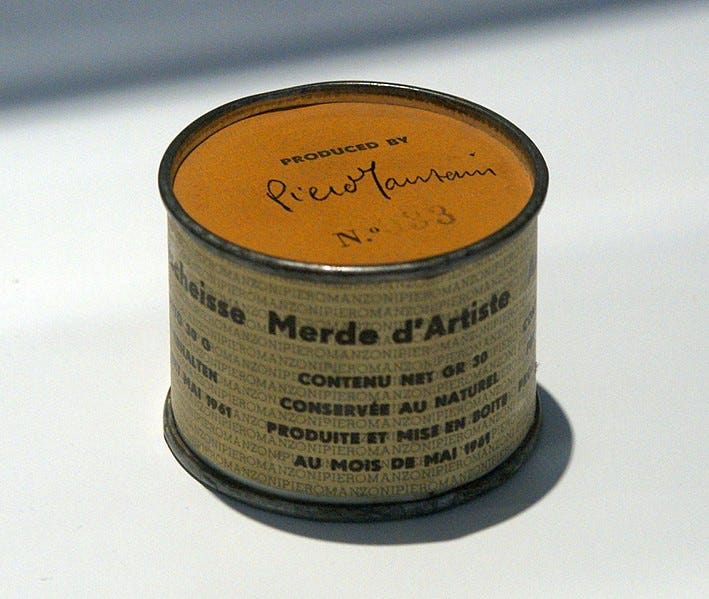
And in perhaps the ultimate parody of artistic ego, Manzoni manufactured 90 sealed cans in which was contained — so the artist asserted — his own excrement, as stated on the cans’ labels. To underline the concept, each 30-gram can was priced by weight based on the current value of gold (around $1.12 per gram in 1961).
At around the same time, Manzoni made one of my personal favourite works of absurdist art when he took a stone plinth — the sort usually reserved for statues of soldiers on horseback — and turned it upside down. Looked at in a certain way, it was as if the entire world was now on top of the plinth.
Manzoni had made the planet Earth into a work of art. He called it Base of the World (1961).
Through the transformative power of their own curiosity and resourcefulness, both Manzoni and Calle teach that sources of creative innovation reside in unexpected places. In their artistic endeavours, they encourage us to step back from mere observation and carefully examine the range of possibilities being presented.
And so our gaze is shifted. The constraints of conventional thinking are shed. And preconceived notions of what art must be are confronted. It all depends on your point of view.

If you liked this, you may also be interested in my book Masterpieces of Art Explained, an examination of some of art’s most enthralling images.
Would you like to get…
A free guide to the Essential Styles in Western Art History, plus updates and exclusive news about me and my writing? Download for free here.
Join me…
On Instagram for more great paintings on the go!