
There is no God or Soul within you
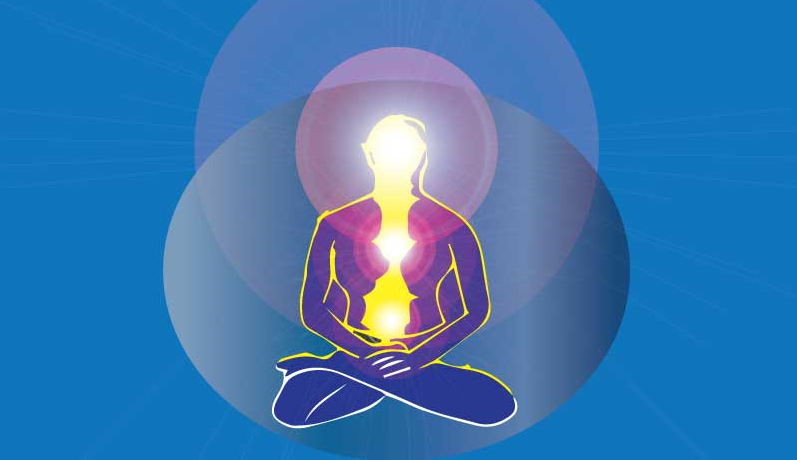
Following is an excerpt from a samvaad (dialogue) session with Acharya Prashant.
Questioner: I still can’t grasp how you can visualize Brahman, God, whatever you may call it, inside of you, being part of you and not being somewhere outside. I won’t say I am a strong Christian, but whenever there are bad times I would pray, but I would pray somewhere outside, I would pray somewhere ‘out there’. Whereas, in some of the Vedanta books they mention that once one realises that the Atman is also the Brahman. So how does one realize God this way?”
Acharya Prashant: The question is — ‘how is it possible to visualise God or Truth or the Ultimate within oneself’? The questioner says that she has been brought up in the tradition of visualising God; if at all visualization has to happen; outside of herself — the Christian way. But then she says that she has read in some of the Vedanta books that, because there is identity between Atman and Brahman so, God is within you because Atma is within you. Atma is within you, Brahma is God and Atman is the same as Brahman, so by implication, God too is within you. So, the questioner says that she’s not finding it easy to reconcile this.
At no point does Vedanta say that the Atma is within you. It is a gross misinterpretation, misunderstanding. There are the two principal paths. Looking within is primarily a feature of the path of knowledge “Gyan marga”.
When you look within, it is not the Truth that you look at.When you look within, it is always your falseness and ignorance that you encounter. That’s why the path of knowledge is the path of negation ‘neti, neti’.
You look at everything that you can find within yourself. You look at it, scrutinize it closely, and you ask — is this the ultimate? Is this final? Timeless? Ever reliable? Never changing? And the inevitable and obvious answer every time is — ‘no, this is not that’.
You look at your thoughts, emotions, deeply held beliefs, ideologies, identities, relationships, possessions, your entire knowledge, past, future and the hopes from future and you question ruthlessly. You do not just accept anything because it happens to be present in your own mind.
The path of knowledge is a path that requires tremendous honesty, and the result of that honesty is a foregone conclusion — whatever you look at with honesty just loses its charm. Not that you intend that to happen, your intention is probably to come up upon something that is beautiful, tremendous, magnificent, worth laying down your life for. But that does not quite happen. Maybe things have their sheen, their aura from a distance.
Maybe, as long as you are ignorant about something it continues to enthrall you. But the closer you get to it, the more disappointed you are with it. That’s the path of realization. You negate, negate and negate. Finally, what is left?
Obviously, everything that could be the subject of negation has now been put aside. So, now you are left with only that which was negating. We said it requires honesty to look within, enquire and negate. But then there is still somebody who is wearing the mantel of honesty and with the sword of realization is hacking down everything within. This is the final trace of ego that is left and this ego, once it has exhausted everything else, finally disappears under the watch of its own honesty. Right?
So, did you find God within? Well, no. All you are left with, is a void within. There is nothing that is found. All that was to be found was hacked down into pieces. When does Vedanta say that if you look within you will find God? At no place has it said that.
When you say “within”, within what? This sack of skin? When you say within, you surely mean some special arrangement within which you are trying to peep. That could be either the body or the mind. Are we trying to assert that the Atman is something that has special proportions? Only then it can be contained within something in space! Similarly, when you say that the ‘Atman is within me’, you probably must realise that you are saying you are bigger than the Atman! Any envelope has to be larger than the thing that it contains. Right?
So, what are we saying? We are saying, ‘I am big’. And when I say, ‘I am big’, I’m referring to the ego. Right? The ‘little Self’. I’m big and the Atman is within me, so the Atman is smaller than me. All this talk of ‘my Atma’ or a ‘personal Self’, is pure ego nothing else. And when I say ‘pure’, I do not mean in sense of acceptance or affirmation. When I say, ‘pure ego’, I mean much the same as ‘pure poison’. Are you getting it?
No, Vedanta does not say that Atma is within you. Atma is that which cannot be contained in anything. Atma is that which does not even pervade space. Atma is that which you cannot even think of, talk of, not even imagine! So, how can then Atma be contained within you? So, no, Vedanta does not say that Atma is within you.
Whenever the truth is to be visualised, the visualization is always done in all humility outside of yourself and therefore, the from that is given to Truth is kept as fantastic and para-human as possible.
The underlying idea is first of all — Truth cannot be within me, for I am so full of falseness. Secondly — even if the truth is outside of me, it cannot look like me.
So, even if I am to represent it as a statue, as a picture, as an image, through words, through any kind of artistic expression, then the expression has to be a little transcendental.
Now you know why you have so many myths attached to those who have come to represent godliness — those myths are deliberate! Those myths were intended to keep the ego in check. If the supreme Truth were to be represented as an ordinary mortal; and that could be done, not that there would be something fundamentally or technically wrong with that, that could be done; then that might give the ego a good shot of nutrition! ‘See, that’s the final truth and that looks so much like me! And if the truth looks so much like me, why can’t I be the ultimate?’
That’s why in India you have deity with 8 hands, 40 heads, doing all kinds of unusual, abnormal, if not paranormal things. Obviously, those who conceptualized all that knew a bit about the basic laws of science and anatomy and genetics, but all that was deliberate.
So, God as an idea is helpful only if it helps you look at yourself and that is the purpose of spirituality — not to attain God so much, but to look honestly at yourself. Attainment of God is just a technique to dissolve the ego. God, then is not so much of a truth but actually a method. God is not the end. The end is dissolution of ego. The idea of God is a method, it’s a trick, it’s a way. It helps drill some humility into us, nothing more than that.
Where does the whole thing called ‘spirituality’ gain its relevance from? Why is any human endeavour relevant at all? Why do we act? Why do we seek? Why do we read? Because we are restless, because we are not complete within, because there is a certain discontentment from the status quo. Right? Therefore, spirituality has to be about looking at oneself. Because it is the ‘little Self’, the ego, that is not all right with itself, clamouring for attention, openly declaring that it is sick.
If there is a patient that needs attention, would you care for the patient or would you start worshiping the Deity of Health? Tell me please! Unfortunately, a lot of spirituality has turned into a neglect of the patient and a worship of the deity of health. And the more you worship the deity of health, the more it enables you to neglect the patient for a little more while.
If the deity of health was conceptualized, it was merely to remind the patient that his current condition is not his destiny. That health is possible, and the proof of health is there on the wall in the form of a picture, or on the table in the form of a book of description, or in the temple in the form of a marvelous deity. Those things are there just to enable the patient to go into himself and be healed.
Remember, God as such, specially in Vedanta, is not a reality but a very, very useful idea and Brahma that you talked of, is not God. God, in the normal usage is the counterpart of Ishwar.
Q: There are so many links.
AP: But it’s very, very simple if you go into pure Vedanta. It’s very simple if you go to the mother scriptures but if you occupy yourself with reading commentaries, then there is a possibility of confusion.
Q: Even if you are saying the same thing you cannot know something more. Even in your book you are saying you cannot know more than what you know already. So, if I’ll be reading that only what my mind will grasp, is what I already know, how will I know something more from the scripture?
AP: At least the scripture will tell you the limits of your knowing and once you come to that, once you come to that, then your confidence in your knowledge will drop. Right now, even right now, if you are quite confident about your knowledge, and your confidence in your knowledge drops, that is exactly what is needed. Even this assertion — “how can I know more than what I know?” — It’s quite a confident assertion!
Q: It’s not what I’m saying, it was in your book.
AP: How do you know in what context I was saying that? That’s why the book is just an invitation, you have to come over and sit here! The book has done its job, you are here now, so don’t quote the book anymore. Yes!
It’s not that the stuff is terribly difficult to comprehend. What is difficult is when you try to reconcile this with what you already believe in. That conciliation will be impossible, and you will say you are confused.
Otherwise there is nothing confusing in this. And we want to accord and keep according some kind of validity to our pre-existing knowledge. Why? because it is ‘our’ knowledge. ‘How can my knowledge be proven suddenly false’? So even if we come across something dimensionally new, we want to somehow fit it in with our pre-existing patterns of knowledge, so that we can say — ‘I have something new and it is just an extension or continuation of what I already knew’. ‘I have ornamented my old knowledge, so I have become better, I have not discarded anything’. But then all spirituality is the art of rejection.
You have to discard! Without discarding you continue to have what you already have, and if you are alright with that, then there is no need to read anything or, travel anywhere or, meet someone. If we are good as we are, then why do we need any endeavour?
So, first of all drop the idea that ‘we are all right as we are’. And even that is quite fashionable in spiritual circles today — ‘you are great and beautiful as you are’. If you are great and beautiful as you are, why did you require someone else to tell you that? You are great, so you should know all this on your own!
One has to have the humility to firstly accept that things are not alright and from that humble acceptance a lot starts falling, you start getting unburdened, lightness comes to life.
You see, this world is a book, and our so-called ‘God’ or ‘Ishwar’ is the author. All problems arise when we give more importance to the book than the author!
Watch the full video here.
You are welcome to know more about Acharya Prashant and the work of the Foundation. You can also contact the Foundation directly.