

Business, Leadership
There Is a Try
The Road To Understanding
I study leadership today with the same child-like fascination I started with almost 34 years ago. I went through several leadership seminars during high school, hosted by my high school band, but from the very first seminar, I knew I was hooked.
I used to carry around a handwritten list of “things that leaders do,” adding to it if I came across something good. It was a lot like the many articles on leadership we see today, except this was 1986. If I came into a challenging situation, I would scroll down this list and try to leadership my way out of it.
After high school, I started reading books on leadership, especially in the early 90’s. I spent a lot of time at the book store reading about the newest methods and styles, and learning the latest buzzwords.
I tried to read and remember as much as I could.
I had to do that because I certainly couldn’t afford to purchase any of those books, not then anyway.
Sometime in 1992, I got myself a library card so I could study the leadership books a little longer. It was around this time when I came across what is still my favorite leadership book to-date.
The book was called Leaders: The Strategies for Taking Charge, written by Warren Bennis and Burt Nanus. It was published in 1985, one year before I began my own study of leadership, but I didn’t read it until 1992.
Leaders fundamentally changed the way I think about leadership, and it has lasted even till today. The book became the basis for my personal and practical philosophy which I call, The Endeavor Perspective.
Warren Bennis is quoted quite often for his work on Leaders. If you’ve ever read or heard someone say,
“Managers do things right, leaders do the right thing.”
That’s a paraphrasing of Warren Bennis. Before him, there just wasn’t a lot of research done on leadership. He was a pioneer in a new industry. It was always my hope to meet him, but sadly he passed away in 2014.
After reading the book, and studying it profusely, I used it to judge every other book on leadership I’ve ever read. I would take a leadership book and basically rewrite it so it would fit into the book’s four-strategy framework. It worked with just about every single book.
At the time I didn’t know why it worked so well, but I kept doing it for about 15 or 16 years. I worked constantly with the four strategies, studying them, tweaking them, and renaming them. Finally in late 2010, I hit upon the idea of The Endeavor Perspective, and everything began to make sense. I gained insight into how and why the concepts of leadership and management were separate skills, yet equally necessary in every endeavor.
When Bennis and Nanus studied their 90 leaders of the day (60 from the business sector, 30 from the public sector), they weren’t studying leadership traits as they suspected. Since the leaders in the study were handpicked because they were successful, what was actually being studied were principles for success.
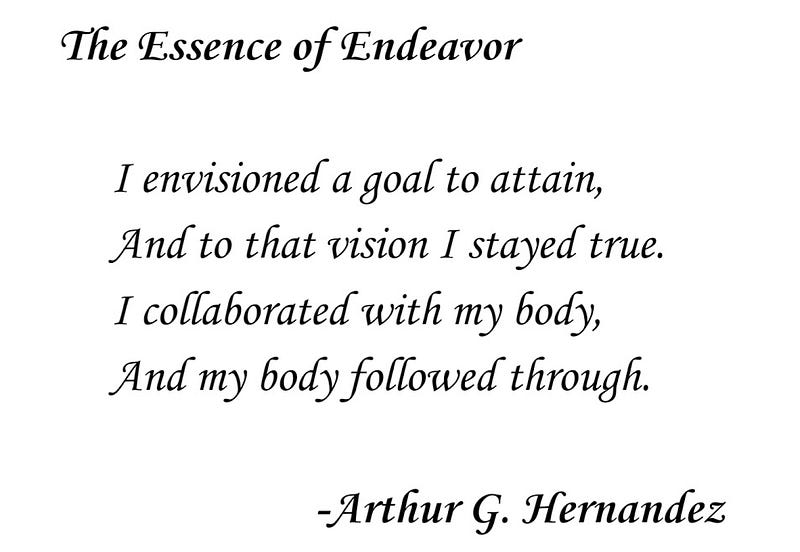
Now comes into play The Endeavor Perspective, which is basically looking at things from the angle of trying. In the case of the Bennis and Nanus approach, it was the angle of trying to determine the principles for success. Something became clear to me. As humans, we all try. We try to do something, try to be something, try to be someone, etc. What determines our success or failure is the quality of our try. Each of the leaders in the Bennis and Nanus study utilized four principles (strategies) in a balanced measure. This is what made their endeavors, their tries, successful.
Suddenly, I realized Yoda was wrong! “There is a try!”
Bennis and Nanus elaborated on these four success principles, and referred to them as strategies. Later I understood them to be just natural skills, available to everyone. The skills of vision and collaboration are leadership skills because they deal with people. The skills of adherence and action are management skills because they deal with things such as structuring and work. In order to have a successful endeavor, you must utilize and balance the two leadership skills with the two management skills.
With the aid of this book, I developed a framework for analyzing the balance of leadership and management skills present within a given system. Even when it wasn’t fully developed I could still use it to determine if the contents of a leadership book could actually teach someone how to be successful. Would you be surprised to know that one day I just gave up on reading them? Sadly, it’s true.
Every leadership author has their own list of habits for success.
I was able to categorize the success lists I found in the leadership books using my framework. I realized that many times the author was better skilled at selling you a book than actually transforming you into a successful leader.
Today, I understand that everyone’s journey to success is unique. There exists a specific road for each of them to follow, but it’s built with many crossroads and distractions. I have a tendency to travel sideways over these roads in the chance I cross someone’s path that might need a direction or two. My road doesn’t always seem to go the same way as everyone else’s, but I don’t mind. It feels right.