
There are Twenty Russian Agents in the U.S. Congress
Who is your Representative working for?

No fewer than ten members of the U.S. House of Representatives and ten members of the U.S. Senate are agents of the Russian Federation. Before I get around to naming names, I will establish my credentials. Before I turned to the academic route, I was an intelligence analyst. I did not run agents, but I worked with and contributed to the product. When I needed to know, I had some access to sources and methods. Before that, my father was a counterintelligence officer for several years. He never provided details about those years. But from an early age, I learned the general mindset that goes with that kind of work.
I will name names. They are not all the names I could name. I will only focus on the top ten “solid” candidates in each house of the legislature of the United States.
Proof in a court of law is not the goal of counterintelligence — finding the truth is. If you want to skip straight to the names, go to the section entitled “Agents of influence and provocateurs in recent American politics” in the next-to-last section. Between here and there, I will define some terminology relating to intelligence and counterintelligence. I will also include some classic cases to show how these categories apply in practice. If that sort of thing bores you, skip to the end. If, like me, you find these things interesting — and in particular how they relate to the relationship between agencies of Russian intelligence, the penetration of the Republican Party, and the 2016 election of Donald Trump — read on.
Intelligence and Counterintelligence 101
“Agent” is a term of art in intelligence work. Professional employees of the American Central Intelligence Agency (CIA) and related agencies of the Intelligence Community (IC) or the Russian “Special Services,” including the Special Intelligence Service (SVR), the Main Intelligence Directorate (GU, previously GRU) of the military, and the Foreign Intelligence Service (FSB), are intelligence officers. Agents do the bidding of a foreign intelligence service. They may be paid or unpaid. They may be witting accomplices or unwitting tools. They may know who they are working for, and they may not.
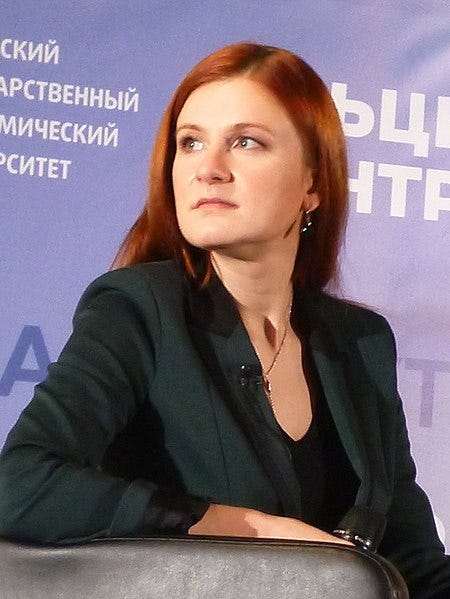
The person an agent reports to is an operative, often an intelligence officer. He is involved in recruiting, guiding, and giving essential training to the agent. Sometimes, the officer may recruit an agent and instruct that agent on how to recruit and train others. The line can continue for as long as the conspiracy can hold. Agents are captured, so they are only told the least they need to do their job. One operative often runs many lines of agents, each of which does not know the others’ identities. Discovered agents may be jailed (or executed). Operatives are usually left untouched (or, at worst, expelled). For example, Maria Butina (agent) worked for Aleksander Torshin (operative). Americans jailed her for her infiltration and influence activities within the NRA and the Republican Party. After her imprisonment, the U.S. deported her to Russia. There, they rewarded her with a safe seat in the Russian parliament.
Agent recruitment
How are agents recruited? The techniques vary and relate to the character of the agent involved. Professionals summarize the motives for espionage with the acronym MICE: money, ideology, coercion, and ego.
- Money: an agent wants to be paid for their work
- Ideology: an agent believes in the cause
- Coercion: an agent can be blackmailed, or brought to slide from an “innocent” helpful relationship into one that can later be used against him
- Ego: an agent may want the boost that comes with leading a double life, playing games to show their “superiority” over their target
Agent recruitment by ideology
Some agents do what they do because they have concluded that their side is in the wrong. This has been very important when dealing with Soviet and Russian spies. Oleg Penkovsky (Colonel, Russian GRU) and Oleg Gordievsky (Colonel, Russian KGB) came to the West out of disillusionment. In doing so, each helped to prevent nuclear wars, in 1962 and 1983.
Penkovsky grew disillusioned with his government in April 1961. Khrushchev's de-Stalinization program revealed the depths of Soviet evil. Through a British businessman, Penkovsky offered his services to British intelligence (MI6). Between April 1961 and August 1962 he passed over 5,000 photographs of classified military, political, and economic documents to the British and U.S. intelligence services. The information he provided on the Soviets’ relatively weak capabilities in long-range missiles proved invaluable to the United States before and during the Cuban missile crisis. Shortly after the crisis, he was arrested and executed.
Gordievsky’s crisis of faith came after the Soviet invasion of Czechoslovakia in 1968. He tried to send a covert message to the Danish Security Intelligence Service, but he was ordered to return to Moscow before he could make contact. When he returned to Copenhagen in October 1972, both the Danes and the British had concluded he was a persuadable agent. MI6 contacted him and began running him as a double agent in 1974. In 1982, the KGB posted Gordievsky to London.
There he rose through the ranks, gaining access to higher and higher levels of Soviet secrets. These he passed to MI6 via a London safe house. Among his contributions was averting a potential nuclear confrontation with the Soviet Union. NATO exercise Able Archer 83 was misinterpreted by the Soviets as preparations for an attack. This led them to consider a “pre-emptive” strike. Revealing this problem to the West allowed NATO and the United States to take action to ease Soviet fears.
Gordievsky also identified Mikhail Gorbachev as the Soviet heir-apparent. When Gordievsky was summoned back to Moscow and interrogated, MI6 arranged his covert extraction from Russia to Britain. He settled in Britain, and the Russians sentenced him to death in absentia. After an attempted poisoning with Thallium, he moved from one “safe house” in London to another near the city, where he lives to this day.
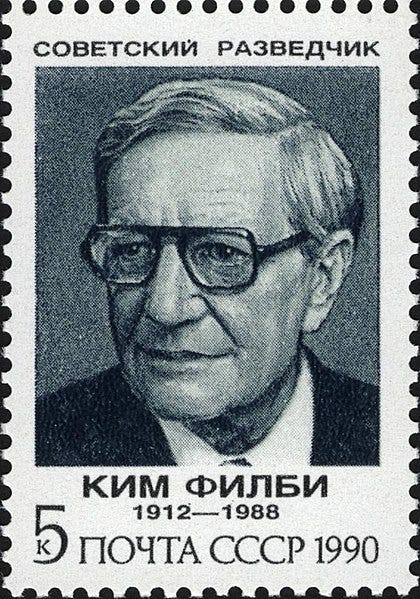
Service for ideology works both ways. Harold “Kim” Philby (MI6), a double agent for the Soviet Union, was a long believer in Soviet communism. Recruited by Soviet intelligence in 1934, he worked as a journalist, covering the Spanish Civil War and the Battle of France. In 1940, he began working for MI6, and by the end of World War II he had become a high-ranking officer. In 1949 MI6 appointed Philby as the first secretary to the British Embassy in Washington. There he served as chief British liaison with American intelligence agencies. During his career, he passed immense amounts of intelligence to the USSR. This included tipping off two other spies with ideological motives, Donald Maclean and Guy Burgess, who fled to Moscow. In January 1963, after he was unmasked as a Soviet agent, Philby also defected to Moscow. There he lived as a colonel in the KGB until his death in 1988.
The U.S. arrested Julius and Ethel Rosenberg in 1950 for espionage thought to date back to the 1940s. The U.S. charged them with giving the Soviet Union atomic secrets. Among these are elements of the design for the plutonium bomb dropped on Nagasaki. Julius’ spy ring also gave the Soviets details of proximity fuses and radar tubes, keys to air defenses if the Cold War had ever turned hot. Communications intercepts from the Venona Project confirmed Julius’ spying. But the United States considered the intercepts too sensitive to be used in court. The same top-secret intercepts that made Julius’ case airtight showed Ethel had a minor role at most. But to admit how the Americans knew that would threaten the secrecy of their source. To maintain that secrecy, the U.S. convicted and executed both Rosenbergs after a sham trial.
In the games of intelligence and counterintelligence, nobody’s hands are clean.
Ideology is not always the motive
Not all justifications are “noble.” Aldrich “Rick” Ames, a 31-year CIA counterintelligence officer, committed espionage for the money. By the 1970s, he was drinking heavily. While posted in Mexico City, he engaged in at least three extramarital affairs. One of these led to a divorce that Ames thought might bankrupt him. His new wife also proved to be a heavy spender. He later claimed that it was this financial pressure that had first led him to consider spying for the USSR.
In 1985, Ames provided information that he considered “essentially valueless” but would establish his credentials as a CIA insider. He asked for $50,000, which the Soviets paid. Ames later claimed that he had not prepared for more than the initial “con game” to meet his indebtedness. But having “crossed a line” he “could never step back.” Money plus Coercion: two of the elements of MICE.
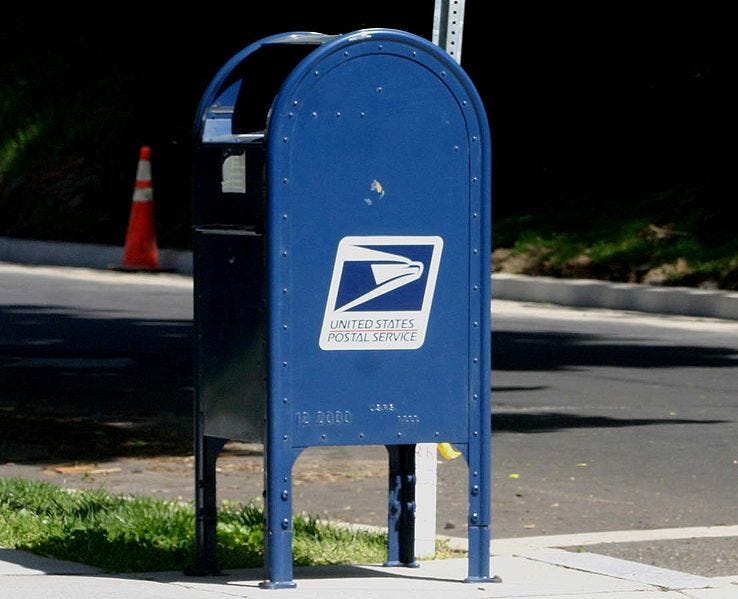
One of the best places to be a spy is in your own counterintelligence service. Everyone is looking outward, but gives extra slack to “one of the boys.” It’s not like the red flags weren’t there. By the time of his arrest in 1994, Ames’s lifestyle was well past anything one could justify with his $60,000 a year salary.
- Ames’ teeth, yellowed by heavy smoking, were capped.
- From “bargain basement” attire, Ames changed to wearing tailor-made suits his superiors couldn’t afford.
- He purchased a $540,000 house in Arlington, Virginia, in cash.
- He bought a $50,000 Jaguar automobile.
- His home remodeling and redecoration cost $99,000.
- His monthly phone bills exceeded $6,000, mostly calls by Ames’ wife to her family in Colombia.
- He had premium credit cards, with minimum monthly payments exceeding his monthly salary.
What do you have to do to get caught in D.C.?
At the time of his arrest in 1994, Ames had compromised more highly classified CIA assets than any other officer in history until Robert Hanssen’s arrest seven years later.
Robert Hanssen was an FBI double agent from 1979 to 2001 in what the U.S. Department of Justice has called “possibly the worst intelligence disaster in U.S. history.” In 1979, three years after joining the FBI, Hanssen approached the Soviet GRU to offer his services, which lasted until 1981. He then restarted his espionage activities in 1985 and continued until the collapse of the Soviet Union. The next year, he restored those communications and continued spying until his arrest. Throughout this, Hanssen was careful to remain anonymous to the Russians. He provided information; they provided cash. It worked through a system of “dead drops” he arranged. Before his capture, Hanssen sold thousands of classified documents to the KGB. These included U.S. nuclear war plans, developments in weapons technologies, and details of the U.S. counterintelligence program.
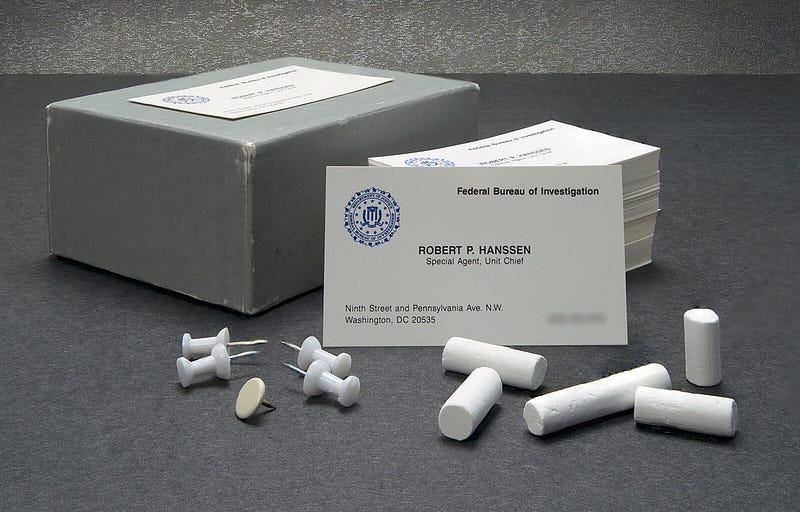
When he reopened his connection in 1985, Hanssen sent an anonymous letter to the KGB offering his services. In return, he asked for $100,000 in cash. In this letter, he gave the names of three KGB agents secretly working for the FBI: Boris Yuzhin, Valery Martynov, and Sergei Motorin. And while Hanssen was unaware of it, he confirmed a report by Ames that had already exposed all three agents earlier that year. Yuzhin was ordered back to Moscow in 1982 and investigated, but the Soviets did not arrest him until Hanssen’s confirmation.
After Hanssen, Moscow also recalled Martynov and Motorin, who they tried and convicted of espionage. The KGB executed Martynov and Motorin with a gunshot to the back of the head. They imprisoned Yuzhin for six years before he was released to emigrate to the U.S.
Because the FBI blamed Ames for the leak, Hanssen was never suspected. But there was some concern that not every American intelligence failure could link to Ames. Was there another mole?
The FBI stationed Hanssen in Washington, D.C. in 1987. His job was to study all known and rumored penetrations of the FBI to find the man who had betrayed Martynov and Motorin. This meant that he was looking for himself. Hanssen not only ensured that he did not reveal himself, but he turned over the entire study to the KGB. Also, he revealed a multimillion-dollar eavesdropping tunnel built by the FBI under the Soviet Embassy.
Hanssen’s greatest betrayal was of Dmitri Polyakov, who provided information while he rose to the rank of general in the Soviet Army. Yet the Soviets did not act against Polyakov until Aldrich Ames betrayed him a second time in 1985. At the time, the CIA blamed Ames for giving Polyakov’s name to the Soviets. Hanssen’s report remained unrevealed until after his 2001 capture. Some CIA and FBI officials later came to believe the Soviets turned Polyakov into a triple agent.
Hanssen had a talent for intelligence tradecraft, and he was in an ideal place to deflect investigations away from himself. It wasn’t until a KGB agent sold an audiotape from the anonymous mole that the U.S. identified him through fingerprints and voice analysis.
Like Ames, Hanssen claimed no political or ideological motive for his actions. He told the FBI his only motivation was financial, accumulating more than $600,000 in cash, about $50,000 in diamonds, and a promise, which he says he never took seriously, of another $800,000 in a Russian bank account.
But another motive might have been ego. According to court documents, Hanssen harbored a fantasy of retiring from the FBI. He would then move to Moscow to train future spies, like his boyhood hero, Kim Philby. He explained his plans to his Soviet handlers:
Want me to lecture in your 101 course in my old age? I would be a novelty attraction. I’d decided on this course when I was 14. … I read Philby’s book. — Robert Hanssen
“So that when the time comes, you will accept (m)y senior services as a guest lecturer,” read a note found by federal investigators.
Eventually, I would appreciate an escape plan. (Nothing lasts forever.) — Robert Hanssen
Besides Money, never forget the E in MICE: Ego.
Types of agents
There are many kinds of agents. Since the point is to operate without drawing attention, the terms secret agent and undercover agent are redundant. These terms are much more used by laypeople than professionals.
Much more useful are labels like double agent or agent-in-place. A double agent represents himself as serving one intelligence agency while actually working for another. If instead of two agencies the agent serves three, the term is a triple agent (like, perhaps, Polyakov). A double or triple agent may provide information to each service about each of the others, but in the end, there is normally one side that has the double or triple agents’ ultimate allegiance.
If an agent is discovered, sometimes he can be turned. A double agent discovered by the agency against which they are now spying, if used in that agency’s service against the enemy, is a redoubled agent. Someone may redouble an agent without the agent even knowing that he or she is being used — for example, by giving the double agent inaccurate or deceptive material to pass on as genuine intelligence. If the double agent is discovered and turned again, he may be a triple agent without knowing it. It is not without reason that intelligence and counterintelligence are sometimes referred to as a “wilderness of mirrors.”
For example, Edward Lee Howard joined the CIA in 1980 with his wife, where they were both trained in intelligence and counterintelligence techniques. Before going on their first assignment, a routine polygraph test showed he had lied about past drug use. The CIA fired him. Angry over the perceived unfairness of being dumped, he started drinking heavily. He then began making phone calls to some former colleagues, both in Washington and in Moscow, including some on lines he had been told had been tapped by the KGB.
At some point, Howard apparently leaked classified information to the Soviet security services. The CIA blamed his revelations for exposing Adolf Tolkachev, who died at the hands of the KGB. Under pursuit by the CIA, Howard fled to Moscow, where he insisted he refused to divulge anything of real importance for his Soviet protection. He died there, reportedly of a broken neck after a fall. To the end, Howard claimed he was not responsible for Tolkachev’s discovery and death.
He may have been telling the truth. On August 1, 1985, after twenty-five years of service in the KGB, Vitaly Yurchenko walked into the US Embassy in Rome and defected to the United States. In interrogations by the CIA, he accused Howard and another officer, Ronald Pelton, of working for the KGB. In November of that year, Yurchenko re-defected back to the Soviet Union. Perhaps Yurchenko was acting as a re-doubled agent, seeking to fool the CIA with wrong leads to protect the identity of Aldrich Ames. To this day, we don’t know.
“Wilderness of mirrors,” indeed.
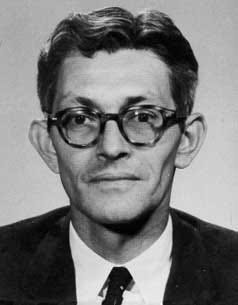
James Jesus Angleton was an intellectual. He thrived on doing the convoluted work of counterintelligence. He devoted himself to ferreting out Soviet “moles” in the CIA. Yet he never realized that his friend and mentor, British spymaster Kim Philby, was himself a Soviet mole. Meanwhile, William King Harvey was Angleton’s complete opposite. Harvey was a small-town lawyer and hard-drinking womanizer turned FBI agent. His passion for counterintelligence work led him to become the FBI’s leading expert. He and Angleton soon learned to loathe each other. It didn’t help that Harvey presented the CIA with his assessment that Angleton’s friend Philby was a Soviet double agent. In the end, Philby outmaneuvered both of them by fleeing to Russia.
An agent-in-place is like a double agent, with the difference that an agency usually recruits a double agent to take that role. The agent-in-place, like Gordievsky, volunteers for the position. Suppose a person works for Agency A, and then takes a job for agency B to report information to Agency A with no one at Agency B knowing. That is a double agent. An agent-in-place would be someone already working for Agency B who offered services to Agency A of their own initiative. This agent (sometimes a walk-in) continues to work for Agency B while he feeds information to Agency A.
An agent-in-place is valuable to the new employing agency, but his role has significant risks. The U.S. sentenced Robert Hanssen to life imprisonment without the possibility of parole. Ames will be in prison for life. The KGB executed Penkovsky.
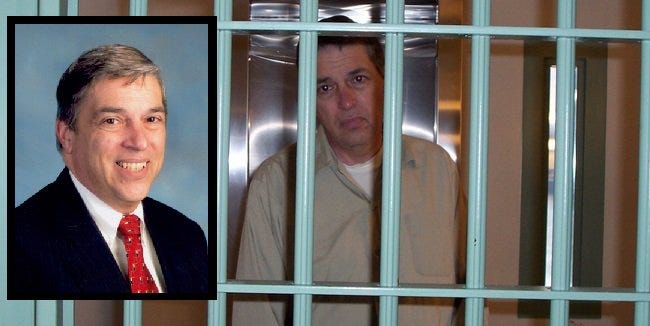
According to an unconfirmed anecdote when KGB officers discovered that one of their own was serving the Americans as an agent-in-place, they threw him feet first into a furnace while his fellow agents watched.
An agent doesn’t have to be a spy
Other variations on the concept of an agent are sleeper agents, agents provocateur, and agents of influence. A sleeper agent is placed in an undercover situation and told to await further instructions before engaging in espionage. A sleeper may remain inactive for months or years, or even the rest of her life. An agent provocateur is someone who infiltrates a group with the purpose of inciting its members to take unlawful acts. These acts would bring them to punishment by the authorities, and/or undermine the rule of law.
Finally, an agent of influence is someone not employed by an intelligence agency but acts (wittingly or unwittingly) on its behalf. They may push a true line they believe to be true. They may repeat lies they have been led to believe.
Agents of influence and provocateurs in recent American politics
The Russian agents in the U.S. Congress are, primarily, agents of influence. By encouraging illegal acts, like the attack on the U.S. Congress on January 6th, 2021, some are also agent provocateurs. At least some of the conspiracy theories associated with QAnon — including the “stolen election” narrative promoted by Trump and his allies — support their claims with disinformation fed to them and amplified by Russian intelligence. This is no accident.
In 2016, in a closed National Security Council meeting attended by Vladimir Putin and his senior ministers, the Russian president gave his personal authorization to put the full support of three Russian agencies to support a “mentally unstable” Donald Trump and encourage “social turmoil” within the United States. It was a low-risk operation with the potential for a high payoff. “It is acutely necessary to use all possible force to facilitate his [Trump’s] election to the post of US president,” the paper states. This would help bring about Russia’s favored “theoretical political scenario.” It would contribute to “the destabilization of the US’s sociopolitical system” and “see hidden discontent burst into the open.”
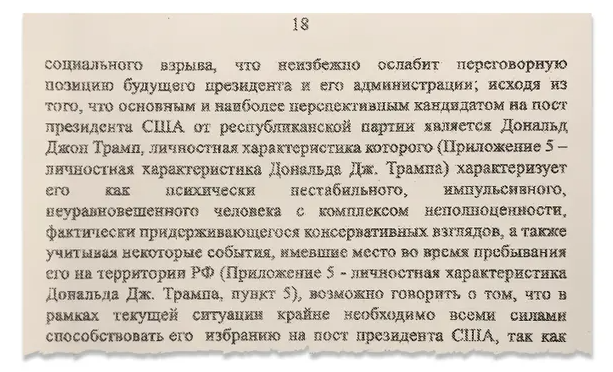
The report — “No 32–04 \ vd” — is classified SECRET. It says Trump was the “most promising candidate” from the Kremlin’s perspective, and includes a brief psychological assessment. Trump was described as an “impulsive, mentally unstable and unbalanced individual who suffers from an inferiority complex.” That’s Ego, the E in MICE.
There is a reference to the effect that Putin possessed kompromat, or potentially compromising material, on Trump. It seems this was collected during earlier “non-official visits to Russian Federation territory.” The document invites Security Council members to find the details in appendix five, paragraph five. That appendix is not available in an unclassified source. If it is true, that’s grounds for the C, Coercion, in MICE.
Ideology, as far as we know, has never had much meaning for Trump, beyond a fondness for strongmen. But money? He has long been noteworthy for his pride in his fortune. He has a tendency to lose money and relies on lines of credit with banks with strong connections to Russia. Some of this would be easier to discount, but Trump’s constant unwillingness to release his tax returns suggests something is going on. That points to Money, the M in MICE.
This is not proof that Trump was a knowing agent of the Russian government. Yet there is strong circumstantial evidence of him being an agent of some sort. He was (and is) an ideal candidate for the role.
Much like the invasion of Ukraine, when Putin and the Security Council approved interference in the 2016 election, it was justified as self-defense against an American threat. Again, like in Ukraine, the plan worked to take advantage of perceived weaknesses. In Trump’s case, there was a “deepening political gulf between left and right” in America, amplified in the American “media-information” space, and a general anti-establishment mood under President Obama.
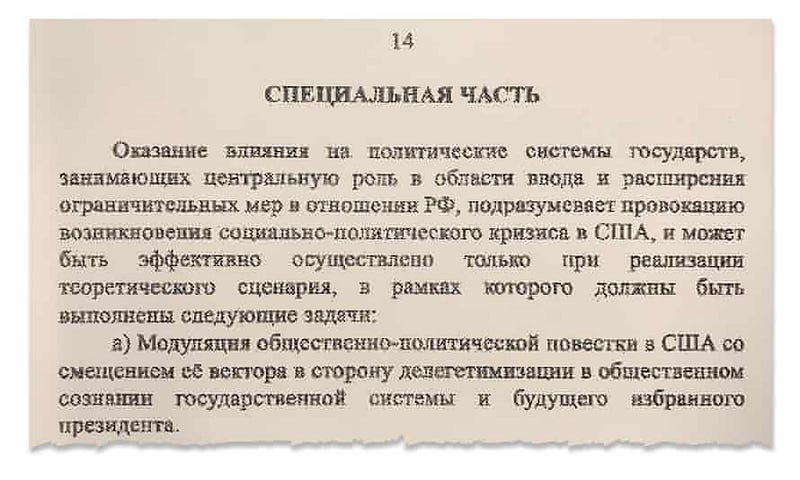
There are paragraphs on how Russia might insert “media viruses” into American public life, which could become self-sustaining and self-replicating. These would alter mass consciousness, especially in vulnerable groups.
The measures were effective immediately on Putin’s signature. The document is consistent with what we know about how briefings are transmitted by the security services and how decisions are made by Putin. They also appear to set out a route map for what actually happened in 2016.
So far, the U.S. has imprisoned, arrested, or issued federal arrest warrants for twelve Russian military intelligence officers, members of the Internet Research Agency (“troll farm”) in St. Petersburg, and many Americans. The Special Counsel investigation under Robert Mueller avoided whether we could indict an American president. But it raised charges related to cooperation between elements within the Trump White House, the Trump campaign, and Russian intelligence.
In addition, the report of the Republican-led Senate Intelligence Committee under Marco Rubio reviewing the Intelligence Community’s Assessment of 2016 Russian election interference is five volumes long. The final report, released in August 2020, found the “Russian government engaged in an aggressive, multi-faceted effort to influence, or attempt to influence, the outcome of the 2016 presidential election.” It confirms that “Russian President Vladimir Putin ordered the Russian effort to hack computer networks and accounts affiliated with the Democratic Party and leak information damaging to Hillary Clinton and her campaign for president.”
Also, Paul Manafort, the former Trump campaign chair, showed a “willingness to share information with individuals closely affiliated with the Russian intelligence services” that “represented a grave counterintelligence threat.” Beyond the Mueller report, the Senate committee found evidence suggesting Manafort and longtime associate Konstantin Kilimnik were “connected” to the Russian government’s effort to hack and leak Democrats’ emails. The details of this relationship remain redacted to this day, but they may have something to do with the Department of Justice’s ongoing efforts to bring fresh charges against Manafort in relation to crimes not already pardoned by Trump.
Finally, despite a Russian attempt to frame Ukraine for these efforts, Trump Administration official Fiona Hill has testified that this was “a fictional narrative perpetrated and propagated by the Russian security services themselves.”
Agents of influence
The plan worked — far beyond the dreams of Putin and the Russian security services. Of course, it rested on fractures that were already present in American society. But to this day, even after Trump-supporting One America News admitted as part of his settlement with two Georgian campaign workers that state officials “have concluded that there was no widespread voter fraud by election workers who counted ballots at the State Farm Arena in November 2020.” (a conclusion reached, in fact, by the end of that year), roughly one-third of Americans continue to believe that Joe Biden came to power because of voter fraud, and candidates like Marjorie Taylor Greene and Lauren Boebert have gone so far into conspiracy theory that Greene was removed from all committee assignments and Boebert has been condemned for her vocal support of the January 6th insurgents.
Proof of who is working for whom is problematic, but by their acts, you will recognize them. In April Congress passed a “lend-lease” bill for Ukraine, unanimously in the Senate, and in the House by a vote of 417 to 10. The ten dissenters, by their actions, identified themselves as agents of influence for the Russian Federation. Their names and party affiliations:
- Andy Biggs (R-Ariz.)
- Dan Bishop (R-N.C.)
- Warren Davidson (R-Ohio)
- Matt Gaetz (R-Fla.)
- Paul Gosar (R-Ariz.)
- Marjorie Taylor Greene (R-Ga.)
- Thomas Massie (R-Ky.)
- Ralph Norman (R-S.C.)
- Scott Perry (R-Pa.)
- Tom Tiffany (R-Wis.)
Two of these ten (Perry and Biggs) are among the five House members subpoenaed to testify to the committee investigating the January 6th attack on the U.S. Capitol.
Massie is the only Representative to hold a perfect 16-of-16 record of opposing legislation to support Ukraine and oppose Russia. He even joined conspiracy-theorist Marjorie Taylor Greene to oppose a resolution to protect religious freedoms in Ukraine. For his efforts, he received a phone call from President Trump and Trump’s endorsement for the May 17 Republican primary.
More recently, the U.S. Senate passed by an overwhelming bipartisan majority a $40 billion package of military and humanitarian aid to Ukraine. Republican minority leader Mitch McConnell came out to support this aid and even traveled to Kyiv with several Republican Senators to underline the strength of that support.
The future of America’s security and core strategic interests will be shaped by the outcome of this fight. Anyone concerned about the cost of supporting a Ukrainian victory should consider the much larger cost should Ukraine lose. — Mitch McConnell (R-Ky.)
Despite McConnell’s influence, he did not unite the Republicans in their support. When the bill passed by a vote of 86–11, the eleven dissenters were all Republicans. Sen. Rand Paul (R-Ky.) delayed passage of the bill by a week because he wanted something in the legislation that would have created an inspector general to oversee Ukraine’s funds. Giving him the benefit of the doubt, we have ten Senators who supported Putin and Russia over Ukraine and the West.
- Marsha Blackburn (R-Tenn.)
- John Boozeman (R-Ark.)
- Mike Braun (R-Ind.)
- Mike Crapo (R-Id.)
- Bill Hagerty (R-Tenn.)
- Josh Hawley (R-Mo.)
- Mike Lee (R-Utah)
- Cynthia Lummis (R-Wyo.)
- Roger Marshall (R-Kan.)
- Tommy Tuberville (R-Al.)
Why do they do it?
Some justified their opposition in the same terms as Trump, who denounced the price tag and its break with his “America First” agenda. But, as we have seen, that agenda is itself the product of a Russian influence operation. It’s not even original: the first “America First” movement tapped into the long strain of American isolationism to oppose and delay America’s involvement in the Second World War to the benefit of the Nazis.
Perhaps, for some, it’s simple bribery: Marina Butina is not the first Russian to buy access to conservative circles, and not just by claiming an ideological connection but for favorable economic deals. In history, bribery has been too common among presidents and members of Congress. More recently, Paul Manafort needed Russian money almost as much as Russia desired internal polling from the Trump campaign to craft their messages on American social media on behalf of their preferred candidate. And the Russians have a lot of money to spend on behalf of their goals. One critic places Vladimir Putin’s personal wealth at “something close to a trillion dollars that he can control and move… Putin controls more money directly and indirectly than any individual in human history.” And this wealth depends on him remaining in power. For those open to bribery, there is far more money available than in any of the spy cases mentioned above.
Perhaps, like the original “America Firsters,” some of the Russian agents in the American Congress are recruits based on a shared ideology. There is a wide variety of perspectives among the nine groups in American politics, from “flag and faith conservatives” to the “progressive Left.” But there are perspectives outside of all the nine tribes of American politics and these include support for Putin and Putinism. We must remember some may prefer the personalist authoritarian Fascism of Putin’s Russia to the liberal democratic ideology of the United States.
The Russians have pursued this ideological outcome for several years, and while they have directed memes and disinformation at everyone, they have centered their effort on the legislators of the American “right.” One key player, Dr. Edward Dmitrievich Lozansky, emigrated to the United States in 2017, where he joined the Republican Party and became a lobbyist. Over ten years prior, he had published a book in Russian, through the publishing arm of the Ministry of Foreign Affairs, about how to use lobbying on Russia’s behalf, and once in the U.S., he was involved in the creation of nearly every recent significant conservative group in the U.S., as well as building a close connection to the Trump campaign.
Coercion? By definition, one never hears of successful blackmail: neither side has reason to announce it. Some have suggested that Senator Lindsey Graham’s quick 180-degree turn from Trump opponent to Trump supporter relates to information on Graham passed on to Trump — by the Russians, or by the Trump campaign’s opposition research — and used against the Senator. Given that the two groups overlapped, that may not be a useful distinction. If it was a confirmation of persistent rumors that Graham is a closeted gay, that could be a career-ender in deep-Red South Carolina, and a reason to change political allegiances. But it may be nothing more than Graham swinging with the changing political winds or, like any politician, making calculated transactions to swing policy on the issues most important to him.
Ego? Undoubtedly. Ego is a prerequisite for running for elective office. The greater the ego, the easier it is for a professional to stroke it and recruit an agent. It doesn’t prove that any of these politicians have been turned in that way. It does mean that many are susceptible to it.
Counterintelligence cases are hard to prove in a court of law. Often, the most conclusive evidence is found through sources and methods that would be compromised if revealed in open court. Even Grand Juries (and some judges) are potential leaks. But the danger of getting it wrong is so great that the bar is not the criminal law burden of “beyond a reasonable doubt.” It is more like the civil law burden of “the preponderance of the evidence.”
We can make a case that doesn’t have to meet the criminal standard. An understanding of how agents are recruited and run, plus a review of the behavior of American politicians, raises serious questions. There is a lot of damning evidence. It shows that if the (R) next to a legislator's name should not always be read as “Russian,” there are at least several members of Congress who may work for someone other than their voters. Several of them are agents (witting or unwitting) of the Russian Federation.
Thanks for reading! If you don’t want to miss a post, subscribe to always get my stories in your inbox. And make sure you can read every story on Medium by signing up for a membership that supports me and other writers.


.jpg)
.jpg)


