
There and Back Again — My Reprisal as A Pianist
My fingers find the notes again and it feels like a homecoming
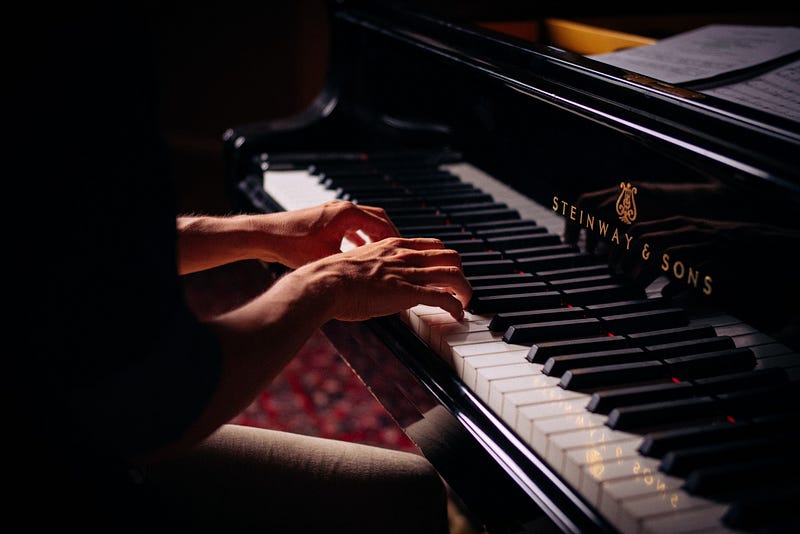
“People err who think my art comes easily to me. I assure you, dear friend, nobody has devoted so much time and thought to compositions as I. There is not a famous master whose music I have not industriously studied through many times.”― Wolfgang Amadeus Mozart
I stare down at the black and white keys of my childhood piano. Like reconnecting with a long-forgotten friend, it is at once familiar and distant.
I dedicated my childhood to this muse. We were once so close. Demanding and unrelenting, I’d sacrificed my trivialities of youth in worship of her.
While other kids watched cartoons, I practiced my scales and arpeggios. While they frolicked on playgrounds, I was at piano lessons. While they let their childhood imaginations run wild, I poured my heart and soul into the works of Chopin, Mozart, and Beethoven — attempting to understand their lifetimes of wisdom through my handful of years.
Black and white. A stark contrast with its bold simplicity. A dual-toned goddess draped in ivory. It sits patiently, holding within its 88 keys the silent power of its mysterious potential.
The concept is simple — you hit a key and it plays a sound. Surely anyone can do this.
You hit more keys with more fingers and the piano plays more sounds. When there are enough sounds and sufficient clever manipulation of time, melodies and harmonies begin to form.
Motifs emerge — some dancing, some lulling— and variations in tone are crafted. Nothing is ever played exactly the same twice. The music takes on a life of its own. The dots and lines that call the 5-lined staff home rearrange themselves magically into a narrative that captivates my soul.
I feel what the music wants me to feel. I become nothing more than a medium for it. I see the direction the music wants to go and I’m powerless to stop it.
It paints a vibrant, brilliant picture of a thousand colors in my mind’s eye, from the deepest of dark blues in Beethoven’s sorrow to the happiest of yellows in Haydn’s classics.
“There’s nothing remarkable about it. All one has to do is hit the right keys at the right time and the instrument plays itself.” — J. S. Bach
The piano that I once knew as intimately as my own soul betrays me.
Or rather, I betrayed it — abandoned it and left it behind to silently collect dust. How dare I let this beautiful instrument fall into the background like an inanimate piece of furniture?
Under my traitorous gaze, the black and white of the keys run together. Seemingly identical and impossible to distinguish from one another, it scares me. I’ve fallen so far from grace.
I rest my hands lightly above the keys. They settle into the opening of Chopin’s Nocturne in E Flat Major — a piece that is slower, hopeful, and close to my heart. It’s my apology for being away for so long.
My fingers are stiff and awkward. Typing on a keyboard is no substitute for the rigors of a piano. A mistimed entrance here, a disastrous run there. Wrong notes scattered throughout like a bull in a china shop.
Once so capable, fluid, and free, I am now clumsy and foolish. Washed up and a mere fragment of my previous self, I do not deserve the awards and trophies I once held so confidently.
My accolades — proudly displayed by my mother — look down and mock me with silent disdain.
“To play a wrong note is insignificant; to play without passion is inexcusable.”― Ludwig van Beethoven
I don’t enjoy feeling like a failure. My fingers may not be what they once were but decades of living, breathing, and identifying as a pianist do not fade so easily.
I bid myself to have patience. To take things back down to their fundamentals. Right hand, then left hand, then put them back together. It is better to practice slowly and correctly, than to blunder through like a trainwreck.
I remind myself that practice makes perfect. Inwardly, I sigh; I hate this saying.
“I tell my piano the things I used to tell you.” — Frederic Chopin
Through all these years, my sheet music still holds my secrets. The markings from my piano teacher bring back memories. Her scribbled numbers where I struggled with the rhythm; her red circles highlighting my wrong notes.
There’s a kettle drawn into the corner of my Rachmaninoff’s Prelude in C Sharp Minor. It’s a reminder for me to start tranquilly, like the calm surface of the water; then to build gradually to a rolling boil before erupting ferociously and triumphantly into the four staves required to accommodate the full fury of notes.
A sketch of a broom is nestled into the middle of my Chopin’s Grande Valse Brillante Op.18 (Waltz in E Flat Major). I’m to evoke a crazy aunt wielding a broom — she’s trying to chase down mice at the beginning but as the craziness unwinds, she indiscriminately whacks anything and anyone who crosses her path.
I don’t know how my piano teacher came up with these ideas, but they’re brilliant. It’s not easy breathing life and vigor back into classical music — especially nowadays in the eyes of a child.
And it wasn’t just narratives she painted. I need only hear the word “mazurka” and I’m whisked back in time to my piano teacher’s living room. She’s holding my hand and guiding me through the footwork of a mazurka. I can hear her telling me:
“It’s a DANCE! Feel it! One, two, three. One, two, three. Now you try!”
It’s been more than a decade since I trained under her tutelage but I remember these moments like it was only yesterday.
Painstakingly, the music comes back to me. Like a stubborn lover who’s been spurned, I must be cajoling and patient, insistent and persistent.
My fingers find the notes again and it feels like a homecoming. My fingers on the keys, the keys moving the hammers, the hammers striking the strings. Like peering into the belly of a beast, a grand piano has nothing to hide.
Gradually, I move past the mechanics. The notes become fluid again and, light as Tchaikovsky’s sugar plum fairy, I take flight and dance.
On the wings of polonaises and minuets, I make my way through space and time. I dip a courtesy to Bachs’ strict contrapuntion and slide down Clementi’s light-hearted sonatas. I indulge in the free spirit of Chopin’s impromptus and wade through moonlit nocturnes.
This is my place; this is where I belong; this is my Liebestraum.
“Mournful and yet grand is the destiny of the artist.”― Franz Liszt