

Therapy: The Flawed Industry People Are Obsessed With
It’s a cornerstone for self-care but not many people address how flawed it actually is.
If I didn’t study to be an accountant, I would’ve been a psychologist. The idea of sitting down with people, talking through their various personal issues and helping people cope with complex emotions and just being human feels good.
However, I’m content with where I am in my life right now. I feel like the work that I’m doing is meaningful and helpful even though I’ve got a bachelor’s degree in accounting and not a doctorate in psychology.
Part of the reason for that happiness is the fact science is not my strong suit. I know I didn’t care so much about the psychological terms and cared more about helping the people.
The other part is that I recognized to the extent that therapy has become twisted and not what it once was.
On the surface, it seems fine. When we think of therapy and therapists, we see an industry and professionals helping people work through depression, anxiety, bad personality traits or habits and even racism. Whenever someone exhibits bad behaviour or is otherwise troubled by something, our knee-jerk reaction is to think or recommend to people to seek counselling.
It’s become so prominent that people who refuse to seek therapy are labelled as red flags and should be avoided. All the while, we need to be fluent in “therapy speak” to show off that we’re engaging with the therapy world.
But over the years as therapy has expanded and our minds have changed to embrace mental health among other things. The problem is the more we bring this out of the therapy room and into the world, the more we see the strain it takes on the therapy industry.
I still remember a John Oliver piece on treating addictions on his show Last Week Tonight. One portion showed an ex-addict complaining to a camera crew that equine therapy doesn’t work for him. He hates horses. And yet he was getting “treated” at one of the top-rated addiction clinics in the country. A clinic whose owner doesn’t even keep track of his patients and charges thousands of dollars for his treatment program.
The guy complaining about the horses died because the therapy was ineffective, and he relapsed after he was sent back home.
In the mental health world, we see more companies popping up with apps for mental health. Many of which are using AI and bots to address the shortage of human therapists in the industry. And there are some massive problems with this.
And with therapy speak becoming so mainstream we have reality TV shows, podcasts and even card games where people can be their own psychoanalysts.
It feels like overnight, people are now in the position where they can be their own psychiatrists to their friends and family. This is despite the fact becoming a therapist requires extensive studying that no mere podcast or reality TV show can provide.
But what’s worse is that what we actually think of therapy is twisted. The reality is, many who have tried it can tell you it sucks.
Why Does It Suck?
To begin, a Lancet study and the American Psychiatric Association (APA) have said that 50 to 75 percent of patients who took therapy say there was some benefit. However, at least 5 percent said the treatment made things worse. This number increases if the person is in a marginalized group.
The remaining amount — 50 to 25 percent — from therapy reports show that people gained no benefit whatsoever.
In the case of many, potential clients book an appointment with a therapist, show up, feel alienated immediately, and never return. Others convince themselves to work past that and keep going, even when it becomes clearer after each session that nothing is working.
You would think the mental health care system or someone would step in to address bad therapy or to change the system, but they’re not. That should be obvious based on the corporate bodies that have made AI mental health counsellors apps to deal with the surge of people dealing with mental health problems.
And that direction does make sense since APA and other organizations are currently looking at the number of therapists available over the quality. This is why corporations like BetterHelp and Talkspace emerged as app giants. Even though what they’re doing is nice, the quality therein has little to be desired.
Why therapy sucks so much right now is that everyone is going around in circles over this issue.
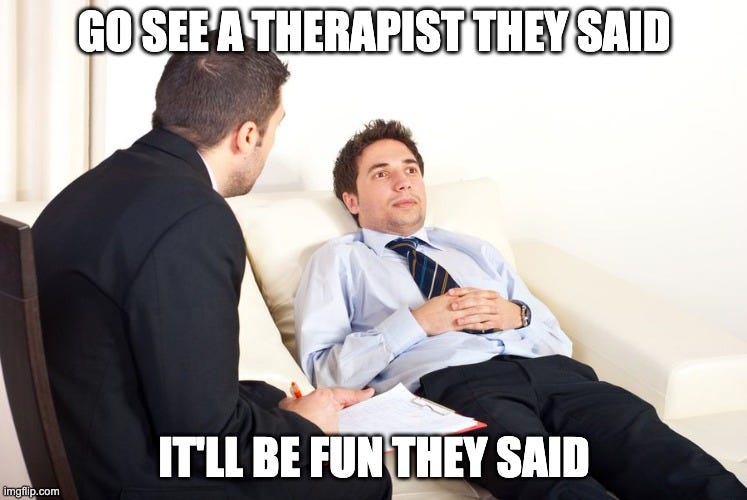
They’re saying to go see a therapist whenever you experience anything bad.
However, the therapy landscape is riddled with bad therapists and now corporations who don’t fully care about putting together proper care and treatment for the legions of people coming to them.
It’s resulted in something that can be best described as this meme below.
What Clients and Therapists Face To Improve
The fundamental problem about delegating therapy to an AI or just being a good therapist boils down to the patients that are coming in. To start, each person has their own “secret agendas” as Jeffy Kottler Ph.D. has said in the past.
On top of many of us thinking therapy land is a place where everyone can get fixed and be these amazing people after a few months, customers can come in thinking a few sessions will be revolutionary for them.
Those secret agendas can also shift expectations. Sometimes people are blackmailed into going or they’re looking for leverage, or they want reassurance on several things.
Beyond that, therapists should know from the start that changing a person is very difficult. Even in a setting where the client is committed to changing, the transformation can often be murky. This is on top of what makes a good therapist is someone that can explain what is to come.
Problem is, many therapists don’t and AI is not advanced enough to be able to adequately do that either.
Another way to look at modern-day therapists is that many are psychic healers. And as soon as you start introducing mysticism into these industries, you can see some really big problems happening. First and foremost you have a therapist who thinks they can predict your future and how to best address problems moving forward before they even happen.
Beyond that, clients also imagine that therapy is so good that they only need six sessions whereas studies show improvement in 15 to 20 sessions for most people.
And all of this is before we get into the hundreds of theoretical models that are being used right now. And each model has its own version of the brain or mind, the nature of distress, and what’s offered as treatment. This is on top of the fact these models are mixed and matched, giving a mixed bag of results despite these models being tested.
In the end, to deal with the onslaught of people looking for treatment, therapists have opted for the “common factors” which suggest that good therapy can be boiled down to a handful of items:
- You need to have empathy
- You need to share a clear goal
- Offer positive regard
- And affirm your client
It’s called “therapeutic alliance” and while relational art is a part of the success or failure of therapy, this insight hasn’t really made these alliances easier to foster. And yet this is a tactic that every therapist seems to be doing today.
The Problem Of Finding A Good Therapist
Even in this overall flawed environment, finding a therapist — let alone any therapist — is incredibly difficult today. Depending on where you live, you might have only one or a few therapists you can turn to. And in some areas, there isn’t even one available.
Beyond that, there also comes the costs. Many therapists rarely accept insurance so you’ll have to pay out of pocket. And if you’re using any app, those subscriptions are coming out of your pocket.
Even when money isn’t an issue, it can be difficult to pick what therapist to go to. If you’re not referred or received a personal recommendation, you will turn to databases. And while that’ll give you plenty of options possibly, they prioritize costs, proximity and availability rather than the quality or even expertise of that therapist.
You won’t even know if the therapist is trustworthy, professional or likable until you book an appointment, pay the cost, and go to their office.
This is on top of building that alliance requires a lot of time and can’t just be done in a single session. It’s like making friends. You’re not immediately best pals until you’ve spent years hanging out with one another and understanding each other.
Beyond that, the big reason people end up quitting sessions stems from a bad therapist as well as the therapist not willing to let clients go. Therapists are allowed to refer to other therapists if they think their clients would benefit from that. But that likelihood has diminished. If you’re low on clients, the last thing you want to do is recommend your precious client to someone else.
What Can Be Done To Make Therapy Better?
The biggest flaw in therapy right now is the “first come, first serve” model that has gripped the industry. It’s gotten so bad that corporations are now able to monetize the industry.
And we’ve seen enough to know that corporate rule isn’t really helping much on some of these broader issues. Case and point, the environment can be added to this list.
Seeing an improvement would be pushing corporations out and freeing genuine therapists and clients. One step towards that is having mental health be covered by the government.
We’ve already pushed movements to bring mental health awareness into conversations. We understand now that people suffering from mental health issues or addictions are not sub-human beasts that need to be locked in prison. The problem now is we’ve become obsessed with therapy and therapists and we’ve got a system that doesn’t help us out at any stage if we need serious help.
Ensuring the costs are covered so patients can go to multiple therapists without any problem to see which one fits them well will make a big difference. Beyond that, therapists getting government funding will ensure more reliable funds for their business and won’t feel pressured to keep every client in order to keep the lights on. This is on top of getting more therapists from other backgrounds since the therapy industry is predominately white and wealthy men.
Another improvement is vetting specific treatments as this can reduce the amount of bad therapy and advice that’s thrown around. Putting evidence-based regulations in place can lead to tempering our expectations of therapy as this “panacea” whenever you’re feeling down.
All in all, the therapy industry as the ultimate form of self-care is deeply flawed. And the problems that the industry is facing isn’t so much that we’re dealing with incompetent therapists. But rather, the therapists we do have are not adequately prepared to deal with the mental problems and addictions we face.
Therapy right now is like playing darts for the first time, you’re going to be making a lot of misses. But unlike darts, the costs of missing are significantly larger.
Until some big changes are made to the industry that tilt it towards much better care, it might be best to temper expectations. And if you are seeing a therapist, really make some assessments about the quality of treatment you’re getting and how many sessions you’ve gone through.
Enjoyed the article? Please consider offering your support!
👉 Subscribe to my email list here and receive emails whenever I publish on Medium!
Or you can leave a tip on my Patreon page. Just press the button below! 👇


