
Theory of Constraints 106: The Five Focusing Steps
A series of 5-minute posts on applying principles of flow to knowledge work
In the previous post, I told the story of a software engineering team at Microsoft who used the Theory of Constraints to produce dramatic improvements in productivity.
But I hope something bothered you: how exactly did they know which changes to make? What process did they use to develop that particular solution? Unless we know this, the best we can do is follow rigid prescriptions that are unlikely to work in different contexts.
Now we are finally reaching the very heart of TOC, the continuous improvement method to increase throughput in any system of value creation, known as the Five Focusing Steps:
Step 1: Identify the constraint
This tells us where to focus our improvement efforts, since we know that only an improvement at the constraint makes a difference.
Step 2: Optimize the constraint
Before adding capacity, we need to use the capacity we already have. “Optimize” in this sense means “doing everything possible to use the constraint to its fullest capacity.”
Step 3: Subordinate the non-constraints
The job of all non-constraints is to subordinate their decisions to the constraint’s needs. They should optimize for constraint (and thus system) performance, not their own individual performance, the results of which we witnessed in post #102.
Step 4: Elevate the constraint
Only once we’ve completed the previous steps does it make sense to add more constraint capacity, and thereby increase system performance. Because adding capacity is tremendously expensive in terms of time and money, we do it as a last resort, not a first resort.
Step 5: Return to step 1
The inevitable result of the first four steps, and the reason this is a “continuous” improvement method, is that the constraint moves somewhere else. This step insists that you start back at the beginning, and don’t let inertia become the constraint.
Let’s take a closer look at Step #1, and why it represents a significant shift in how we conduct improvement within organizations.
Identifying the constraint
Because only improvements at the constraint make a difference to the company as a whole, identifying that constraint is the obvious first step.
The reassuring truth is that you don’t have to identify it perfectly from the very beginning. This is a self-correcting process, not a waterfall where small errors in the beginning become huge mistakes by the end. The advantage of working with a dynamic, interconnected system is that it responds very quickly to changes. The behavior of the system tells you whether you chose correctly.
Let’s say you mis-identify the constraint, and add capacity there, but the real constraint is actually downstream:
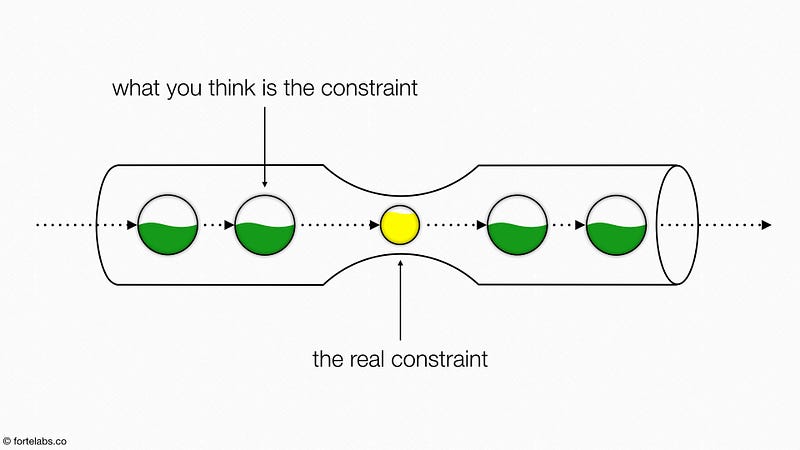
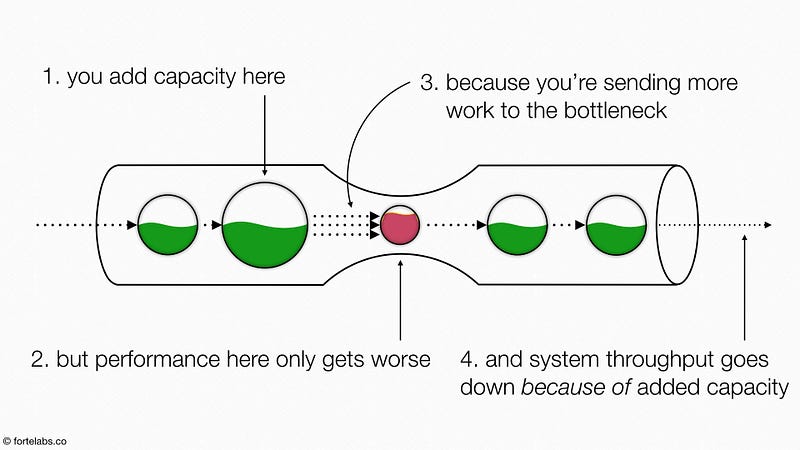
Adding upstream capacity will only send more work to the real bottleneck, reducing its throughput and thus the system’s throughput. The irony of the situation is that system performance is deteriorating not despite your efforts to add capacity, but directly because of them:
A similar thing happens when you mis-identify the constraint as being downstream of the true constraint:
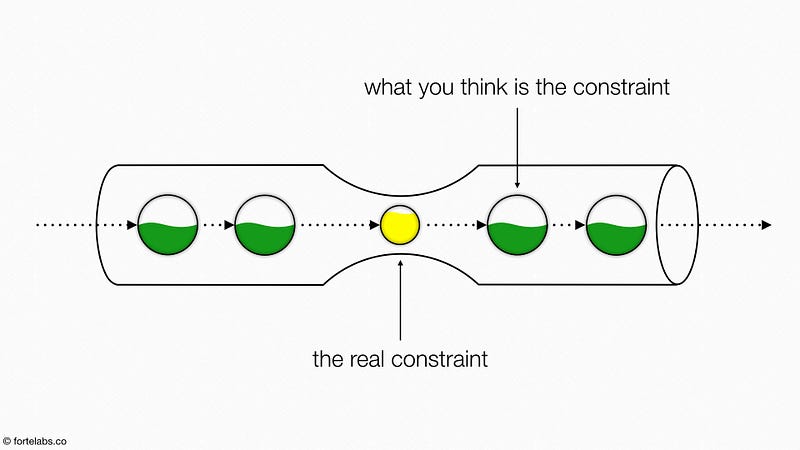
Adding more downstream capacity pulls completed work away from the constraint more quickly than it can process new work. Which means this newly expanded resource will soon be starved for anything to do, increasing costs while not contributing anything to throughput:
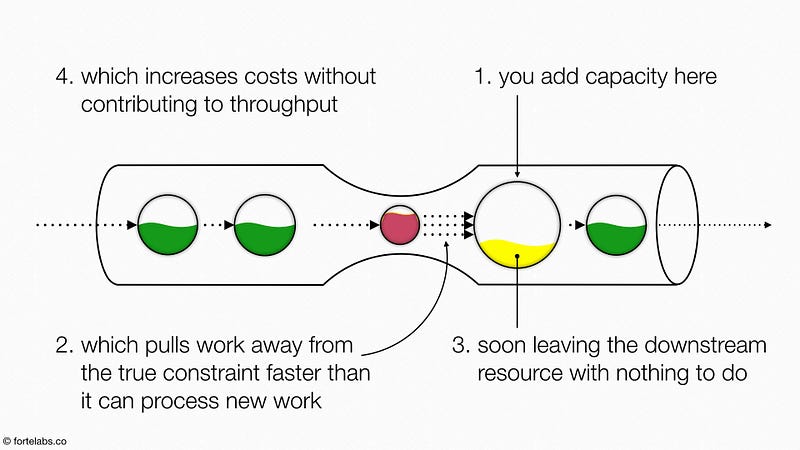
The behavior of the system in this way tells you whether you’re improving the right thing. And it does it very quickly, in the form of changes to throughput that show up within days or weeks, instead of months or years.
What we’re talking about here is actually a fundamental change to how we go about improving any kind of complex system, such as a company.
Instead of collecting vast amounts of data on every aspect of the business, we make our best guess as to where the constraint lies, and let reality be our guide. Instead of spending vast amounts of time making a detailed plan covering every contingency, we acknowledge that we don’t have answers, only hypotheses.
Instead of forcing all-encompassing rollouts changing every part of the system at once, we focus our attention intensely on one spot, even if we’re not sure it’s the right one. Instead of treating the constantly changing dynamics of the business as an enemy to contain, basing our decisions on point-in-time snapshots, we encourage the system to cycle even faster, so that our feedback loops will be tightened and accelerated.
The Germans call this Fingerspitzengefühl, or “finger tips feeling,” an intuitive sense of the unfolding dynamics of a situation. As in sports or combat, you develop this instinct through high-frequency participation at the very center of action, not back in the office making plans.
To extend the metaphor, look at a map of the value stream of your organization. If you cannot put your finger on one spot that you believe might be the constraint, or aren’t willing to risk having this hypothesis proven wrong, you will never be able to focus your efforts. Without focus, you’ll be left starting dozens of random projects in random directions, hoping to hit on something through luck or by following prescriptions. Even if you do have a success, you won’t understand why.
This is why Goldratt said, if he had to summarize all of the Theory of Constraints in a single word, it would be focus.
Next post: #107 Identifying the Constraint >>>
<<< Previous post: #105 Drum-Buffer-Rope at Microsoft
Sign up here for a free 30-day trial of the new Praxis blog, or subscribe to the newsletter to receive notifications of free articles. You can also follow us on Twitter, Facebook, LinkedIn, or YouTube.


