
The Übermensch: Man, Beast, Superman
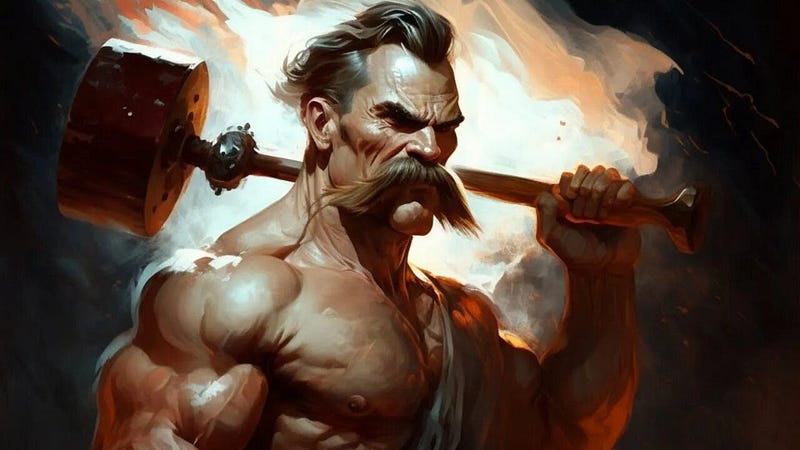
To “behave like an animal” is to act according to one’s base instincts. Man is, obviously, an animal, but what it means to be human is diametrically opposed to animality. Control over our instincts is our mark of distinction. We consider ourselves “more evolved” the more we are able to act unlike animals. However, according to Nietzsche, this is mistaken. For Nietzsche, when man behaves in this way, when he denies his instincts, he regresses to a state worse than beasts.
Man, he says, is something that must be overcome. His term for what this would be is the übermensch (which is often erroneously translated as ‘overman’ to avoid the trivialised translation: ‘superman’). In the prologue to Thus Spoke Zarathustra, Nietzsche has his prophet say:
Man is a rope, tied between beast and overman — a rope over an abyss. A dangerous across, a dangerous on-the-way, a dangerous looking back, a dangerous shuddering and stopping. What is great in man is that he is a bridge and not an end.
He doesn’t say much about the übermensch specifically, except that he would consider man a ‘laughing stock and painful embarrassment’, in the same way man considers an ape a ‘laughing stock and painful embarrassment’. He says that, ‘you have made your way from worm to man, and much in you is still worm. Once you were apes, and even now, too, man is more ape than any ape’.
Here, he is referring to the true opposite of the overman — which is not beast (as his bridge analogy suggests), but the so-called ‘last man’. This is the ‘life-denying’ nihilist who is unable to overcome man because he has lost his connection with the earth; i.e. his life-affirming instincts. This is what Nietzsche means when he says that the übermensch is the ‘meaning of the earth’:
I beseech you, my brothers, remain faithful to the earth, and do not believe those who speak to you of otherwordly hopes! Poison-mixers are they, whether they know it or not. Despisers of life are they, decaying and poisoned themselves, of whom the earth is weary: so let them go.
Here, he is referring to those who forego this world in favour of the after-life. Later on, in what has become a prescient remark (in the age of demographic decline), he describes a society of ‘last men’ not even having the will to reproduce:
“Lust is sin,” says one group that preaches death; “let us step aside and beget no children.”
“Giving birth is troublesome,” says another group; “why go on giving birth? One bears only unfortunates!”
This is an example of our control over instincts thwarting not only ability to transcend ourselves, but our very existence. This is why Nietzsche suggests that we return to the earth and learn from the creatures that we believe we are better than. After a disappointing encounter with a group of humans, Zarathustra returns to the mountains and to his two companions, the eagle and the serpent:
“These are my animals,” said Zarathustra and was happy in his heart. “The proudest animal under the sun and the wisest animal under the sun — they have gone out on a search. They want to determine whether Zarathustra is still alive. Verily, do I still live? I found life more dangerous among men than among animals; on dangerous paths walks Zarathustra. May my animals lead me!”
When Zarathustra had said this he recalled the words of the saint in the forest, sighed, and spoke thus to his heart: “That I might be wiser! That I might be wise through and through like my serpent! But there I ask the impossible: so I ask my pride that it always go along with my wisdom. And when my wisdom leaves me one day — alas, it loves to fly away — let my pride then fly with my folly.”
Thus Zarathustra began to go under.