
‘The Zone of Interest’ is Gaza propaganda
How dare you ask me to feel something.
Let’s talk about subjectivity. All human perspective is subjective. That should be news to no one.
This includes the extent to which we feel emotions and empathy.
Some people don’t experience emotions or empathy. Assuming they’re not lobotomised, we usually describe those people as sociopaths.
From an evolutionary standpoint, this is just the universe “trying things out”: what if we make this human cry about everything? what if we make this human more sensitive to pain? what if we make this one feel nothing at all?
The universe is one big system of trial and error to see what works.
Now, say we take the sociopath’s subjective perspective that emotions are just weaknesses to be exploited. This is not uncommon. We see it in our day-to-day lives, to a lesser extent, in the way men feel they have to hide emotions to be tough, or in the WASP ideal of the stiff upper lip.
From a social justice and contemporary moralistic standpoint, you’d likely (I would, anyway) argue these unfeeling tendencies are “wrong”. This is, of course, my subjective opinion.
The point I’m trying to set up here is that we have an idea of what a healthy emotional human is, but in life, in the universe, there’s no such thing as normal, no such thing as a “healthy emotional human”. History, as we know, is written by the winners.
If those winners end up being sociopaths, then the losers are the ones that feel empathy.
Why am I talking about this?
I huddled in discomfort trying not to cry. I did cry.
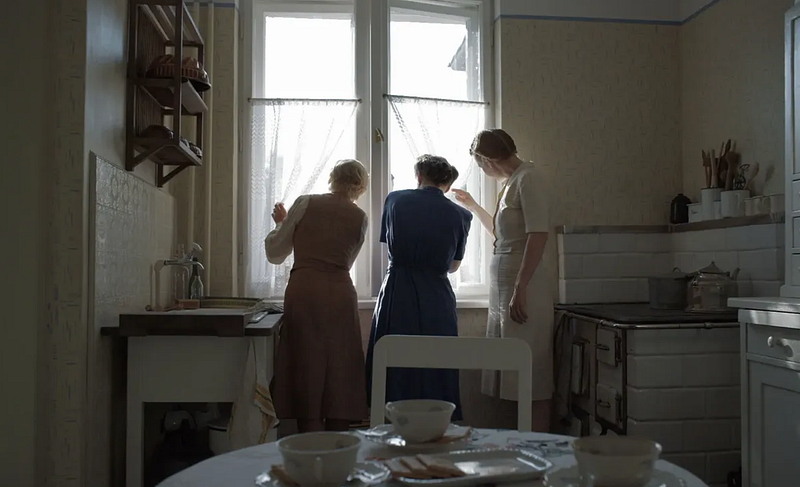
Well, if you’ve seen The Zone of Interest, you’ll know that the film, set during WWII, follows a family living their pleasant, happy, affluent life, swimming in the garden pool, fishing, riding horses, being catered to by a pocketful of servants. The twist? Only one large wall divides them from the sufferings of the Auschwitz concentration camp.

You never see the suffering, but you hear it.
If you’re an empathetic person like myself, the movie, slow-paced, quiet, is screaming just below the surface. The throat-tearing shrieks ebb at the edge of each frame, begging the characters, begging the audience, begging you to feel something.
That, of course, is the point of the movie. How can a family live their lives so happily, somehow ignoring the worst of all human horrors happening on their literal doorstep?
Feel something. Do something.
I watched The Zone of Interest in a cinema, and for almost two hours, I huddled in discomfort trying not to cry. I did cry. I knew enough WWII history to know no help was coming, no relief. Of the victims, we see little more than a jawbone fished from a river and some gold teeth. The mastery of this film is that it doesn’t even need to give us a human victim to latch onto. The despair in our guts is enough. The museum filled with piles of shoes, if anything, detracts.
I don’t think the horror of Auschwitz can be defined. Not in words, not in pictures. It’s often said that the scariest thing in the world is the unknown. The Zone of Interest translates that perfectly, never showing you the cruelty — as if it could ever be truly captured.
Instead, it bludgeons you with silence, with helplessness. I was totally defeated well before the movie ended. The rest of the audience sat in a macabre silence as the credits rolled.
And then it happened.
One lady at the back of the audience started yelling.
“Is this propaganda!?” she screamed, “Is this about Gaza!?”
None of the distraught, sullen audience responded. A few of us turned our heads to look at her.
Silence.
“Is this propaganda!?” she demanded again, outraged by what she had just seen.
Myself and some of the crowd drifted out, ignoring her as she carried on yelling. I was bewildered, trying to make sense of her response.
Here is a film that displays in horrific detail how wilful ignorance triumphs. This lady connected the emotional dots, thought of the people crying out to be heard in Gaza, the people being systematically murdered, a genocide taking place, and on an intuitive level, she understood that history was, in one form or another, repeating itself, right now, in front of her.
Maybe not on her literal doorstep, but in the digital age, nowhere is very far away.
And her response?
Propaganda.
How dare you ask me to feel something.
That a human being alive today can watch a film like The Zone of Interest, understand its exact relevance, and still choose wilful ignorance. Her outburst mirrored that of the wife, Hedwig, within the film, terrified her paradise would be snatched away, screaming at the maids to mop up a puddle. Monsters are alive and they are among us, from Gaza to the back row of cinemas in Newtown, Sydney.
The thing is, human perspective is subjective. There is no right or wrong when it comes to empathy.
Depending on who wins, she might be right.
For sociopaths, empathy is propaganda.
So, my god, for the sake of humanity, feel something.