
The Zhuangzi Key To Understanding The Chinese Mind
“The Mind is A Mirror of Reality”

Zhuangzi (庄子), or Chuang Tzu, was born during the Warring States period of China (403–221 BC), more than a century after the death of Confucius. He was an influential Chinese philosopher, and is one of the key figures in a philosophical and religious tradition that emphasizes living in harmony with the Dao (Tao), which can be understood as the natural path or way of the universe.
Zhuangzi writings explored the nature of reality, the relativity of things, and the concept of Dao.
For Zhuangzi, words are like vessels for values and conventional distinctions that we inherit from the past. Language, however, encapsulates social ideals and expectations to become instead the source of conflicts, anguish, trouble and their resolution. It is the meanings of words in language that are key obstacles to our contentment, happiness, and tranquility. The imperative is to create new words with conducive meanings to promote continuous harmony in ever-changing fresh contexts.
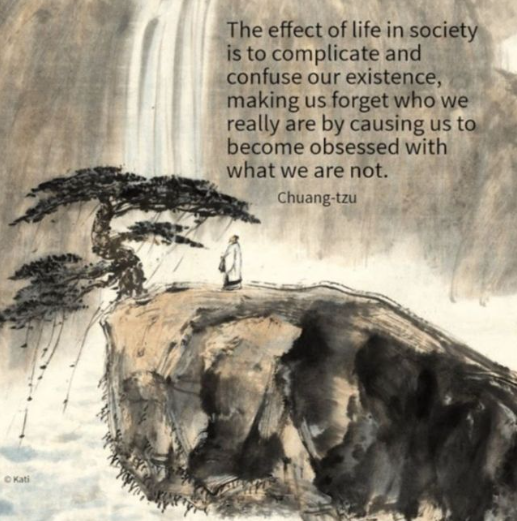
We must therefore treat words as extraneous, and to be deliberately disorientated by language in order to discover that higher knowledge is beyond words. Language is only a repository for meanings, not meanings themselves.
Our ability to transcend conventional perspectives makes us human as we can only discover our essential selves by opening our vast capacity for imagination and creativity. Through this, we shall become free of the ideas, distinctions, and traditions that have become imprisoned in the words we use.
Zhuangzi used the analogy of a butterfly to illustrate how one can transcend our imprisoned reality like in a dream.
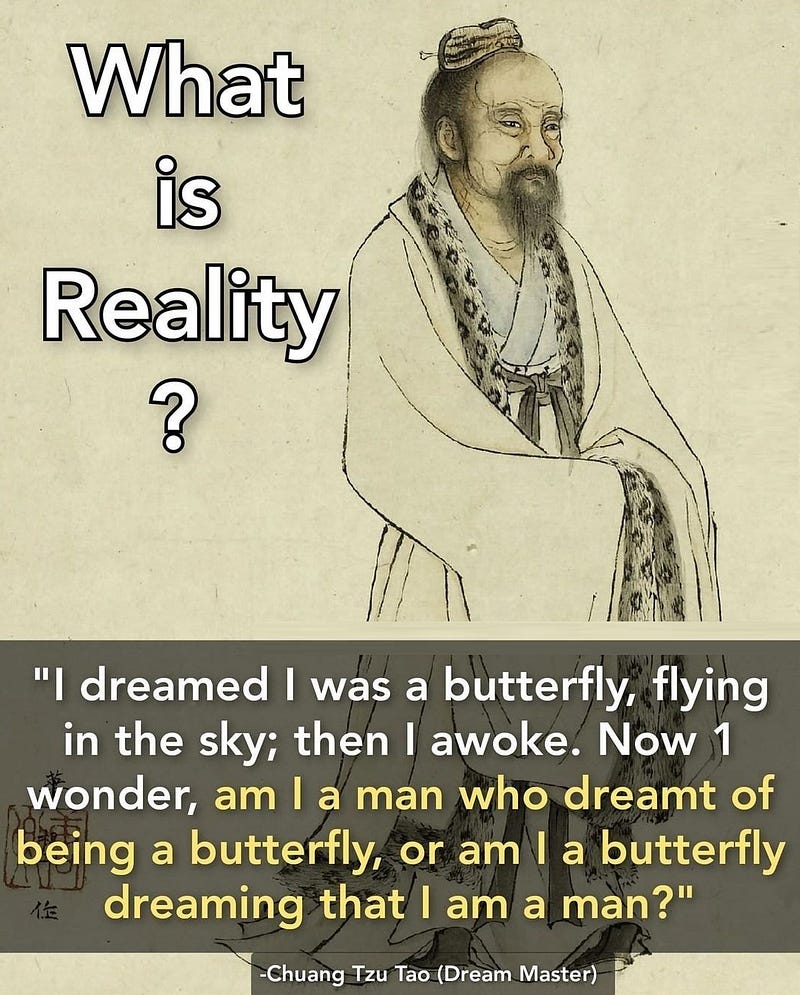
He illustrated his dream parable like this:
“Once upon a time, I, Zhuangzi, dreamt I was a butterfly, fluttering hither and thither, to all intents and purposes a butterfly. I was conscious only of my happiness as a butterfly, unaware that I was Zhuangzi. Soon I awakened, and there I was, veritably myself again. Now I do not know whether I was then a man dreaming I was a butterfly, or whether I am now a butterfly, dreaming I am a man.”
In entertaining for a moment the idea that we might be dreaming we are a butterfly that is dreaming it is human, we can engage in the very activity which allows us to break free of the normal, conventional, and human way of understanding the world. Essentially, a butterfly, according to Zhuangzi, sees the world as it truly is — a permanently changing reality.
A healthy skepticism is needed towards inherited ideas by “emptying the container of the Self”, referring to a kind of disciplined “forgetfulness” of that which is extraneous to the true Self. In so doing, we shall develop the capacity and capability to be “in” but not “of” the world.
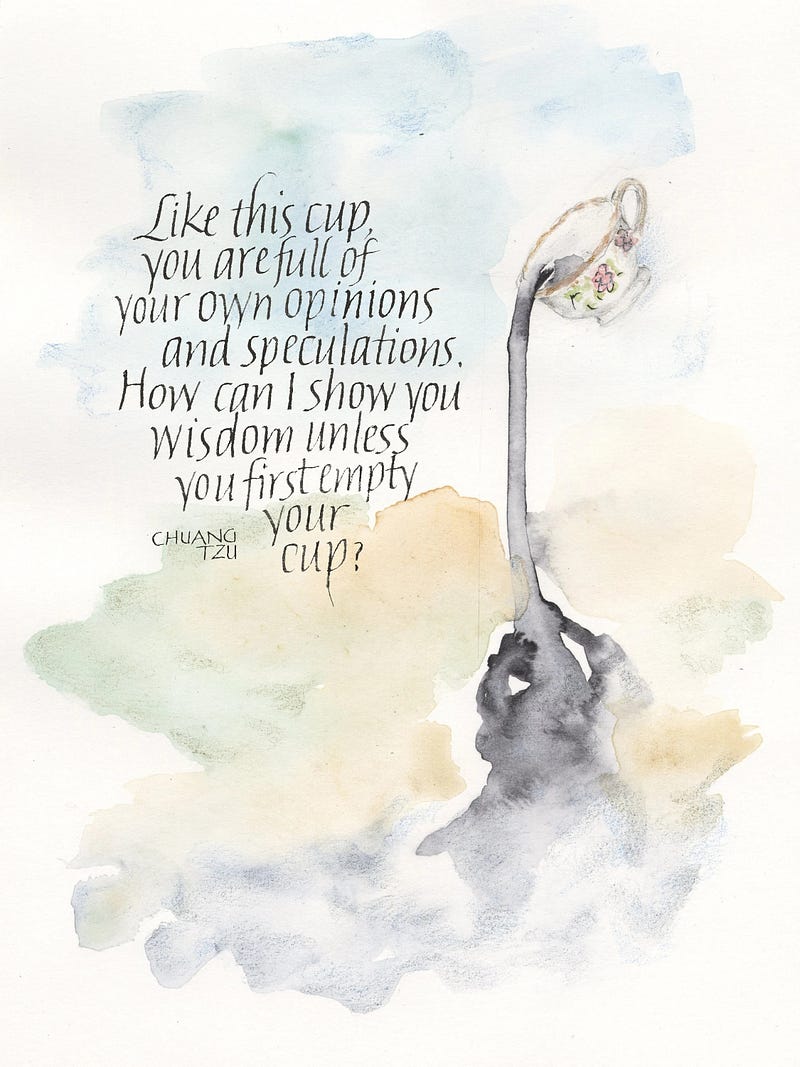
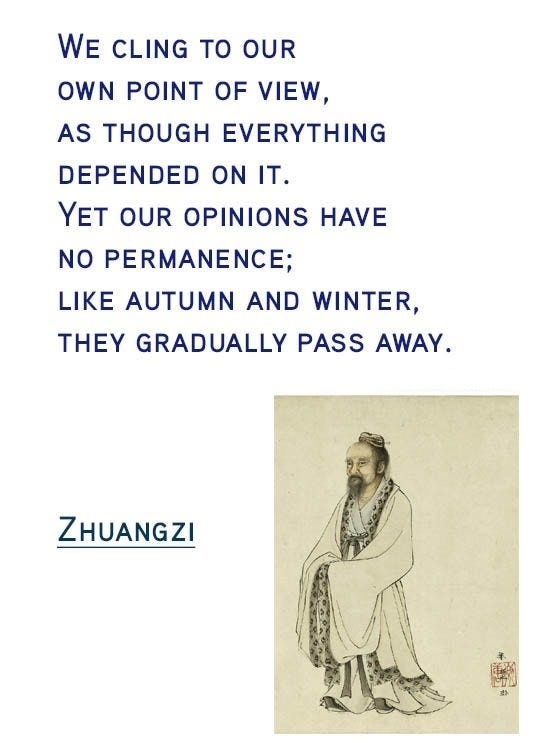
Zhuangzi is not advocating that we deny the social animal in us whose behaviors are influenced and determined to some extent by the socio-cultural eco-system that defined our respective role in accordance with respective power relations. Rather, to be “in” and not “of” the false socially-constructed reality means that we can consciously and intentionally accept, albeit temporarily, what is beyond our control with equanimity.
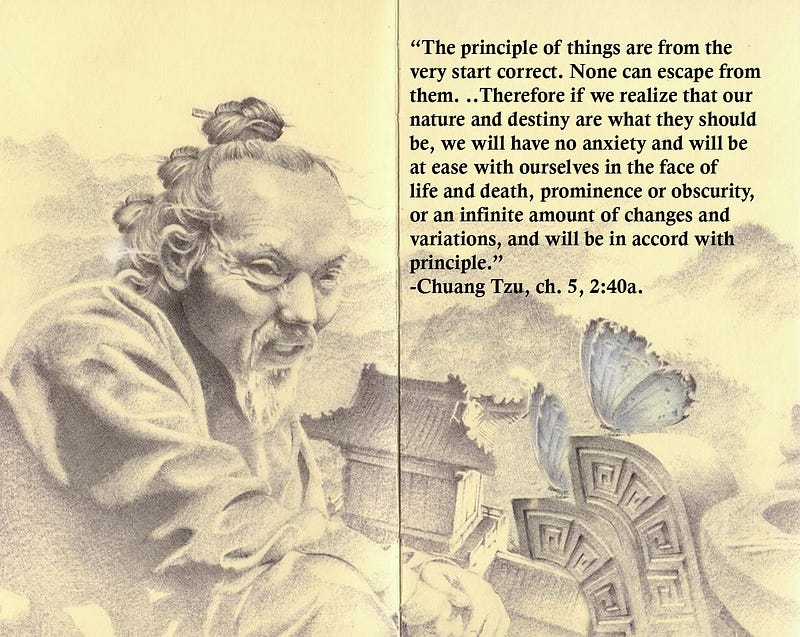
Zhuangzi believes that individuals should act in accordance with the natural flow of events rather than imposing their power and will. He advocates for spontaneity (“ziran”) (自然), and non-action (“wu-wei”) (無為). He aligns with the Yin-Yang (阴阳) idea that harmony with the natural order resulted from the natural balance of Yin and Yang forces.
Chinese Yin-Yang (阴阳) cosmology is rooted in Daoist and Chinese cosmological traditions where the interplay of Yin and Yang represents the dynamic balance and complementary nature of opposites in the universe.
Zhuangzi’s philosophy emphasizes harmony with the Dao, the natural way or path of the universe. He encourages individuals to align themselves with the spontaneity and naturalness of the Dao.
Zhuangzi challenges fixed distinctions and encourages more fluid perspectives. His relativity and skepticism extend to the idea that opposites are interdependent and mutually defining like interdependent opposites that define and complement each other. For Zhuangzi, the balance between these forces is essential for the harmony and functioning of the natural world.
Yin and Yang are not static, as they represent the cyclical and transformative nature of the cosmos. For Zhuangzi, these cyclical changes are also reflected in the natural world as seen in the metamorphosis of the butterfly. And also in the constant transformation and change in social relationships and politico-economic powers, as driven by the dynamic nature of the Dao.
Zhuangxi’s philosophy is broad and encompasses a wide range of themes that focus on topics such as the relativity of knowledge, the limitations of language, and the pursuit of individual freedom. It is an integral part of the rich tapestry of Chinese intellectual and social thought. His philosophy has influenced not only Daoism but also Chinese Buddhism as well as other Chinese and Western schools of thought. Zhuangzi is often quoted by ancient imperial kings and emperors, and modern China political leaders like Mao Tse Tung, Deng Xiaoping, and Xi Jinping.
For more details on Zhuangzi, a good Reference is:
Please enjoy my recent Articles.

You can also subscribe to my stories and social media posts via your email. Enjoy more interesting Articles by signing up to Medium here:


