
The Zen Beggar
A Conversation With A Beggar — Fiction
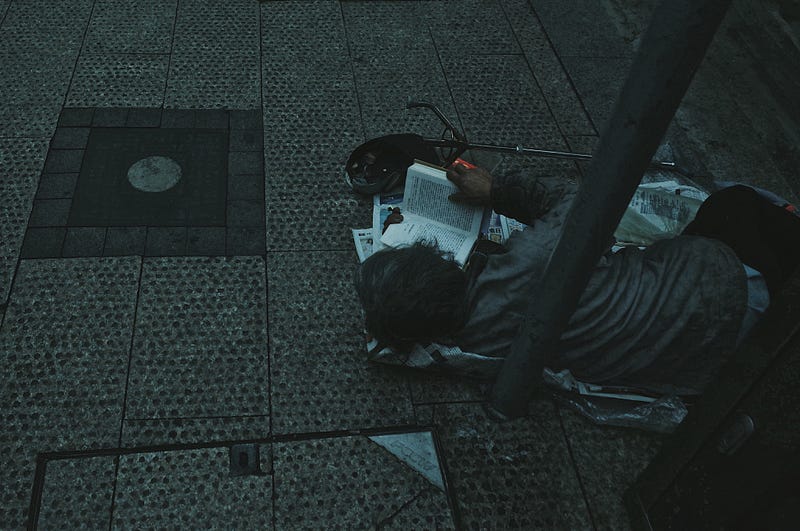
I took a 10 rupee note from my pocket and held it towards the beggar (lying on the ground), for him to take it. He closed the book that he was reading and looked at me for some time. He sat down with his back rested against the pole and said:
I noticed you ignoring me before as you walked past me. Why did you come back now ?— asked the beggar
Shocked to hear such a response and have never expected such an embarrassing moment, I responded: “nothing, just take it.”
He looked at me with a smile but did not take the note.
I was still awkwardly holding the note towards him, but he refused to take it, and instead began to question me.
I will accept the money, but would you be interested in buying me a cup of tea and to have a light conversation at this cafe? — he said, pointing to the nearby cafe.
I was confused about whether to stay or leave, whether to put the note down and escape for breathing space, or am I supposed to get angry? After all, he is only a beggar, should I put up with him, would that mean I am a total shit of a person.
Questions kept flying over my head as I managed to stop and responded:
Okay alright. We can have tea.
Shit, what are you doing? Had you gone mad? —said my voice in the head.
We got into the cafe.
So tell me. Why did you come back?
Hmm, I felt bad for not helping you.
Seriously? Do not lie.
I mean, there were voices in my head. I believe it was God speaking to me.
What did God say?
He said: I am selfish, greedy, and cruel for ignoring you.
Interesting. What else he said?
He threatened me with possible future sufferings that I will have to endure for not helping you. So I felt bad.
The waiter placed the teacups and a flask of steaming tea and left. The beggar poured the tea on to the cups.
Are you going to play ‘Zen monk’ at my expense?
What do you mean?
Aren’t you going to ask me to empty my cup?
Hahaha…no. Just relax and have your tea. And let us see how events unfold.
Huh?. Okay.
We started sipping the tea.
And so you came back to offer me money because of God?
Yes.
So, I suppose you are using me.
What? I am using you?
Yes exactly. You hope to feel better by offering me some money. You hope to please your God by using me. If that is not selfishness, I do not know what is.
But God wants me to do so.
So now you are handing over the responsibility back to God. Good.
I guess yes, Thy will be done.
hahaha…
Why are you laughing?
No nothing. I liked it. May I ask you a question?
You had always been, so shoot. I can't believe this is real.
What is real?
This. Allowing myself to have a tea-conversation with a beggar.
Strange. Is it not.
Yes. So what is the next question?
Since it is God who asked you to do so…
Wait. He did not ask me to give you money. He just blamed me for not giving you money.
Okay. Is it possible that it is God who suffers and not you?
What? No never. I am the one who suffers. How could God suffer?
But it is he who let you know. It is through God (as you say) you came to know you were sinning by not helping me. Right?
Yes. I guess so.
So maybe it is God who suffered and he expects you to make him feel better. So he tries to threaten you. Just like you tried to use me. That is, God is shamelessly throwing away his responsibility towards you to make him feel good. Right?
Kind of. Sounds true. But why?
Wait. Maybe God is trying to make you feel guilty so that he can use you like a puppet.
Now I understand why you are a beggar.
Hahahah….
Don’t laugh. You want me to end up like you? I am sure if I listen to you, God will punish me. You are an atheist.
Being an atheist is another joke. An atheist wastes all his energy fighting with an idea, whereas a theist is blindly attached to an idea. You can keep being a puppet to the voice in your head or take a step to be free. It is up to you. Anyway, thanks for the tea.
Wait. You are leaving me in confusion. You had added one more subscriber to my list of voices in the head. Previously I just had to listen to God, now I have to bear your voice too. Fuck!.
Why don't you learn to sit and listen to yourself instead of wasting time and energy trying to live in accordance with somebody’s voice? It is never too late to begin.
All of humanity’s problems stem from man’s inability to sit quietly in a room alone,” — Blaise Pascal


